

Don't stand so close to me – understanding consent can help with those tricky social distancing moments
- Written by: Elspeth Tilley, Associate Professor of English (Expressive Arts), Massey University
You’re walking on a public footpath when a jogger overtakes you from behind, well inside the recommended two-metre physical distance. What to do? By the time you’ve reacted it’s too late. Just another random encounter in the strange new world of COVID-19.
New Zealand’s alert level 2 restrictions ask that we “consider others” by keeping two metres from strangers when “out and about”. In reality, we’ve seen a rise in anxiety on public transport and airlines.
With social gatherings up to 100 people allowed from May 29, such anxieties may only increase.
Debate about social distancing often pits “COVID-19 is gone” against “COVID-19 might not be gone, let’s be careful”. It’s an unwinnable argument: because of the virus’s incubation period we still don’t know.
It’s also a red herring, because if we focus only on risk we overlook consent.
Consent is one of the most important ethical doctrines. It means respecting people’s right to free choice within agreed legal parameters and according to their ability to exercise that right.
When it comes to consent, New Zealand gets a “can do better” grade. We’ve even had public education programs about sexual consent, such as the Don’t Guess the Yes campaign from the New Zealand Police.
While this article is not about sexual consent, social distancing requirements offer an opportunity to learn more about consent in general. This might then equip us better to navigate other situations.
Consent 101: an introduction
Living in a cohesive society means we give up some autonomy. We agree to live by the law – or to go into lockdown when asked by our government. We still retain plenty of personal control within that social contract. Ethically, someone can only remove that remaining autonomy with our informed consent.
Consent is usually a process of communication. A capable person is given enough information to voluntarily make a knowledgeable decision about participating in an activity.
Power and vulnerability are complicating factors. The principles of consent aim to protect vulnerable people from being exploited by those with more resources, including more information.
For example, intoxicated people are vulnerable. A drunk person can’t consent to anything, including a breach of their social distance. It’s why bars took longer to reopen than restaurants while safety systems were set up.
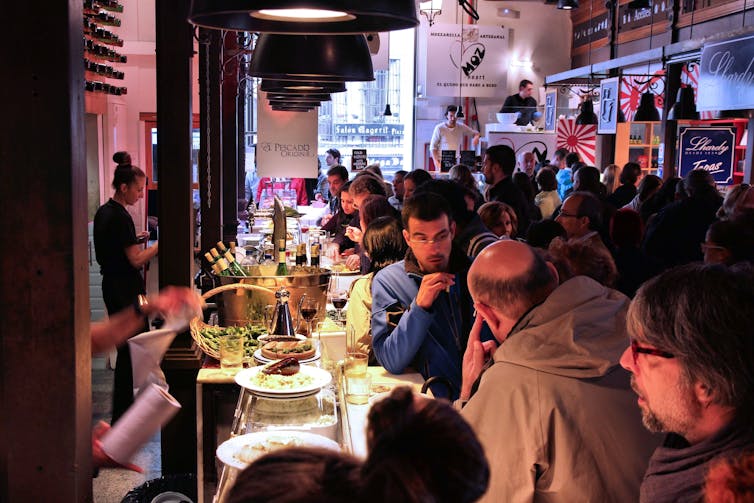 Alcohol and consent don’t mix – that’s why bars selling alcohol but not food took longer to reopen as precautions were put in place.
www.shutterstock.com
Alcohol and consent don’t mix – that’s why bars selling alcohol but not food took longer to reopen as precautions were put in place.
www.shutterstock.com
Back to our hypothetical jogging incident. Was there informed consent? Before COVID-19, choosing to be in a public place implied accepting proximity with others. Currently, though, there is a public health directive to stay apart.
Read more: 7 tips to help kids feeling anxious about going back to school
Assuming the jogger did not have a (socially distanced) friendly chat with the walker to obtain their informed consent to breach their government-recommended minimum distance, can they ethically presume to make that decision on another’s behalf?
First, is there a power difference between the jogger and the walker? Arguably, the person breaking distancing holds more power. Once it’s done, it can’t be undone.
In this instance, the jogger also has more power than the walker because they have more information. They can see ahead, predict a breach is likely to occur, and decide how to react. The walker cannot see behind them.
Was our walker vulnerable? Our jogger does not know. They cannot tell whether the walker is in a vulnerable COVID-19 category, lives with a newborn baby, has cancer or is a carer for someone elderly.
Finally, what does our social contract suggest? In New Zealand everyone has equal rights to use public walkways. As fair-minded people it’s unlikely we’d want vulnerable people’s disadvantage worsened by removing their right to go out for a walk.
Assume other people are vulnerable
On all counts, our jogger can best fulfil their ethical duties by assuming the walker is vulnerable and actively protecting them from potential harm.
Under level 4 restrictions, Prime Minister Jacinda Ardern suggested we act as though we have COVID-19. It’s what is known as a heuristic – a useful mental shortcut to help us make decisions. Perhaps it’s time for a new one.
It may be most helpful now to act as though everyone we encounter in public is vulnerable. It is easier to imagine other people being vulnerable than to trick our brains into thinking we are unwell when we feel fine.
Presuming the vulnerability of others until proven otherwise ticks the consent box: an easy rule of thumb for doing the right thing.
Consent is sometimes described in the literature of ethics as a “social gift”. By upholding consent we give the gift of respect for others’ right to choose when they want to step beyond their own “bubble”.
A sense of doing the right thing is also psychologically rewarding for the giver – it makes us feel positive about ourselves.
Understanding consent means that as we jog (or cycle, or get on a bus or plane) we can leave the job of calculating current COVID-19 risks to the experts. Instead we can focus on something within our immediate control: by the simple social gift of stepping back, waiting or veering around them, we recognise and validate the humanity and personal autonomy of others.
Authors: Elspeth Tilley, Associate Professor of English (Expressive Arts), Massey University


















