

No big packed lectures allowed if we're to safely bring uni students back to campus
- Written by: Geoff Hanmer, Adjunct Professor of Architecture, University of Adelaide
A return to face to face teaching at universities and technical colleges “where possible” is one of the goals of the Morrison government’s three step framework for a COVIDsafe Australia.
A look at the space available for teaching shows some return of students is possible.
But nearly all tiered lecture theatres will not comply with the social distancing rule of staying 1.5m apart, assuming they are seated at capacity. Those lectures will have to remain online or the rules around class sizes will need to change.
Back to the campus
Universities moved teaching operations off campus to cope with the COVID-19 pandemic. Many lectures and tutorials are now done online.
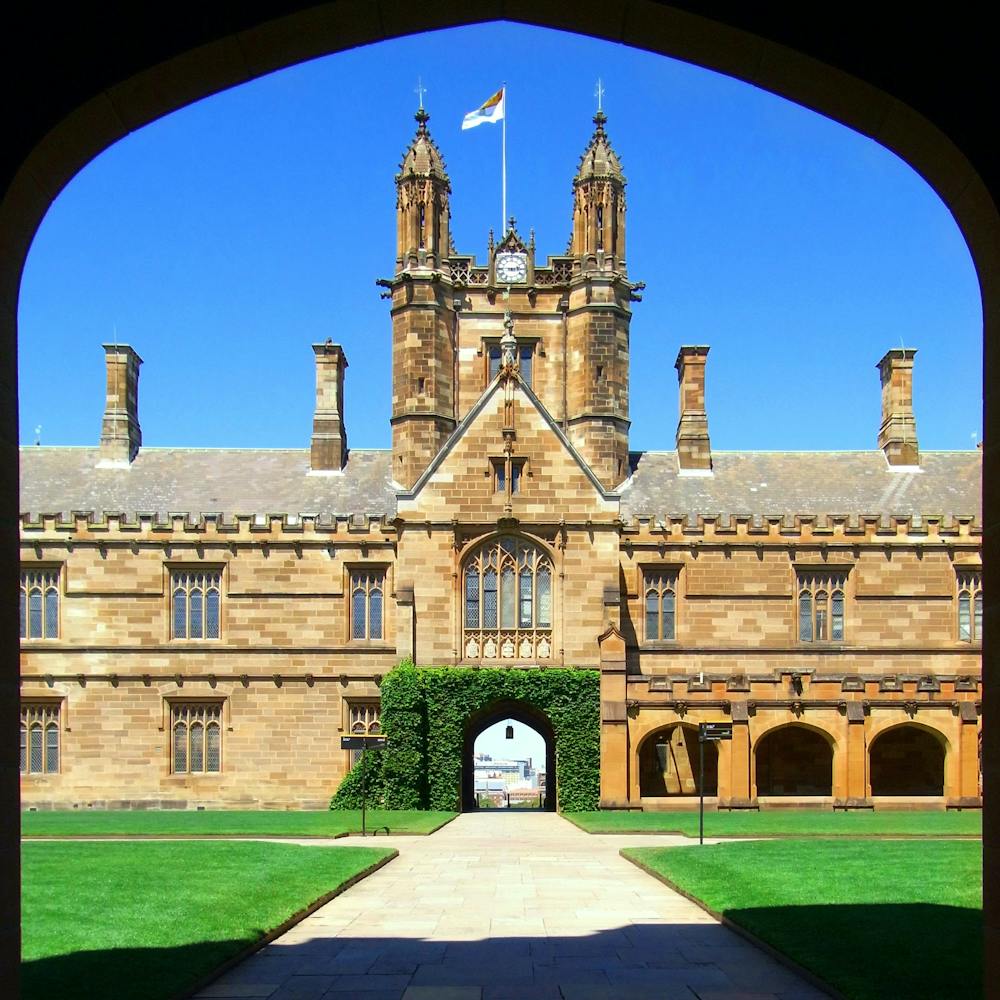 The campuses have been quiet since teaching moved online.
Flickr/Gordon Wrigley, CC BY
The campuses have been quiet since teaching moved online.
Flickr/Gordon Wrigley, CC BY
Universities have the challenge of working out how to safely get staff, students (and researchers) back to campus.
But the teaching space data from eight Australian universities reveals a number of problems in returning to campus while meeting social distancing rules. Some of these can be overcome, but others, including the key goal of increasing face to face teaching, will be much harder.
Until we reach Step 3, when up to 100 people may be permitted to gather in one space, opening up a campus is impractical. Under Steps 1 and 2 only 20 people are allowed in one space.
Come up to the lab
It should be possible to reestablish most laboratory based teaching and research to meet Step 3 guidelines without too many complications. The space data shows most laboratories provide about 4m² per person on average, although space between benches in some older labs may pose issues.
Where open plan offices are being used, they will have to meet social distancing rules.
Most university open plan offices have a density that is significantly lower than the 4m² average set by the guidelines, although achieving the 1.5m distancing rule may require some adaptations, such as additional screens.
Staff will be needed on campus as students return, but simple provisions similar to that used in retail shops, including floor signs and barriers, will be adequate to achieve the distancing guidelines. The continuing trend to move student services online will also help.
Cramped lecture rooms
Teaching space is much more problematic. The space data shows it is not possible to deliver conventional lectures in most existing tiered auditoriums during Step 3 restrictions. The absolute limit of 100 students in one space, narrow seat aisles and close seat spacing make them difficult to adapt.
Online lectures will still be necessary for the foreseeable future.
It is possible to deliver small group teaching, in groups of 19 to 100, but the space data we examined show only about one-third of non-lecture and non-laboratory teaching hours could be delivered on campus across a typical 50-hour week.
The smallest room that could accommodate a group of 19 students and an academic is 80m² under Step 3 guidelines. Only about 20% of campus teaching spaces are big enough although this percentage does vary from campus to campus.
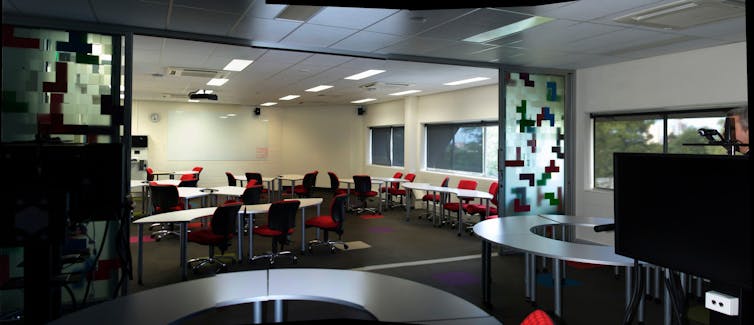 Universities will need to move the furniture to keep students safely distanced apart.
Flickr/Dan Munnerley, CC BY-NC-ND
Universities will need to move the furniture to keep students safely distanced apart.
Flickr/Dan Munnerley, CC BY-NC-ND
Successfully delivering small group teaching will probably require a lot of work on existing course structures and plenty of furniture relocation. But the opportunity to provide this type of teaching to the limit of capacity will be valuable in supporting retention and improving student experience.
Students love campus life
A campus is the largest capital investment a university makes and there are valid reasons why this is so. Attrition, retention and student experience data all suggest face to face teaching and other aspects of campus life are effective ways to attract, engage and retain undergraduate students.
A campus is also essential to deliver laboratory-based research. STEM research accounts for the majority of university research income and delivers many useful things, including perhaps a SARS-CoV-2 vaccine.
The timing of Step 3 is in the hands of state governments. For example, Queensland says it will move to Step 3 on July 10 while Tasmania has chosen July 13.
By the start of Semester 2 in late July or early August, it is probable that most states will have moved to Step 3.
UNSW, which moved to a three term model last year, will commence Term 2 on June 1, too early for Step 3.
Getting to campus
Another challenge though for universities is that of getting staff and students to campus on time. The capacity of public transport has been severely reduced by social distancing rules under Step 3.
Read more: Universities need to train lecturers in online delivery, or they risk students dropping out
In many cases it will not be practical to operate a campus with a full student or staff load.
Because campus populations are likely to be considerably reduced for a significant period of time, the challenges currently faced by on campus shops, food outlets and recreational facilities will continue.
The faint silver lining to all of this could be a long-term shift towards small group teaching, supplemented by high quality online materials, rather than reverting to the large lecture as we knew it.
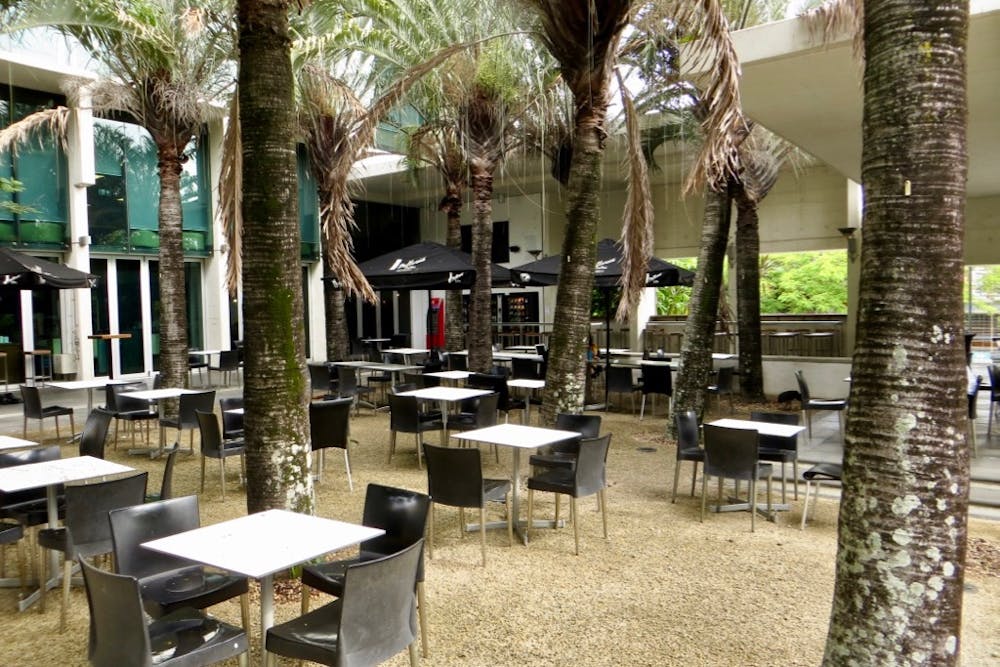 Students will need to keep their distance at campus cafes and shops.
Flickr/Kaya, CC BY-NC-ND
Students will need to keep their distance at campus cafes and shops.
Flickr/Kaya, CC BY-NC-ND
Authors: Geoff Hanmer, Adjunct Professor of Architecture, University of Adelaide


















