

what to expect from Scott Morrison's virtual summit with India's Narendra Modi
- Written by: Purnendra Jain, Adjunct Professor, Asian Studies, University of Adelaide
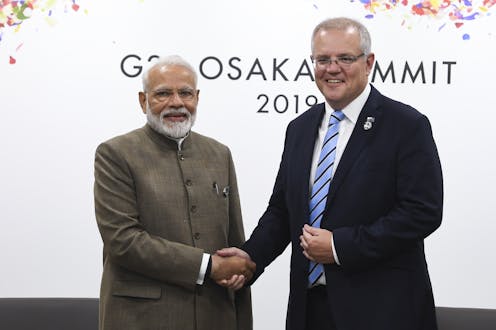
Prime Minister Scott Morrison and Indian Prime Minister Narendra Modi will finally hold a virtual summit this week after efforts to meet in person were scuttled by the bushfires and coronavirus.
The meeting is significant, not just because it is happening online, but also due to the cooling of relations each country is currently experiencing with China.
Beijing has taken a retaliatory stance towards Australia’s demand for a global inquiry into the COVID-19 pandemic. And in an incident that has garnered less attention, Indian and Chinese soldiers have clashed numerous times in recent weeks along their border, prompting fears of possible escalation.
While it is unlikely that the “C” word will figure in the talks between Morrison and Modi, China will no doubt loom large in both leaders’ minds.
Room for growth in trade and investment
Australia-India relations have been on a roller coaster for many decades. Australia has long sought closer ties with India, but Delhi has responded with more hesitancy.
Take, for example, prime ministerial visits. While most Australian prime ministers have visited India in recent years, the reverse has not been the case. Modi’s 2014 visit to Australia was the first for an Indian leader since Rajiv Gandhi came in 1986.
The Australian government has also issued various reports over the years to try and engage India economically, but the relationship has remained imbalanced.
Read more: Narendra Modi has won the largest election in the world. What will this mean for India?
For example, bilateral trade remains heavily in Australia’s favour, with close to A$17bn in exports to India in 2018 compared to just A$5bn in imports from India.
India is Australia’s eighth-largest trading partner and fifth-largest export market – largely driven by coal and international education. Australia, meanwhile, is just 27th on India’s list of global export markets.
Since the two countries signed a strategic partnership in 2009, both sides have seen greater potential for expanding trade and investment, and growing closer diplomatically.
The India Economic Strategy Report, compiled by Peter Varghese for the Australian government in 2018, identified key areas where growth is possible in the coming decade, including education, agribusiness, resources and energy, and tourism.
Australia is particularly keen to reduce its over-dependence on China in higher education. According to Varghese’s report, HSBC found the number of Indian parents wanting their children to study abroad had jumped from 47% to 62% from 2016-17. By 2030, India wants to lift its enrolment rate in higher education from the current 27% to 50%.
The overall targets mentioned in Varghese’s report could see Australian exports to India grow to around A$45bn by 2035.
Read more: Government report provides important opportunity to rethink Australia's relationship with India
In response, India was about to issue its first-ever Australia engagement strategy report prepared by a former Indian diplomat, Anil Wadhwa, during Morrison’s visit to India earlier this year. But this has still to see the light of day.
While economic possibilities abound, huge challenges remain. India’s withdrawal from the Regional Comprehensive Economic Partnership, a proposed free-trade agreement between Australia, New Zealand, China, Japan, South Korea and the ASEAN members, has sent the wrong signals to the rest of the region.
In addition, an Australia-India economic partnership agreement has yet to be finalised, nine years after negotiations began.
The COVID-19 pandemic will also likely slow India’s economic growth and increase domestic calls for more economic self-reliance. This could in turn have repercussions for Australian exports to India.
Also, given the decline in household incomes in India caused by the pandemic, a big jump in inbound tourists or full-fee paying students coming to Australia is unlikely in the short term.
More room for strategic cooperation
Strategically, there is room for growth, as well. Both countries are members of the so-called “Quad”, a security dialogue framework comprising Japan, India, Australia and the United States.
After being hesitant initially, both have now committed to it. India has signalled a desire to become more involved as Modi has pushed back against China’s influence in the region.
Read more: Australia and India: some way to go yet
With India’s growing defence and security links with the US, Canberra is also feeling more comfortable forging defence agreements with New Delhi, such as the proposed Mutual Logistics Supply Pact, an agreement for reciprocal access to military logistics facilities. It is expected to be signed during the virtual summit.
Australia should also expect an invitation to take part in the Malabar naval exercises with India, Japan and the US in the Bay of Bengal this year.
Australia had participated in the exercises in 2007, but withdrew after China expressed concerns. It has been in talks to rejoin the exercises since 2015.
Morrison has enthusiastically promoted his samosa diplomacy through his Twitter account and Modi has eagerly responded. There is much potential to improve relations in the coming years, as well. As Australia’s newly appointed high commissioner to India, Barry O’Farrell, said recently
over the last few months and years, India and Australia have grown closer together. India and Australia are at a historical high.
Authors: Purnendra Jain, Adjunct Professor, Asian Studies, University of Adelaide


















