

how Australia compares to the rest of the world
- Written by: Sunanda Creagh, Head of Digital Storytelling
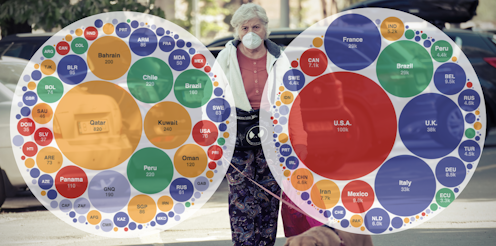
When it comes to coronavirus cases, deaths and tests, Australia is performing better than many other countries with comparable populations and geographies, a new COVID-19 data visualisation reveals.
Use the tool below, which uses data drawn from Our World in Data, to explore how each country compares on:
- the total number of COVID-19 cases
- the total number of cases per million people
- the number of daily new confirmed cases
- the number of daily new confirmed cases per million people.
On COVID-19 fatalities for each country, you can see:
- the total number of deaths
- the total number of deaths per million people
- the number of daily new deaths
- the number of daily new deaths per million people
And for tests performed by each country (except China, which Our World in Data says has limited publicly available data on testing rates nationwide), you can see:
- the total number of tests performed
- the total tests per thousand people
- the number of daily new tests
- the number of daily new tests per thousand people.
Hit the “play” button to show how the situation for each metric developed over time (noting the long period at the beginning for which COVID-19 cases appeared to be confined to China, and the lack of publicly available data for nationwide testing rates in China). You can read more here about the limitations of the data.
The Conversation asked Adam Kamradt-Scott, an expert on health security and pandemic preparedness, to reflect on what the data reveal at date of this article’s publication. Here’s what he told us:
Australia is doing well
Overall, the data show Australia is doing pretty well. It has conducted a high number of tests (currently about 57 tests per thousand people), which is more than the US, Canada or South Korea have done per thousand. The comparison with South Korea, which has been widely praised for its handling of the pandemic, is especially notable and reflects well on Australia.
In Australia, the number of total cases, new cases and cases per million is low.
I hold some reservations about the speed with which social distancing measures are being relaxed around Australia, as there’s a risk we could see a surge of new infections if there are undetected cases.
But as long as we are able to maintain a high level of testing and people follow the guidance after testing, we might be OK.
It’s interesting to see Australia compares favourably with Canada, which is broadly comparable to Australia in population size and geographical spread, given Canada also went through the 2003 SARS outbreak and so has more experience in handling a pandemic.
Total tests and tests per thousands
You’d have to say one of the standouts is Bahrain. Based on this data, it has done an average of about 190 tests per thousand. That is pretty high, which can provide a measure of reassurance you are capturing the majority of cases.
So when we look at the overall number of tests, the US, Russia and Italy appear to be best but when you look at tests per thousand, Bahrain leaps ahead. (It’s worth noting, however, it’s a small and densely populated country, which puts it at an advantage when it comes to tests per head of population).
US president Donald Trump has said America has “more testing than anybody else”. This data currently show that while the US has the highest number of tests overall, it is bested by Australia, New Zealand, Russia, Bahrain, Italy and many other countries if you measure tests per thousand people (a better indication of how widespread testing is).
Deaths and deaths per million
Belgium is unfortunately a bit of a surprise, appearing in this data set to be suffering the highest rate of fatalities per million people. Quite a lot has been made of the UK and the number of fatalities there compared to other parts of Europe. But compared to others, Belgium is hardest hit when it comes to deaths per million, but this may have to do with the way they report data.
It’s worth remembering that in some countries, though, we’ll never really know how many people have really died of COVID-19. That’s because, in some cases, countries didn’t test people who died.
That’s a limitation of the data, which relies on what countries report. If some countries are simply burying people who have died without investigating the cause of death, then the picture can be skewed.
We will never know the full number of deaths in all countries from COVID-19, principally because it is very difficult to verify the cause of death in many parts of the world. You need the lab capacity and affordable access to testing, which many countries lack. In those circumstances, they can only make an educated guess.
Sweden, which has reportedly pursued a “herd immunity” strategy and eschewed many of the lockdown measures other countries have in place, is an interesting one. It is not as bad as Belgium, but it’s certainly up there with about 440 deaths per million. And if we look at new deaths per million, it also looks grim for Sweden (as well as the UK, Brazil and Peru).
The argument the Swedish government is reportedly making is that, in the long run, Sweden is going to be better off. But the Swedish strategy is an inherently risky one.
For example, if there’s a slight mutation or a new strain emerges the question would then be: to what extent does exposure to the previous strain confer immunity? If the answer is “not much” then Sweden could get hit with a second round of infections. That hasn’t happened and may not happen, but it highlights one of the risks.
At the same time, if we see a vaccine successfully developed, then one of the questions the Swedish government will have to answer is whether more lives could have been saved if they’d implemented lockdowns like many other countries did.
Unfortunately, only time will tell.
Authors: Sunanda Creagh, Head of Digital Storytelling


















