

Target Earth: how asteroids made an impact on Australia
- Written by: Andrew Glikson, Earth and paleo-climate scientist, Australian National University
Our planet has had a few close encounters with asteroids of late.
Asteroid 2018 CC came within about 184,000km of Earth on February 6 this year. A few days later asteroid 2018 CB came within 64,000km, which is less than one-fifth the distance of Earth to the Moon.

Animation showing how asteroid 2018 CB passed closely by Earth on February 9. (NASA/JPL-Caltech)
Thankfully, both asteroids were relatively small (estimated between 15m and 40m). Neither posed a risk to Earth (this time), but Earth has not been so lucky in the past.
Read more: Ancient asteroid impacts yield evidence for the nature of the early Earth
Research in Australia and other countries indicates that, in the distant geological past, asteroids as large as Eros (about 34.4km long and 11.2km wide) have impacted Earth. These have triggered major changes in the structure and evolution of the crust and mantle, as I’ve written about before.
 Asteroid Eros.
NASA
Asteroid Eros.
NASA
The impact of asteroids on the Australian continent and marine shelves is examined more closely in my new book, Asteroid impacts, crustal evolution and mineral systems, with special reference to Australia, co-authored by Franco Pirajno.
In the firing line
The terrestrial planets of the inner solar system – Mars, Earth, Venus and Mercury – are all affected by asteroids deflected from the asteroid belt, located between Mars and Jupiter, and by comets falling off the Kuiper belt beyond Neptune.
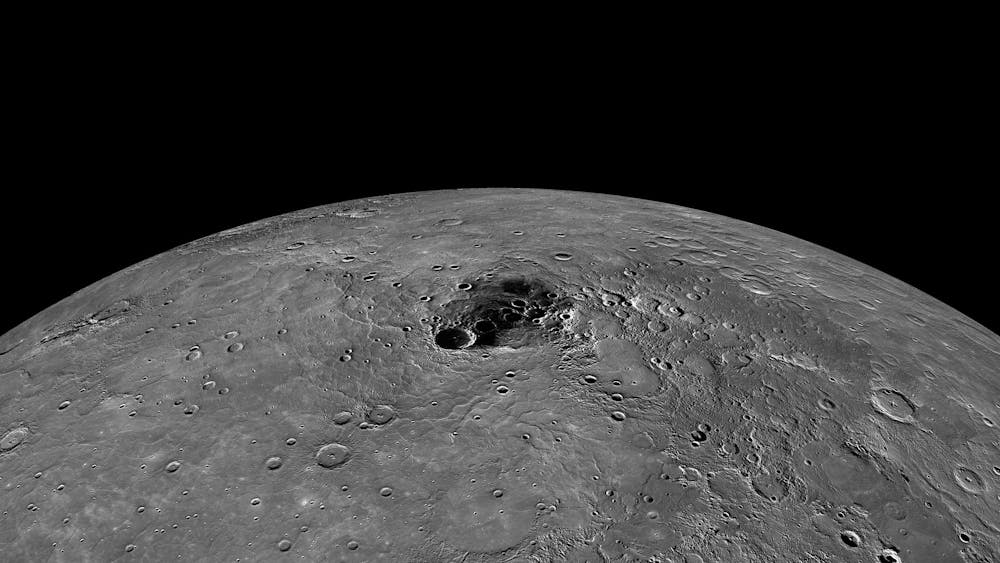 The cratered surface of Mercury.
NASA/Johns Hopkins University Applied Physics Laboratory/Carnegie Institution of Washington
The cratered surface of Mercury.
NASA/Johns Hopkins University Applied Physics Laboratory/Carnegie Institution of Washington
Many of these impact craters are clearly seen on Mars and Mercury as well as on our Moon. Venus too has its craters, but its thick atmosphere obscures these.
When Earth is viewed from space, it displays little or no cratering despite also being located in the trajectory of these asteroids and comets.
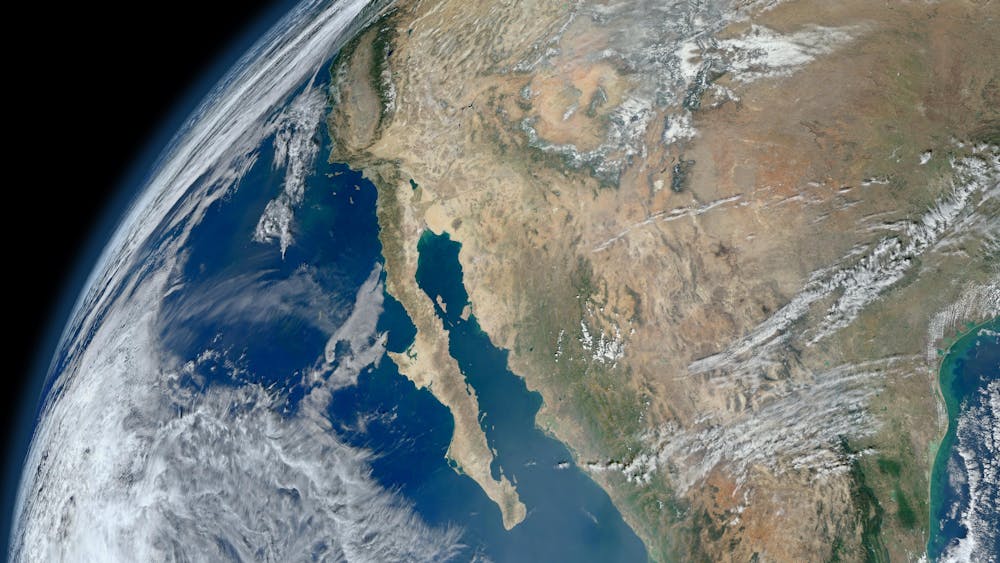 Earth doesn’t look very cratered from space.
NASA
Earth doesn’t look very cratered from space.
NASA
But this impression is apparent rather than real. Many of the impact scars are covered or masked due to the dynamic nature of Earth and the oceans that extend over some two-thirds of the planet’s surface. The masking processes include the accretion and subduction of tectonic plates as well as intensive erosion processes.
It was not until about 1981 that the scientific community began to recognise the significance of extraterrestrial impacts for the mass extinction of species about 66 million years ago, which wiped out the dinosaurs and many other groups.
The American scientists Louis and Walter Alvarez and their colleagues had unearthed a telltale iridium-rich sedimentary layer around the 66 million-year-old Cretaceous-Tertiary boundary at Gubbio, Italy. The element iridium, typically enriched in asteroids, is a signature within sediments for material from a meteorite impact.
The discovery re-established the idea that catastrophes shaped much of Earth’s history, a theory originally promoted by the French zoologist Georges Cuvier.
Impacts on the Earth
Beyond forming craters, the impact of large asteroids on Earth resulted in the formation of structural domes due to elastic rebound of the crust. Examples include the Vredefort dome in South Africa and the buried Woodleigh dome under and east of Shark Bay in Western Australia.
The impacts also caused major seismic activity and faulting, large tsunami events, ejection of masses of particles and dust, and – as mentioned earlier – in some instances the mass extinction of species due to rapid environmental changes.
The asteroid impact record on Earth is thus to a large extent concealed and the subject of an extensive search using structural, geophysical, geochemical and other methods.
Since many impact records are covered by the oceans or were eroded, old stable parts of the Earth crust, named “cratons”, are the best places to look. This is where the scars of ancient asteroid impacts are preserved and can be found, including craters and their deep-seated roots and rebound dome structures.
Australian impacts
The criteria applied for recognition of asteroid impact structures and meteorite craters allowed the identification of at least 38 confirmed impact structures on the Australian continent and surrounding continental shelf.
There are an additional 43 examples of exposed and buried circular ring and dome features, many of which are of possible or probable impact origin.
 The red circles show confirmed impact structures, green circles are impact craters, the yellow circles are possible-to-probable ring structures, red outer rings are impact structures larger than 100km in diameter, and outer white rings are impact structures less than 50km.
Google Earth/Andrew Glikson, Author provided
The red circles show confirmed impact structures, green circles are impact craters, the yellow circles are possible-to-probable ring structures, red outer rings are impact structures larger than 100km in diameter, and outer white rings are impact structures less than 50km.
Google Earth/Andrew Glikson, Author provided
Examples of exposed confirmed impact structures include Gosses Bluff in the southern Northern Territory, Shoemaker in central Western Australia, and Acraman and Lawn Hill in northwestern Queensland.
A Google Earth image of the central ring of the Gosses Bluff impact structure, central Australia, Northern Territory. It is 14km in diameter and was formed around 142 million years ago.
A Google Earth image of the Shoemaker impact structure, Nabberu Basin, in Western Australia. It is 30km in diameter and was likely formed around 1,630 million years ago.
A Google Earth image of the centre of the Acraman impact structure in southern South Australia. It is 90km in diameter and was formed around 590 million years ago.
A Google Earth image of the centre of the Lawn Hill impact structure in northwestern Queensland. It is is 18km in diameter and was formed more than 515 million years ago.
The impact record of Australia thus includes exposed impact structures, buried impact structures, meteorite craters and geophysical ring anomalies of unproven origin.
Examples of large geophysical multi-ring features – total magnetic intensity anomalies, circular gravity anomalies and seismic domes – include probable buried twin impact structures in the Warburton Basin in northeast South Australia, a confirmed buried impact structure at Woodleigh in WA, and confirmed buried impact structures at Tookoonooka and Talundilly in the Eromanga Basin in southwest Queensland.
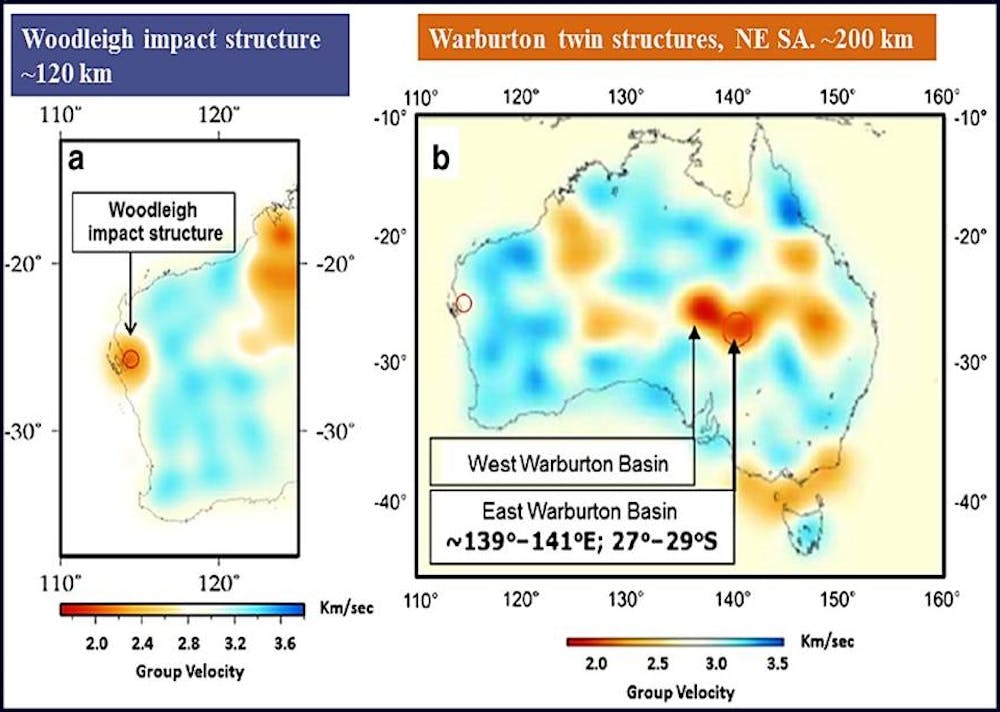 Seismic tomographic (identified 3D images) anomalies of the Warburton twin structures, South Australia, representing probable impact structures, and the Woodleigh impact structure, Western Australia.
Saygin and Kennett 2010/Andrew Glikson, Author provided
Seismic tomographic (identified 3D images) anomalies of the Warburton twin structures, South Australia, representing probable impact structures, and the Woodleigh impact structure, Western Australia.
Saygin and Kennett 2010/Andrew Glikson, Author provided
Fallout of asteroid impacts
Structures and craters caused by asteroid impacts are not the only thing we find. In the Australian landscape there are also the rock fragments and melt drops derived from clouds ejected from the impact craters.
The melt drops, condensed from impact-ejected vapour, are termed “microkrystites”. These are recognised by their radiating quench (cooling) textures and abundance of platinum group element anomalies.
 Impact condensate spherules (called microkrystites) from the 2.63 billion-years-old Jeerinah Impact layer, central Pilbara Craton, Western Australia.
Bruce Simonson, Author provided
Impact condensate spherules (called microkrystites) from the 2.63 billion-years-old Jeerinah Impact layer, central Pilbara Craton, Western Australia.
Bruce Simonson, Author provided
In at least one instance the evidence suggests that an impact by a cluster of large asteroids resulted in an abrupt transformation of crustal structure on the Pilbara, northwestern Australia, as well as the Barberton greenstone belt in South Africa, from a granite/greenstone system to semi-continental crustal environment.
Read more: World's largest asteroid impact site could be right here in Australia
Between 3.26 and 3.24 billion years ago these impacts caused a sharp tectonic uplift and magmatic activity, leading to to an onset of semi-continental crustal conditions.
Thus, far from being free from impacts, the Australian landscape has been shaped many times over millions and billions of years by asteroids falling to Earth.
As studies of Australian impact structure and impact ejecta progress, the critical role of asteroid impacts in the early evolution of the Earth and in the development of the Australian continent are becoming clearer.
Authors: Andrew Glikson, Earth and paleo-climate scientist, Australian National University
Read more http://theconversation.com/target-earth-how-asteroids-made-an-impact-on-australia-92836


















