

Federal departments had no specific COVID plan for aged care: royal commission counsel
- Written by Michelle Grattan, Professorial Fellow, University of Canberra
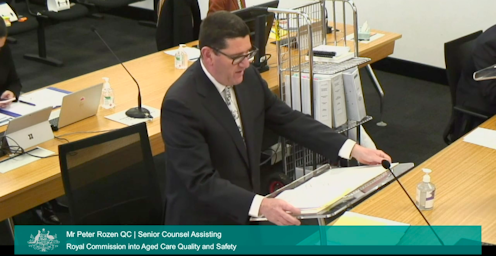
Australia’s aged care sector was “underprepared” to deal with the COVID-19 outbreak and federal authorities had no specific plan for it, according to a stinging indictment from Peter Rozen QC, senior counsel assisting the royal commission into aged care.
In a statement critical of authorities and providers, Rozen said while much was done to prepare the health sector more generally for the pandemic, “neither the Commonwealth Department of Health nor the aged care regulator developed a COVID-19 plan specifically for the aged care sector”.
Rozen was speaking at the start of several days of hearings to look at the sector’s preparations and response to the crisis. The commission will probe the NSW outbreaks in homes but not delve in detail into particular homes in Victoria because the crisis is ongoing there.
Aged care is a Commonwealth responsibility, while the states are responsible for health.
Rozen said on Commonwealth data, more than 1,000 residents had been diagnosed with COVID-19, of whom 168 had died.
The pandemic had “starkly exposed” the flaws in the sector that had been highlighted during the royal commission.
In view of the deficiencies it was “hardly surprising that the aged care sector has struggled to respond to COVID-19”.
He stressed the consequences of the deskilling of the aged care workforce and a shortage of clinical skills in homes.
Rozen quoted health minister Greg Hunt saying on July 29 that “aged care around the country has been immensely prepared”. But, Rozen said, “in a number of important respects, the evidence will demonstrate that the sector has been underprepared”.
“We will be asking if greater attention to preparation may have saved lives and could save lives in the future.”
Rozen said that between June 19 and August 3, a crucial period when new infections in Victoria escalated, there was no updated advice for the aged care sector from the Australian Health Protection Principal Committee - the main source of COVID advice.
“There was no advice about how the sector should respond to the risk posed by aged care workers who may be COVID-19 positive yet asymptomatic, particularly those who work in multiple facilities.”
Rozen was critical of the Commonwealth regulator, the Aged Care Quality and Safety Commission, which oversees the sector.
“The regulator did not have an appropriate aged care sector COVID-19 response plan. Given that it was widely understood that recipients of aged care services were a high risk group, this seems surprising.”
On March 17, the regulator wrote to providers with a survey asking about their preparedness. Overwhelmingly they claimed to be prepared, but evidence would be critical of this survey, Rozen said.
He questioned the late timing of the regulator’s action in relation to the Newmarch House in Sydney and the fact the regulator had not investigated the circumstances of the Dorothy Henderson Lodge and Newmarch House outbreaks.
Read more: View from The Hill: Aged care crisis reflects poor preparation and a broken system
“We also have concerns about whether the regulator’s powers of investigation are adequate,” Rozen said, adding that comparable regulators in areas such as workplace or airline safety were not as fettered.
There were “notorious problems” in the relationship between the health system run by the states and the Commonwealth aged care sector, Rozen said.
He detailed an argument between federal and NSW authorities about whether residents with COVID should be transferred to hospitals, with the federal authorities wanting transfers and the state official opposing.
“Equal access to the hospital system is the fundamental right of all Australians young or old and regardless of where they live,” Rozen said.
“Many of the residents in aged care homes worked their entire lives to build the world class health system of which Australians are justifiable proud.
"They have the same right to access it in their hour of need as the rest of the community. To put it very directly, older people are no less deserving of care because they are old. Such an approach is ageist”.
Rozen noted the time it took, after experience in Sydney, for the Commonwealth health department to advise providers that 80-100% of their workforce might need to isolate in a major outbreak, and even then it was not highlighted.
“Regulators in other fields such as workplace safety publish page one ‘alerts’ to disseminate promptly via safety information they learn from incident investigations.”
Rozen said masks were not made compulsory for aged care workers until July 13 – two days after the first recorded deaths of an aged care resident in Victoria. On July 13, the number of new Victorian infections was 250.
“Why did authorities wait until after the fir st death to take what seems the simple and obvious step of making masks compulsory for aged care workers?”
The head of the Commonwealth’s Aged Care Quality and Safety Commission, Janet Anderson, has told a Senate inquiry St Basil’s Home for the Aged informed the commission of its COVID outbreak on July 10 - contrary to claims made previously that the Commonwealth was not told until July 14.
In a letter to the Senate committee on COVID-19, Anderson wrote she had become aware that on July 10, during a telephone call responding to the commission’s assessment contact program the St Basil’s representative “provided information that one staff member … was diagnosed with COVID-19 on 8 July 2020 and the Public Health Unit (PHU) had been advised”.
Anderson, the aged care minister, Richard Colbeck, and the secretary of the federal health department Brendan Murphy all told the committee on August 4 the Commonwealth had not been informed about the outbreak until July 14.
That was when the Victorian health and human services department notified it. The time lag has been seen by the Andrews government’s critics as further evidence of its poor administration.
In her letter Anderson said the commission was not the first responder to an outbreak and the phone contact had been part of a commission program to seek assurances from facilities that COVID plans had been developed and were ready to be acted on.
“The regulatory official from the Commission who made the assessment contact referred the service’s responses to the Commission’s COVID-19 Response Team and this information was escalated internally and recorded in the Commission’s daily COVID-19 confirmed case tracker, Anderson wrote.
"The Commission did not escalate the matter externally at the time because the St Basil’s representative had confirmed in the interview that they had advised the PHU [the Victorian Public Health Unit] of the outbreak. The representative also confirmed that they had read the ‘First 24 hours’ document.”
Anderson noted this federal health department document lists four actions to be taken in the first 30 minutes. These steps are: isolate and inform the COVID-19 positive case(s); contact the local Public Health Unit; contact the Commonwealth Health Department; lock down the facility.
Anderson said the commission was later advised about the outbreak by the health department on July 14.
“To manage any risks of provider failure to notify the relevant authorities of a COVID-19 outbreak, the Commission now has arrangements in place to confirm immediately with the Commonwealth Department of Health that they have been directly notified by the affected aged care service of any outbreak at that service that comes to the Commision’s attention by whatever means.”
Asked about the bungle, Scott Morrison was sharp. He said the commission was an independent body that operated formally separate from the government but he was concerned about the breakdown in communication.
He said where there were breakdowns and issues, he wanted to know about them and fix them.
“We will be following [the matter] through with the commissioner. And at the end of the day, they’re an independent statutory office and they know their responsibilities and they need to live up to them.”
Authors: Michelle Grattan, Professorial Fellow, University of Canberra

















