

House hunters are rarely told the home energy rating – little wonder the average is as low as 1.8 stars
- Written by: Neville Hurst, Senior Lecturer, School of Property, Construction and Project Management, RMIT University
Most Australian homes have been built to notoriously poor standards. The energy performance of existing homes in Victoria, for instance, averages 1.8 stars – 6 stars is mandatory for newly built homes under the 10-star Nationwide House Energy Rating Scheme (NaTHERS).
Decision-makers typically fail to appreciate the importance of a low star rating, even though it have profound impacts on households’ health and budgets.
These challenges have come to the fore during the COVID-19 pandemic as people spend more time at home. In a home with a low star rating, it can be hard and costly to maintain a comfortable temperature. If it’s too hot or cold occupants’ health can suffer.
Despite these impacts, two new pieces of research reveal it is extremely difficult for house hunters to obtain basic information like energy star ratings in the home rental and ownership markets. The researchers see this issue as systemic.
However, it appears real estate agents are not deliberately withholding information. In a “secret shopper” survey, 91% of the agents didn’t know the energy ratings of homes they sell or lease.
NaTHERS is to be expanded in 2021 to include existing homes. But it won’t be mandatory to measure their energy performance.
When ratings tools are voluntary, experience shows few people use them. In Victoria, for example, homes can be assessed by accredited assessors using the government’s Residential Efficiency Scorecard. Only 3,800 existing homes had been assessed by April 2020, according to state government data provided to me.
The NaTHERS star rating explained.Read more: The other 99%: retrofitting is the key to putting more Australians into eco-homes
Agents know little about energy efficiency
In my doctoral research project completed in 2019, titled Residential Agent Engagement with Energy Efficiency when Advertising in Melbourne, I found Melbourne-based real estate agents do not actively promote information about the energy efficiency of properties. This is likely true Australia-wide, as agency practice is much the same across the states.
Agents typically respond to market trends and buyer preferences and their advertising reflects this. Understandably, agents highlight features they consider most likely to appeal to buyers. It’s up to agents to decide if energy performance will help them sell or lease the house.
As well as in-depth interviews with agents, I evaluated over 150,000 house advertisements. While some did refer to energy-efficient technologies, in most such cases these were simply listed, often in the body of the advertisement.
The message was likely to be lost among other details, thus not emphasising the benefits of energy efficiency.
Read more: Low-energy homes don't just save money, they improve lives
This is partly because energy-efficiency performance reporting isn’t mandatory and the practice isn’t common. Agents have little incentive to develop an understanding of home energy performance and how it contributes to poor housing standards.
 Many renters can do little to improve a house with a low energy rating that leaves them cold in winter and hot in summer.
Shutterstock
Many renters can do little to improve a house with a low energy rating that leaves them cold in winter and hot in summer.
Shutterstock
Read more: Forget heatwaves, our cold houses are much more likely to kill us
Most agents don’t even know the rating
Complementing my research, a recent research project supports the suspicion that real estate agents lack knowledge about the energy efficiency features of their properties.
Environment Victoria recruited volunteers to conduct “secret shopper”-style surveys with agents at properties open for inspection across the state. This ensured the data collected closely matched the information available to other house hunters. Volunteers asked four simple questions of 300 agents, including a follow-up question to each “yes” answer to help verify it.
The overwhelming majority of agents were unable to answer any of the four questions. The survey found:
91% of agents could not point out the energy star rating of the home
68% could not say whether the home had insulation
46% couldn’t identify any energy-saving features. One agent listed the “back fence” as an energy-saving feature.
The secret shoppers found agents were even less aware of energy efficiency when letting out houses compared to selling them. This is particularly concerning because Australia’s worst-performing homes, especially in winter, are typically rented, and tenants are usually less able to improve the energy performance.
Read more: Stimulus that retrofits housing can reduce energy bills and inequity too
The research does not suggest any moral failings by estate agents. As my research found, they are “market followers”. Rather, the findings suggest the need to amend the market rules in which agents operate, to ensure more equitable outcomes for house hunters.
Why mandatory disclosure is needed
Research shows increasing the energy star rating of existing homes to 5.4 stars could reduce heat-related deaths by 90%. Poor home energy performance also contributes to residential greenhouse gas emissions amounting to 19% of Victoria’s total emissions.
 Increasing the energy star rating of existing homes to 5.4 stars could reduce heat-related deaths by 90%.
Shutterstock
Increasing the energy star rating of existing homes to 5.4 stars could reduce heat-related deaths by 90%.
Shutterstock
Clearly, problems like these flow from estate agents’ poor knowledge of energy efficiency and its impact on the housing market, coupled with buyers’ and renters’ ignorance of the energy ratings of the properties they’re looking at. The problems can only be overcome if state and federal governments work together to make it mandatory to disclose the energy efficiency of housing at point of sale.
Home owners would then be required to provide information to buyers and renters about the energy star rating. House hunters could easily compare the performance of all homes they are interested in.
Such transparency would also provide more options to owners. Mandatory disclosure does influence the housing choices buyers make. Properties with higher energy ratings are often more appealing and fetch higher prices.
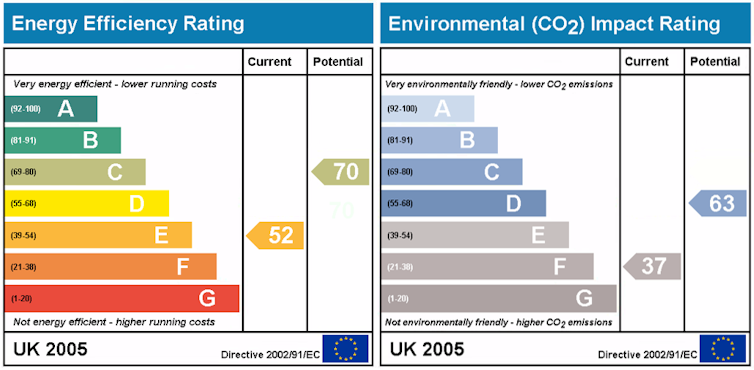 Example of a displayed Energy Performance Certificate from the UK, with an A to G rating.
Read more: Homes with higher energy ratings sell for more. Here's how Australian owners could cash in
Mandatory disclosure is no panacea for improving the poor energy performance of Australian housing, particularly the rental properties that would benefit from minimum standards. However, mandatory disclosure is an essential element of a suite of policies that governments should implement to drive the transition towards net-zero-carbon, healthy homes.
Authors: Neville Hurst, Senior Lecturer, School of Property, Construction and Project Management, RMIT University


















