

COVID-19 is predicted to make child poverty worse. Should NZ's next government make temporary safety nets permanent?
- Written by: Kate C. Prickett, Director of the Roy McKenzie Centre for the Study of Families and Children, Te Herenga Waka — Victoria University of Wellington
Despite the 2017 Labour-led government taking power with a mandate to fight Aotearoa New Zealand’s abysmally high child poverty rate, only incremental progress has been made.
The percentage of children living in poor households dropped only slightly, from 16.5% in June 2018 to 14.9% by June 2019.
That equates to approximately one in seven children (168,500) living in poverty, according to one official measure used in New Zealand and internationally: households with incomes less than 50% of the median disposable household income before housing costs (BHC).
Before COVID-19, the government was projected to be in range of its 2021 BHC poverty target. It was also projected to meet its after-housing-costs (AHC) target (a measure of poverty based on household income with standard housing cost estimates factored in).
The government’s stated reduction targets are 5% of children in poverty based on the BHC measure, and 10% using the AHC measure, by 2028. The somewhat stagnant trend lines from 2017 to 2019, however, suggest there was still a need for the “transformational” policies promised in 2017.
 Even before COVID-19, reduction in child poverty was incremental, despite the Labour-led government’s ‘transformational’ ambition.
GettyImages
Even before COVID-19, reduction in child poverty was incremental, despite the Labour-led government’s ‘transformational’ ambition.
GettyImages
The impact of COVID-19
Then came the COVID-19 pandemic, and the government delivered some of those transformative policies in the form of both temporary and more permanent economic responses.
Families with children relying on income assistance received an income bump through temporary increases in the winter energy payment and a longer term rise in benefit payments. For those who lost jobs, the COVID-19 relief payment was far more generous than the normal Job Seeker benefit.
These changes no doubt made a difference in the day-to-day lives of low-income families. Treasury estimated this short-term safety net, coupled with the full implementation of tax credits through the families package, meant the government was still on track to meet its child poverty targets in 2021.
Unfortunately, that stagnant pre-pandemic trend line is now predicted to move upwards post-2021. The rise consists of children already in families who rely on an income support system that keeps them below the poverty threshold, and those newly in poverty due to their parents’ job or income loss.
Indeed, our research shows families with children were more likely to experience an economic shock during lockdown.
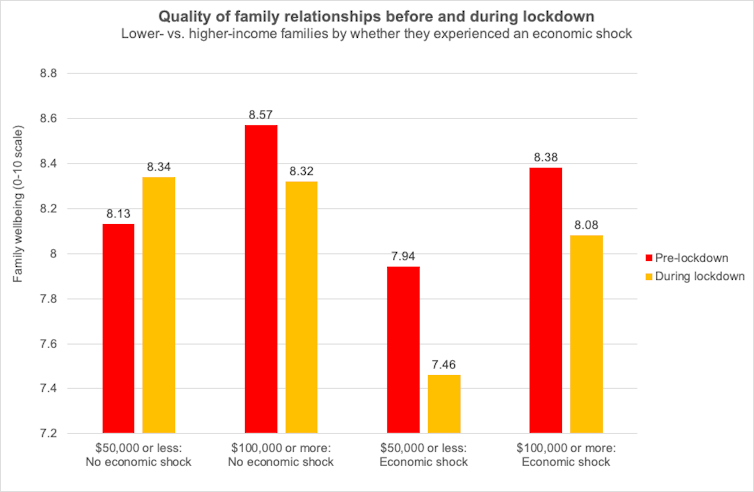 Survey respondents rated how lockdown had affected their family relationships.
Author provided
Survey respondents rated how lockdown had affected their family relationships.
Author provided
Unequal distribution of economic shock
The data are based on our survey of people’s experiences during and after lockdown (March–April 2020). It highlights the disproportionate impact the economic crisis is having on families with children generally, and on low-income working families in particular.
For families with children where at least one adult was working prior to the lockdown, 51% experienced an economic shock due to someone in the household losing their job or some income. This compares with a rate 44% for the population overall.
As well as the financial hit, parents in households that experienced an economic shock reported more negative feelings during the day, such as depression, stress, and worry. Those feelings appeared to persist beyond lockdown.
While all parents reported their sense of well-being improved moderately during the first return to alert level one (July 2020), that rebound wasn’t as high for those who had experienced an economic shock during lockdown.
There was nothing random about which families were most affected: 60% of working families living below the median household income (approximately NZ$50,000 per annum) experienced an economic shock compared with 45% of families in higher income brackets ($100,000 or more).
All working parents who reported an economic shock during lockdown, regardless of household income, reported declines in how they rated their relationship with their family. For parents from lower income households, however, this drop in family well-being was deeper than for higher income families.
In short, not only were parents in low-income households more likely to experience an economic shock, that shock had a bigger impact on their family well-being.
Temporary policies should become permanent
When we look at the child poverty projections from Treasury, it’s important to place them in the context of these findings.
Families who were working and just getting by are more likely to be suffering now and potentially into the future. That applies even more to those who were already struggling before the pandemic and who may find it harder to be part of the economic recovery.
Even the more optimistic child poverty projection, which shows the percentage of children in AHC poverty returning to early 2020 levels by 2024, may be misleading.
Housing prices (and presumably rents) have continued to rise and are projected to outpace wage growth. Indeed, the statistical assumption built into the AHC poverty measure is that families spend approximately 25% of their disposable income on rent — an unrealistically small proportion of financial resources for low income families.
If there is a silver lining, it is that the government’s short-term policy responses to the pandemic, such as the COVID-19 relief payment and wage subsidy programme, gave us a glimpse of what transformative policies could look like: a responsive safety net benefit maintaining families’ financial well-being at a liveable rate.
Without more permanent change, however, those rising child poverty projections will become our sad reality.
Authors: Kate C. Prickett, Director of the Roy McKenzie Centre for the Study of Families and Children, Te Herenga Waka — Victoria University of Wellington


















