Modern Australian
Times Advertising

Waymo has launched a self-driving taxi service

  • Written by James Jin Kang, Lecturer, Computing and Security, Edith Cowan University
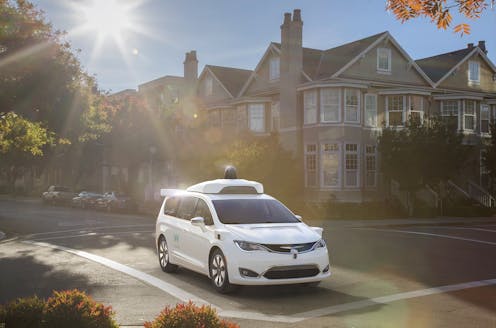
Waymo has launched a self-driving taxi service

The age of the driverless taxi has arrived – at least in parts of Phoenix, Arizona. Self-driving car company Waymo, owned by Google’s parent company Alphabet, announced its autonomous vehicles are now available to the general public (or at least paying customers).

The service is only available in a limited area for now, both because regulations in Arizona are relatively permissive and because the cars need a detailed three-dimensional map to tell them all about the road environment.

Until earlier this year, the self-driving vehicles were under testing and were used in 5-10% of Waymo’s rides. The service has been shut because of the pandemic, but is now back and Waymo is aiming to increase availability.

Are the cars really ‘self-driving’?

Waymo One currently requires a human driver to be present to supervise the self-driving care and override it when necessary, but the new announcement means fully autonomous, unsupervised vehicles. If successful, passengers will have entirely free time in the back seat.

Safety is still a concern though. Waymo claim trials in excess of 20 million miles of autonomous driving as of January 2020. While this sounds reassuring, with current US death rates at 1 per 100 million miles this is woefully small to demonstrate safety on par with human drivers.

However, some research suggests deploying “good enough” self-driving cars will save lives by getting rid of human errors – and that waiting for the technology to become near-perfect before deploying it would be a mistake.

Read more: Autonomous cars: five reasons they still aren't on our roads

Waymo’s plan

Much of Waymo’s success is down to rigorous simulation and training. The company has its roots in Google’s self-driving car project, which began in 2009.

Unlike some other companies working on autonomous vehicles, such as Tesla and Volvo, Waymo is not trying to make a vehicle it can sell to consumers. At present, Waymo is only focused on offering a taxi service, though Avis Budget Group will manage the physical fleet of vehicles.

This may be a smart move. From a consumer psychology perspective, buying a Tesla or any other branded autonomous vehicle is expensive, but getting a driverless taxi will feel just as futuristic at a much lower cost.

The road ahead for autonomous vehicles

Even if Waymo’s technology proves safe and effective in practice, commercial success will depend on whether consumers adopt it. We still see customers in banks who prefer to go to a teller instead of making a transaction via a kiosk or ATM, and computer users who are reluctant to upgrade systems and services to newer versions.

Read more: Airports, ATMs, hospitals: Microsoft Windows XP leak would be less of an issue, if so many didn't use it

There are still drivers resistant to the usage of (any) electronics in cars, so, for some, robot-driven cars will be a hard sell. What’s more, self-driving cars still struggle to manage everyday unexpected obstacles, such as potholes or broken traffic lights. Weather can also take a toll by affecting sensors.

Billions of dollars have been spent on autonomous car research, but they are far from perfect. High-profile deaths) involving autonomous vehicles have also taken some of the shine off the technology.

So, are we ready to embrace the technology and service?

Waymo provided the service before the pandemic; proved the technology works; and, showed there is public demand for such a service. They will now be aiming to convince stakeholders such as governments and business partners that now is the time for autonomous vehicles.

While seeking to address technical reliability issues – such as the requirement for a 5G mobile network – and customer acceptance of their product, Waymo will be hoping they won’t experience any catastrophic accidents as some of their competitors have.

Read more: Legal lessons for Australia from Uber’s self-driving car fatality

Authors: James Jin Kang, Lecturer, Computing and Security, Edith Cowan University

Read more https://theconversation.com/robot-take-the-wheel-waymo-has-launched-a-self-driving-taxi-service-147908

Why Does My Power Keep Tripping? Common Causes Explained by Electricians Sydney

The electrical system is the lifeblood of your home, powering everything from your phones to cooking utensils and more. But from time to time, your po...

Interstate Car Transporter Urges Buyers to Book Early

As the conflict in the Middle East continues to put increasing pressure on local fuel supply, Australian transport companies are experiencing increasi...

Digital Minimalism for Business Owners: Fewer Tools, Better Systems

Be honest. How many apps are open right now? One for scheduling, another for invoices, a third for customer notes, plus a spreadsheet someone email...

The Importance Of Proactive NDIS Renewal Preparation For Sustaining Your Provider Business

Your NDIS renewal notice is not a signal to start preparing. By the time it arrives, preparation should already be well underway. For new providers, s...

Why Fire Extinguisher Testing in Sydney Is Becoming a Records Game, Not Only a Maintenance Job

A fire extinguisher used to feel like one of the simpler parts of building safety. It hung on the wall, wore a service tag, and sat there quietly unle...

The Switchboard Upgrade Question Every Melbourne Renovator Should Ask Before the Walls Close Up

Renovations have a funny way of making people think on surfaces first. Splashback, stone, joinery, tapware, paint. Fair enough too. That is the exciti...

Winter Sanitation Gaps in Parramatta Kitchens: A Hidden Pest Risk

Winter brings a host of changes to our homes, from the chill in the air to the cozy warmth indoors. However, this season also introduces sanitation ch...

When to Seek Advice from Employment Lawyers in Melbourne

Australian employment law is detailed and, at times, complex, with rights and obligations that aren't always obvious to employees or employers witho...

7 Benefits of Professional Gutter Cleaning for Australian Homeowners

Gutters aren't exactly glamorous. They sit up there on the edge of your roof, doing their job quietly - until they stop working. Clogged, overflowing ...

Pipe Floats Strengthening Pipeline Performance In Demanding Environments

Pipelines often travel through environments that are anything but predictable, water currents shift, terrain changes, and materials keep moving unde...

Why Ceiling Fans Are Essential For Comfort, Efficiency, And Modern Living

Creating a comfortable indoor environment is not just about temperature; it is about how air moves, how a room feels, and how efficiently energy is ...

Why Duct Cleaning In Melbourne Is A Smart Investment For Healthier Living Spaces

Behind your walls, ceilings, and vents lies a network quietly working every day to keep your home comfortable. Yet over time, this system can become...

Disability Service Providers Supporting Inclusive And Independent Living

Finding the right support system can feel like assembling a puzzle where every piece must fit just right. For individuals and families navigating di...

A Beginner's Guide to Owning a Caravan in Australia

Owning a caravan opens up a style of travel that's hard to match for freedom and flexibility. However, for those just starting out, the process of c...

Preparing Your Air Conditioner for Summer: What Most Homeowners Overlook

As temperatures rise, many homeowners switch on their air conditioning for the first time in months — only to find it’s not performing the way i...

What Actually Adds Value to Properties in Newcastle

Newcastle has seen steady growth over the past few years, with more buyers looking beyond Sydney for lifestyle, space, and long-term value. As dema...

What is Design and Build in Construction?

Imagine you’re about to start a new construction project, maybe it’s a custom home or a commercial building. You’ve got the idea, the land, an...

Commercial roof leak detection: why early action protects your building

Water ingress is one of the most disruptive and costly issues facing commercial properties. For property managers and facilities teams, even a minor...