

Clarrie Combo, Mrs Brown and Aboriginal soldiers in WW2
- Written by: Kristyn Harman, Senior Lecturer in History; Graduate Research Coordinator, School of Humanities; Course Coordinator, Diploma of History, University of Tasmania
During the second world war, a young Aboriginal soldier, Private Clarrie Combo from New South Wales, exchanged mail with Mrs F. C. Brown from Loxton, South Australia — a white woman whom he had never met.
Very few letters penned by Aboriginal soldiers who served in either of the two world wars survive, yet one of Clarrie’s letters has endured in what might seem a surprising context. Mrs Brown contacted the young soldier after seeing an advertisement calling for volunteers to “adopt” Aboriginal soldiers. His reply was printed in her local newspaper, and its survival provides us with a rare opportunity to learn about military service from an Aboriginal soldier’s perspective.
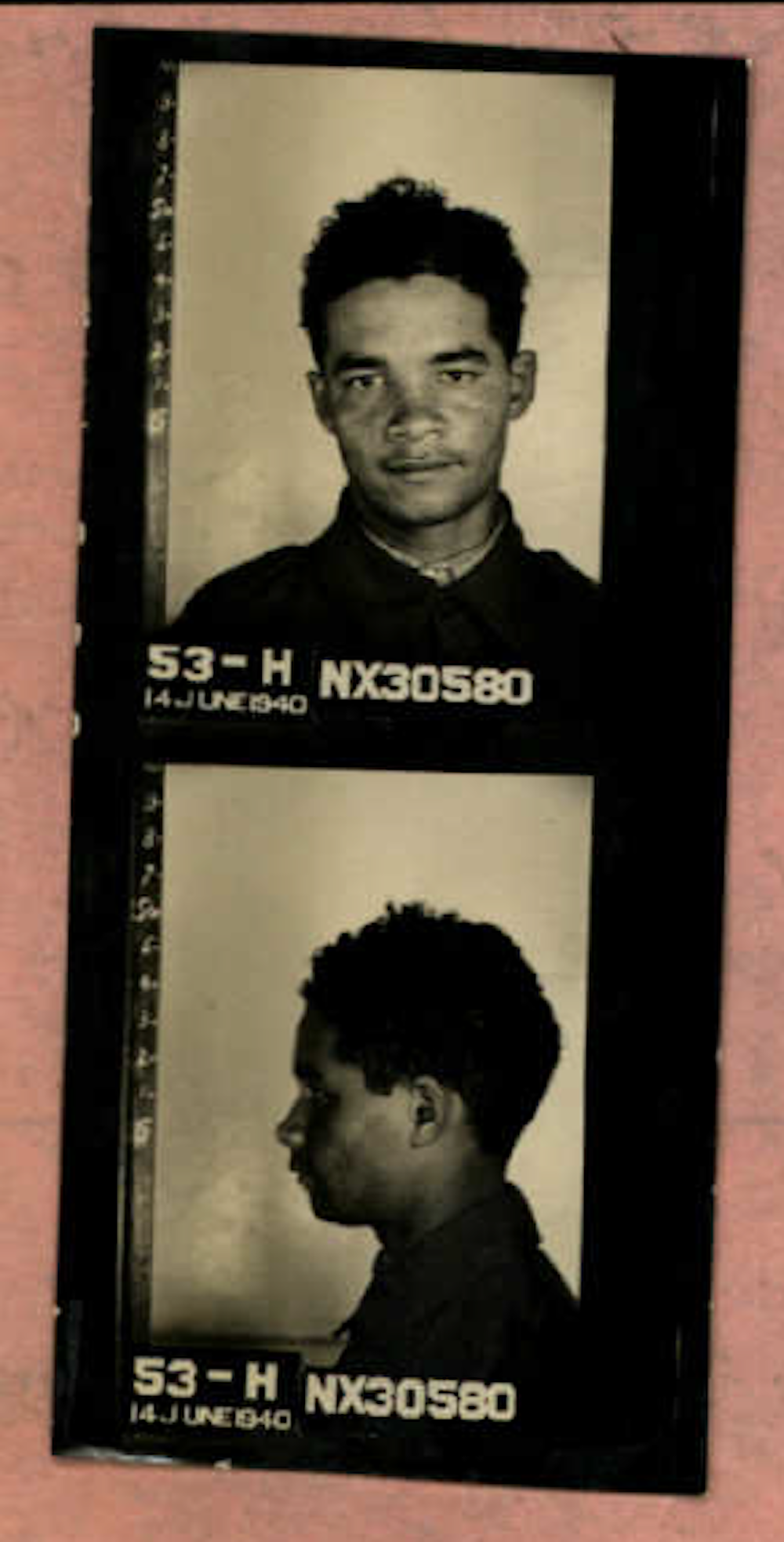 Private Clarence Combo.
NAA: B883, NX30580
Private Clarence Combo.
NAA: B883, NX30580
Clarence Combo was born in Wardell, New South Wales, on 14 September 1919. Young Clarrie grew up in a harsh environment — Kinchela Aboriginal Boys’ Training Home near Kempsey. Consistent with government plans to assimilate Aboriginal people into white Australian society, children like Clarrie were forcibly removed from their families. At Kinchela, boys were called by their allocated numbers rather than names. Identities and cultures were stripped away.
In a country where discriminatory legislation and practices precluded Aboriginal people from earning a fair wage, voting, marrying non-Aboriginal partners, buying property or entering a public bar, it is not too difficult to imagine why some young Aboriginal men signed up for the military when war broke out. An estimated 1,000 Aboriginal soldiers served in the Australian Imperial Force as black diggers during the first world war. By the mid-20th century it was easier for Aboriginal men to sign up, so around 3,000 served Australia during WWII.
Comfort funds
Shortly after WWII began, the Melbourne-based Aborigines Uplift Society, founded by non-Aboriginal activist Arthur Burdeu, created a comforts auxiliary for Aboriginal soldiers. The idea was that women could “adopt” an Aboriginal soldier. They would correspond with him and arrange comfort parcels to be sent to him at the front.
In the Society’s August 1940 Uplift newsletter, Burdeu explained how “native women have not the resources to do as their white sisters, though they are already at work”. In Queensland, for example, children at the Purga Aboriginal Mission sewed underpants, toilet tidies, calico bags and hussifs (sewing kits), and knitted socks, mittens and balaclavas. Yorta Yorta women and children at the Cummeragunja Reserve (located in New South Wales) were also involved in knitting for the war effort.
Newspaper advertisements ran across Australia inviting women to contact Burdeu about “adopting” an Aboriginal soldier. With at least one son-in-law serving Australia, Mrs Brown may have felt compassion for those men whose families could not afford to send them parcels.
Corresponding with Mrs Brown
On September 25, 1941 the Murray Pioneer and Australian River Record published one of Clarrie’s letters to Mrs Brown under the headline “Aboriginal’s Appreciative Letter”. Clarrie opened his correspondence with Mrs Brown by thanking her for writing to him. He wrote: “it is very nice of you to write to someone you do not know”. At a practical level, Clarrie advised Mrs Brown that he wore size seven boots, as she had offered to knit socks for him.
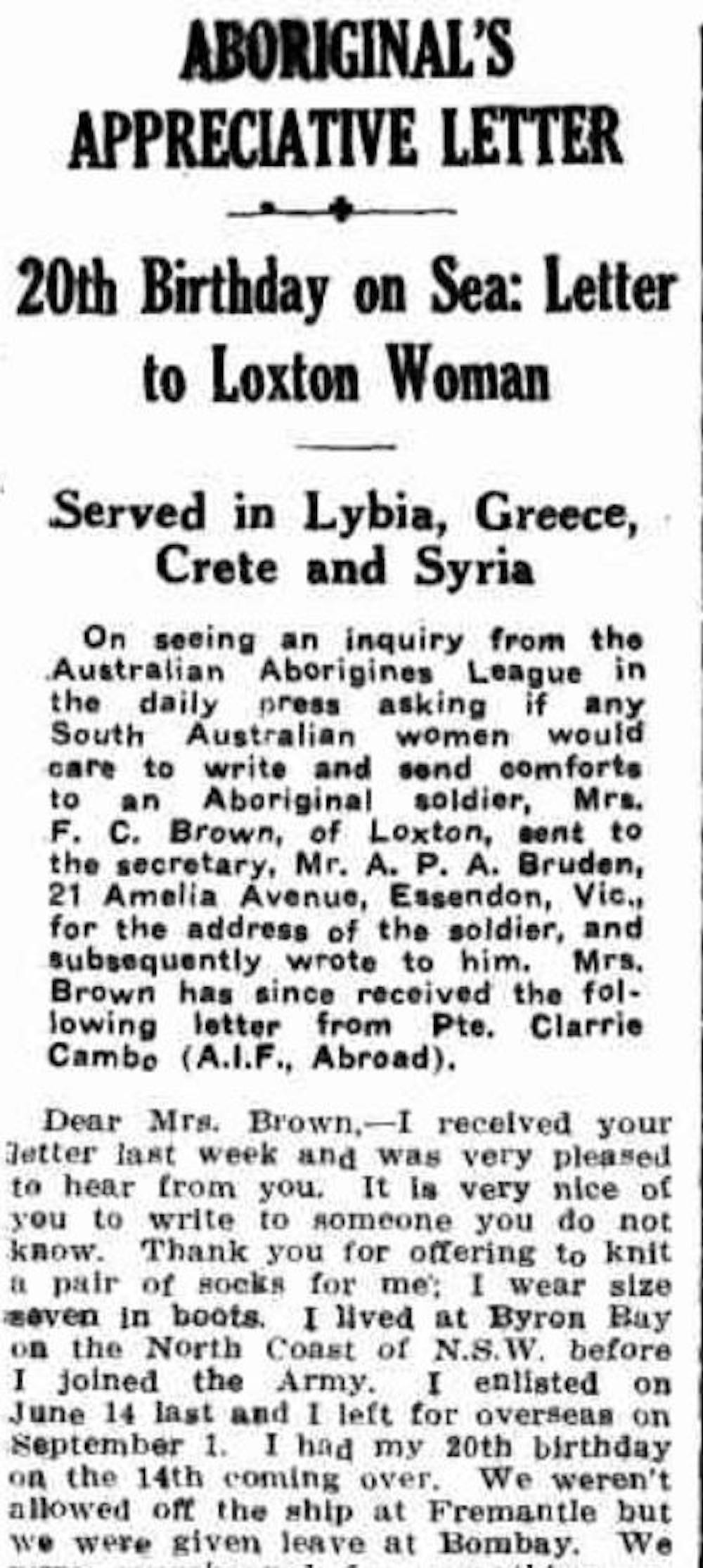 Aboriginal’s Appreciative Letter extract.
https://trove.nla.gov.au/newspaper/article/109261185
Aboriginal’s Appreciative Letter extract.
https://trove.nla.gov.au/newspaper/article/109261185
The young private’s letter provides a unique perspective on his experiences serving abroad. “I was in action for the first time in Greece,” he told his correspondent. He described Greece as “the nicest country that I have been in since leaving Australia”, then marvelled at having seen snow for the first time.
However the horrors of war included being “attacked practically every day by the German planes”. He told Mrs Brown how “a few of my pals were killed over there … There were German planes in the sky all day long and they were always bombing”.
What’s left out of correspondence can also be telling. In War Dance: A Story of the 2/3 Aust. Inf. Battalion A.I.F., Ken Clift provides an insight into racial attitudes amongst some of the men, telling of an altercation between two Australian soldiers, an Aboriginal one named Clarrie and an Indian or Afghan soldier, Tom. As the men argued heatedly, Tom allegedly called Clarrie: “You black bastard”. Clarrie was said to have retorted, “Well Tom, you’re no bloody glass of milk yourself.” Clarrie’s correspondence with Mrs Brown omits any mention of such tensions.
Welcome home
Over five years’ service, Clarrie’s tours of duty included Egypt, Libya, Greece, Crete, Syria, Sri Lanka (formerly Ceylon) and New Guinea. He suffered illness and injuries. In 1941 he caught sandfly fever, an ailment commonly suffered by soldiers fighting in North Africa. His “Proceedings for Discharge” notes that Clarrie received two war injuries, one to his right forearm and the other, a gunshot wound inflicted in New Guinea in June 1945, to his left forearm.
Clarrie’s war experiences included seeing some of his mates injured or killed. He would also have been expected to fire on enemy combatants. However, his correspondence with Mrs Brown, replete with anecdotes about foreign lands and peoples, highlights how being part of Australia’s war effort in the mid-20th century also gave him insights into other places and cultures.
Fortunately, Clarrie survived the war. He was one of five Aboriginal soldiers welcomed home to Wardell by the Cabbage Tree Island Women’s Guild just before Christmas 1945. By the mid-1960s Clarrie was chairing the Aboriginal Cooperative at Cabbage Tree Island and participating in national conferences advocating equal rights for Aboriginal people.
Authors: Kristyn Harman, Senior Lecturer in History; Graduate Research Coordinator, School of Humanities; Course Coordinator, Diploma of History, University of Tasmania
Read more http://theconversation.com/clarrie-combo-mrs-brown-and-aboriginal-soldiers-in-ww2-91643


















