

5 museum objects that tell a story of colonialism and its legacy
- Written by: Alistair Paterson, ARC Future Fellow, University of Western Australia
Two new Australian museums are emerging from old ones as the year draws to a close.
The new Chau Chak Wing Museum at the University of Sydney assembles rich collections from across the campus, and the WA Museum Boola Bardip (Noongar for “Many Stories”) has opened in Perth. Museums remain relevant in a globalised world where stories of objects and collecting connect people, institutions, places and ideas.
Our Collecting the West Project, in collaboration with the Western Australian Museum, the State Library of WA, the Art Gallery of WA and the British Museum, explores the history of collecting in WA since the late 1600s.
We are tracing the role of collecting in histories of empire, exploration and colonisation; the relations between natural history and ethnographic collecting; the role of state instrumentalities and private individuals; and the networks between them.
Here, we highlight five objects, some displayed in Boola Bardip’s Treasures Gallery, to reveal how they can provide us with insights into history, values, emotions and power.
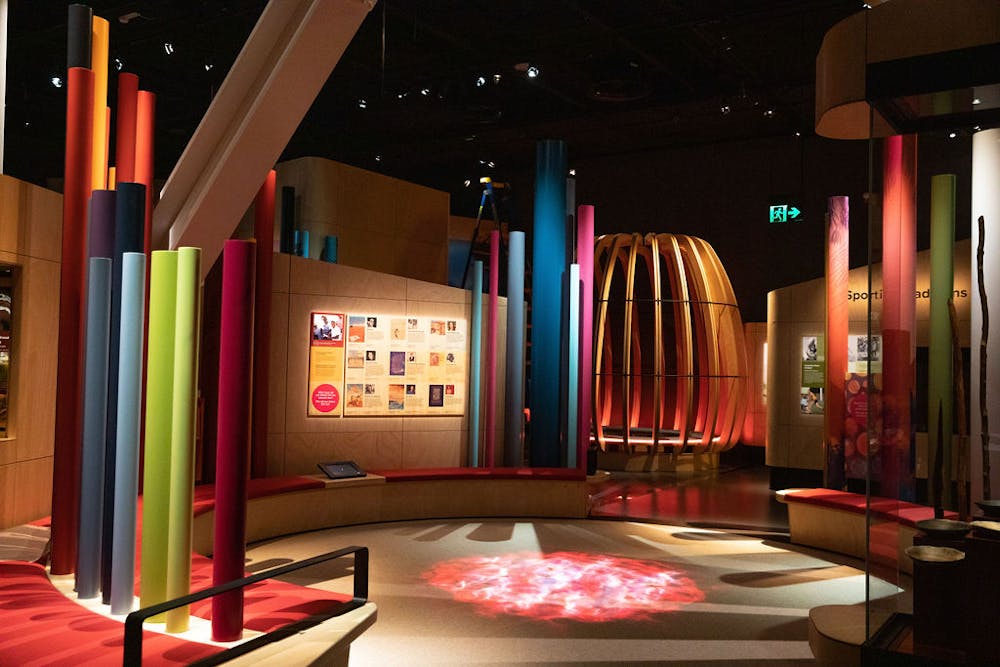 One of the new exhibition spaces, the Ngalang Koort Boodja Wirn gallery at Boola Bardip.
c Michael Haluwana Aeroture
One of the new exhibition spaces, the Ngalang Koort Boodja Wirn gallery at Boola Bardip.
c Michael Haluwana Aeroture
1. Everything was contemporary once — Corona Smoking Bucket, 2020
On March 26 2020, the WA government suspended tourist operations on Rottnest Island (Wadjemup) to support the government response to the pandemic. Australian citizens aboard the Vasco de Gama cruise ship were directed to be quarantined on the island from Monday March 30.
Whadjuk monitors Ben Ugle and Brendan Moore were on the island to support conservation works at the heritage site — a prison that once held Aboriginal people from all over WA, where many died.
The two Whadjuk men chose to perform a smoking ceremony for the island’s transition to pandemic quarantine facility. Smoking ceremonies are often conducted to cleanse a place spiritually, such as after a death, to welcome people, and as a sign of respect to people including past elders.
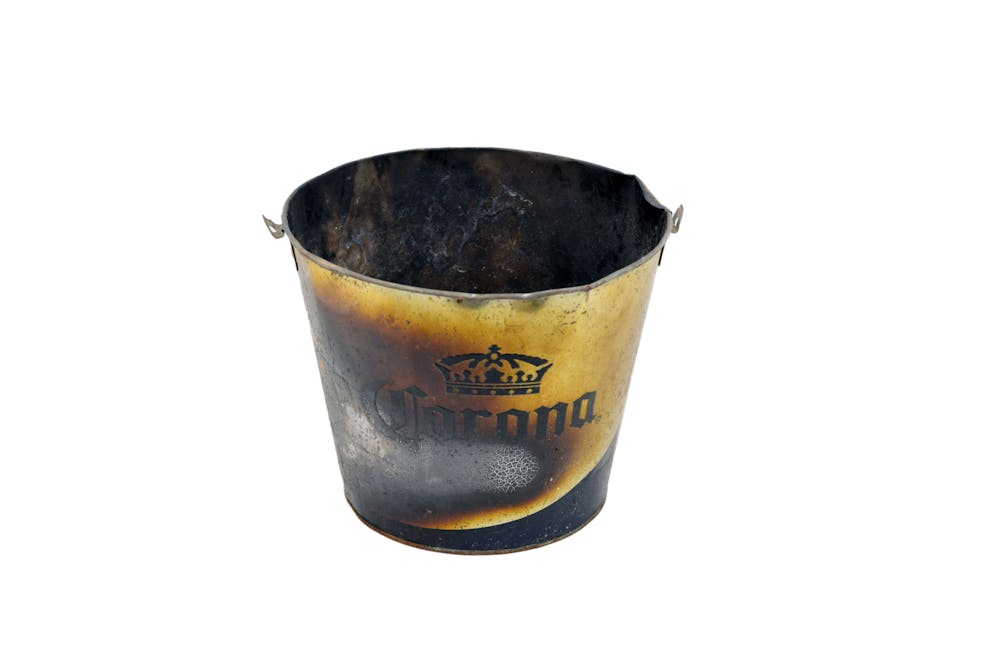 Corona Smoking Bucket: a metal beer bucket used for a smoking ceremony.
Courtesy of Wadjemup Museum Collection.
Corona Smoking Bucket: a metal beer bucket used for a smoking ceremony.
Courtesy of Wadjemup Museum Collection.
A metal tin was found for the smoking ceremony — given the unplanned nature of the event, the only suitable vessel they could find was a Corona beer bucket. Seeing the irony in the serendipitous use of this object, the “Corona Smoking Bucket” was collected for The Wadjemup Museum on Rottnest Island in March 2020.
Like many objects, this bucket symbolises several histories: the fact of its collection, the impact of a global pandemic at a local level, growing recognition of Indigenous cultural practices and the connection between an Indigenous smoking ceremony and the island’s dark history of Aboriginal incarceration (circa 1838-1931).
These histories compete also with the island’s later use — as the site of decades of annual school leavers’ celebrations, reflected in the presence of the Corona bucket.
Read more: Indigenous medicine – a fusion of ritual and remedy
2. Collections carry emotions — Shell, Shark Bay, 1820
This watercolour and ink drawing of a beautiful shell — the Volute ethiopienne — was drawn from a specimen brought back from Shark Bay in 1820 as part of the French Freycinet expedition. It can now be found in the State Library of Western Australia.
Shells from WA were prized for their beauty, part of the Enlightenment’s love affair with discovering the diversity of the natural world.
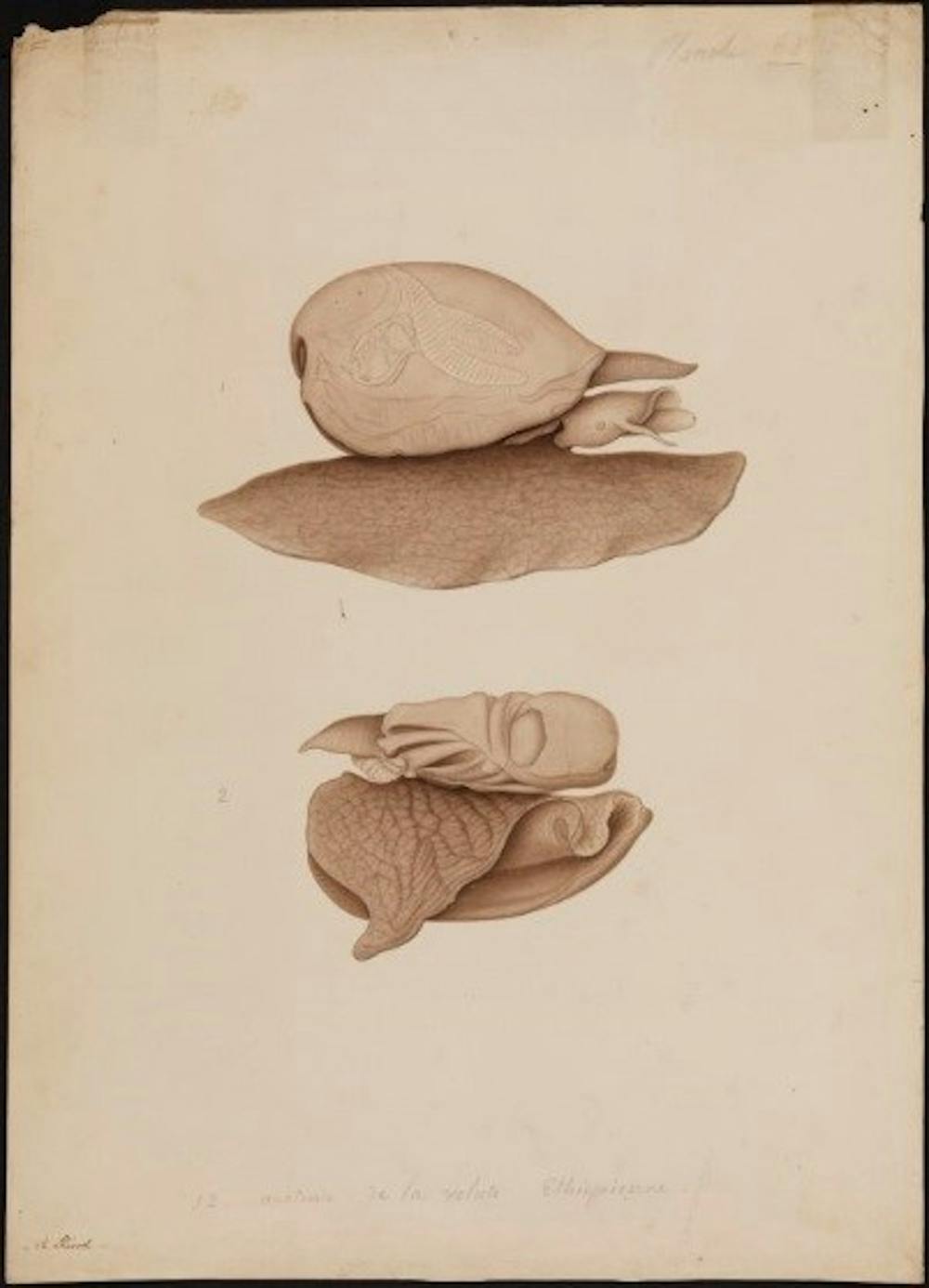 Drawing of Volute ethioienne specimen, Shark Bay, 1820. A. Provist.
Freycinet collections, State Library of Western Australia, ACC 5907A/12.
Drawing of Volute ethioienne specimen, Shark Bay, 1820. A. Provist.
Freycinet collections, State Library of Western Australia, ACC 5907A/12.
Aboriginal people have long valued shells for ornamentation and exchange. Shells were also attractive items for some of the earliest European explorers of the WA coast.
In 1697, for instance, Willem de Vlamingh, a Dutch sea captain working for the Dutch East India Company, collected a number of shells from Shark Bay, including a nautilus and a conch. He failed to find the shipwreck he was searching for, but helped to chart the coast. The English explorer William Dampier arrived in 1699 and some of the shells he collected in Shark Bay ended up in Oxford’s Ashmolean Museum.
French explorers followed. Nicolas Baudin’s expedition took a considerable number of shells back to Paris, where they can now be seen at the Museum National d'Histoire Naturelle.
In his journal of the Baudin expedition, the naturalist François Peron described a mussel he found on the shore:
Of all the species of mussels known so far, the one that I discovered [in Shark Bay] is incontestably the most beautiful. Stripped of its marine coating, it shines with the most vivid colours of the prism and precious stones; it is dazzling, if I may say so.
Read more: Friday essay: the voyage of Nicolas Baudin and 'art in the service of science'
3. Mokare’s place — Spear-thrower, King George Sound, (Albany), c.1831
This spear-thrower was collected by Alexander Collie, the government resident at King George Sound between 1831-33, who formed a close friendship with Menang Noongar man Mokare.
Such historic objects remind us that many collections of plants and objects were formed with the expert assistance of Aboriginal people who knew the land intimately.
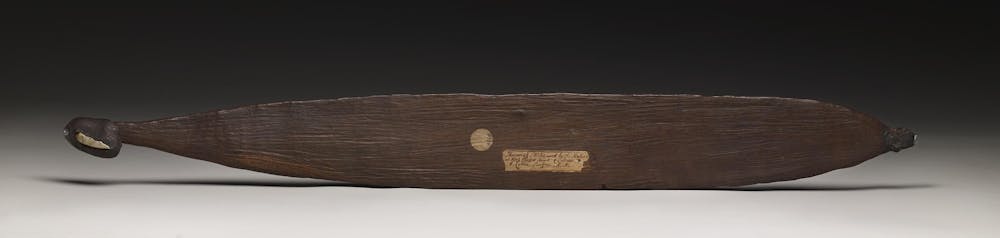 Spear-thrower, Albany.
British Museum, 1613225872
Spear-thrower, Albany.
British Museum, 1613225872
The spear-thrower also highlights how objects can embody moments of unexpected friendships, such as the close relationship that developed between Collie and Mokare. Mokare lived with Collie in his hut in the settlement of Albany in 1831, and when near death, Collie asked to be buried beside his friend.
Collie had worked as a naval surgeon and sent objects he collected back to the Royal Navy’s Haslar Hospital Naval Museum at Portsmouth, to assist in naval education. In 1855 the admiralty disbanded the museum, depositing the spear-thrower and other objects in the British Museum.
In 2016-2017, the spear-thrower, along with other objects collected by Collie, returned to Albany to be displayed in the Yurlmun exhibition, which focused on the meaning of these collections to Menang Noongar people today. Despite these objects being only a temporary loan from the British Museum (where they are now in storage), the Menang people viewed their arrival as a “return home to country”.
The objects collected by Collie point to the role of the Royal Navy as a key network of colonisation; the agency of individual Aboriginal people in processes of colonial collection and the potential of these collections to highlight not only the role played by Indigenous people such as Mokare but also the cultural knowledge contained in the objects themselves.
 A portrait of Mokare by Louis de Sainson (1833).
Wikimedia Commons
A portrait of Mokare by Louis de Sainson (1833).
Wikimedia Commons
A much earlier collection of weapons, also from Albany, hints at the complexity of collecting practices undertaken within colonial contexts. A Royal Navy surveying expedition, captained by Phillip Parker King, visited King George Sound in December 1821. The crew were engaged with the Menang people in a prolonged and intimate trading exchange for two weeks. In exchange for ships’ biscuit, the crew collected:
one hundred spears, thirty throwing sticks, forty hammers, one hundred and fifty knives and a few hand-clubs.
By contrast, at Hanover Bay on today’s Kimberley coast, a few months earlier, a cache of Worrorra weapons and artefacts were taken as a retaliatory theft for the spearing of the crew’s surgeon.
The crew members related this theft in their journals with the language of revenge: “taking possession of”, “riches”, “spoil”, “prize” and “treasure”, where they took pleasure in “capturing” an Aboriginal “depot”.
These collecting moments reveal different kinds of intimacies — of friendships and violence, trade and exchange — that occurred during early coastal encounters. They also explain why there is no early material from WA in Western Australian collections — most went to Britain as a result of these imperial networks.
4. Colonialism never dies — Wooden dish, Broome, pre 1892
This small wooden bowl carries a history that hints at the role of colonial state instrumentalities in collecting. It is part of a large collection at the WA Museum known as the Phillips Collection.
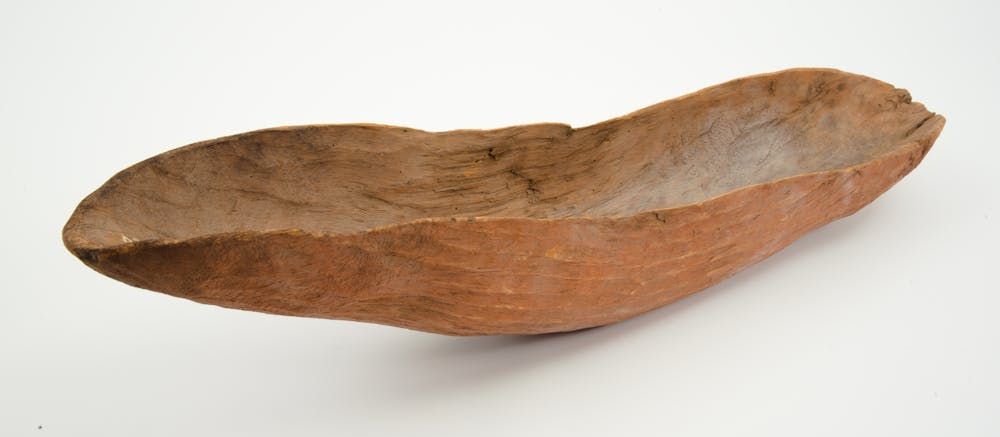 Wooden dish from Broome, pre-1892, made by Yawuru people, presented by the Commissioner of Police to the WA Museum.
Courtesy of the WA museum
Wooden dish from Broome, pre-1892, made by Yawuru people, presented by the Commissioner of Police to the WA Museum.
Courtesy of the WA museum
George Braithwaite Phillips was the commissioner of police between 1887-1890. His family was amongst the first colonists to emigrate to the Swan River Colony (now Perth), coming from Barbados, where they owned sugar plantations.
Phillips had been a high profile civil servant and the commandant of the Western Australian Military Forces. From those positions he was able to commandeer a large network of policemen throughout the colony to collect both Aboriginal material culture and human remains.
Many of the Aboriginal objects collected by police, though not the ancestral human remains, were displayed at International Exhibitions in Paris, Glasgow and Melbourne.
Read more: The violent collectors who gathered Indigenous artefacts for the Queensland Museum
The collection, which included this bowl from Broome, made by Yawuru people, helped form the new Western Australian Museum and Art Gallery in 1894. (The bowl can now be seen at WA Museum Boola Bardip.)
Bernard Woodward, the museum’s first director, continued to ask Phillips for help in sourcing both ethnographic objects and human remains, many of them destined to be exchanged for natural history specimens and ethnographic material from other parts of the world.
So, this bowl is a powerful object. It speaks to Aboriginal cultural practices, the police as active agents of colonisation, and the complex terrain of colonial encounters and their aftermath that form part of the museum’s own inheritance — now slowly being addressed in consultation with relevant communities.
5. Collections are commodities — Red figure hydria, 350-320BC
This red figure vase (circa 350-320BC), probably from Bari — then a Greek colony — was, according to the museum’s first art and craft register, given by Professor E H Giglioli in 1902. Giglioli (1845-1909) was the Director of the Museo Zoologico in Florence — a zoologist and anthropologist remembered as the father of Italian science.
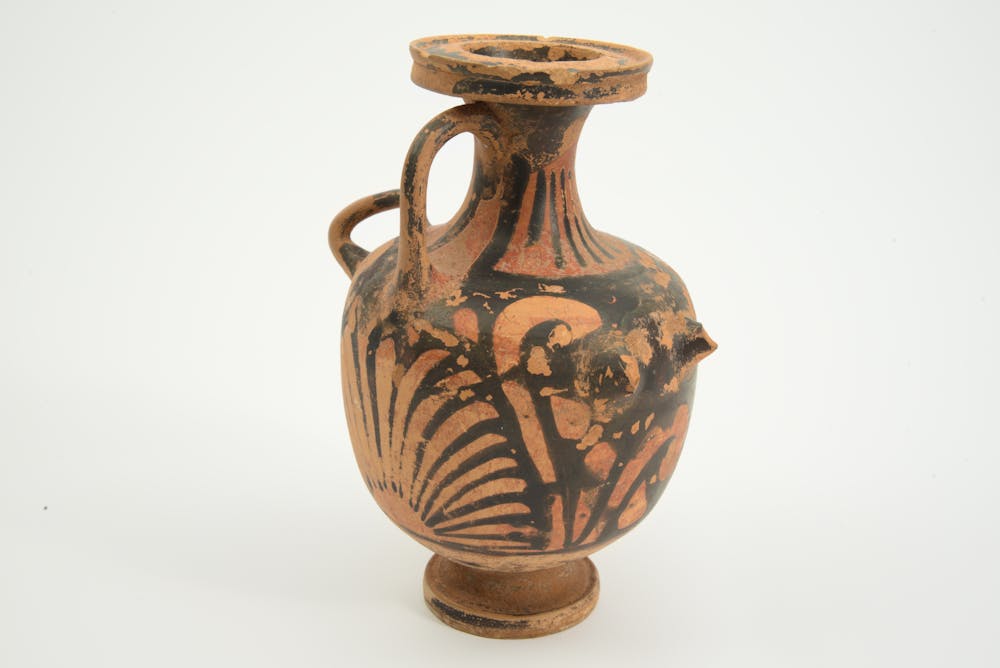 Red figure hydria (water jar), Bari, Apulia, southern Italy.
Courtesy of the WA Museum.
Red figure hydria (water jar), Bari, Apulia, southern Italy.
Courtesy of the WA Museum.
He visited Australia in 1867, writing a book on Australian Aboriginal people. Giglioli understood the uniqueness of WA’s flora and fauna, seeking valuable specimens with which to build his own collection and to trade for other specimens from elsewhere in the world.
Giglioli sent Roman and Etruscan antiquities he acquired in Italy to Perth in exchange for natural history specimens, human remains and ethnographic material.
Collections circulated through collecting institutions, often exchanged or bartered. Giglioli exchanged the WA material with the Smithsonian Museum.
In Australia, antiquities from Europe had their own rarity value. Widely understood as the foundation of Western culture and aesthetics, antiquities were hard to come by in colonial society.
In 1904, Woodward wrote:
it is of paramount importance that the local craftsmen should have good examples to study, in order that they may successfully compete with their fellows in the older centres of civilisation.
The notion of civilisation was especially important in a young nation. Colonial societies, wanting to demonstrate their rightful place amongst civilised societies, often purchased copies of originals.
So it is not surprising Woodward wanted to exchange Western Australian natural history and ethnographic specimens for objects representing the high end of European artistic production or material representing the birth of European civilisation.
This was part of his effort to educate Western Australians into what they thought was the best that Western civilisation offered.
While this was a way for museums around the world to build their collections, it also involved practices that are totally discredited today and which many find deeply distressing. It is important to know about this history and address its legacies.
The collections made by early explorers and settlers, sometimes in collaboration with Indigenous peoples, are important for their role in the development of knowledge about WA, opening up areas of scientific discovery and knowledge about First Peoples, the richness of the state’s flora and fauna and our shared historical experiences.
They are also tangible symbols of colonialism and its legacy today.
Authors: Alistair Paterson, ARC Future Fellow, University of Western Australia


















