

The royal commission report on the Christchurch atrocity is a beginning, not an end
- Written by: Kris Gledhill, Professor of Law, Auckland University of Technology
When a terrorist kills 51 people and attempts to kill many others, a government has to do two things — ensure the responsible people and institutions are held accountable, and make changes to reduce the risk of another atrocity.
The basis of this obligation rests in human rights law: the state has a duty to protect its citizens from arbitrary loss of life. Royal commissions can investigate whether that duty has been breached.
It is important to acknowledge, however, that reports such as that just released publicly by the Royal Commission of Inquiry into the Terrorist Attack on Christchurch Mosques are part of a process, not an ending.
The report made 44 recommendations, covering improvements to counter-terrorism, firearms licensing, social cohesion and support for those affected by atrocities. It also recommended new laws be created for crimes motivated by hate and the planning of atrocities.
The government has accepted all the recommendations “in principle”, which makes it clear these are a starting point for further discussion.
The government has also apologised for the failures of intelligence and policing. But, from a human rights perspective, several things still merit review: the commission process, its recommendations for the future, and its findings of fact.
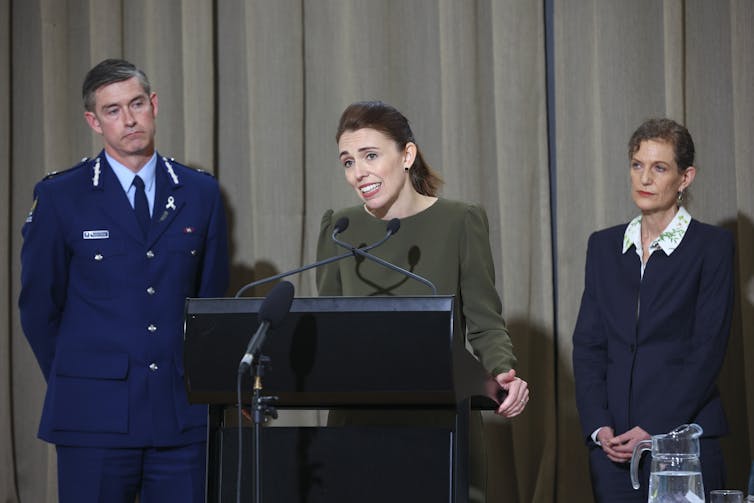 Apologies: Prime Minister Jacinda Ardern with Police Commissioner Andrew Coster and Director-General of Security Rebecca Kitteridge respond to the release of the royal commission report, December 8 2020.
GettyImages
Apologies: Prime Minister Jacinda Ardern with Police Commissioner Andrew Coster and Director-General of Security Rebecca Kitteridge respond to the release of the royal commission report, December 8 2020.
GettyImages
Moral and legal challenges
The duty to investigate potential state fault when there is an atrocity or disaster is owed primarily to the families of the deceased and those who were put at risk. They must be core participants in the process.
So we should listen carefully to the views of those directly affected, including the wider Muslim community, which had concerns from the outset about the commission’s terms of reference.
While the commission involved a Muslim Community Reference Group, its main function was compiling and assessing written and oral evidence. The two commissioners, with counsel assisting and a secretariat, led this process. But could more have been done, such as ensuring the team included a lawyer tasked with representing the direct victims?
Politically, there will be challenges in enacting some of the commission’s recommendations, too. New hate-based crimes might be opposed on the basis that bigoted motivations can already be raised as aggravating factors at sentencing.
Similarly, extending hate speech regulation will come up against the argument that undiluted free speech is the best counter measure.
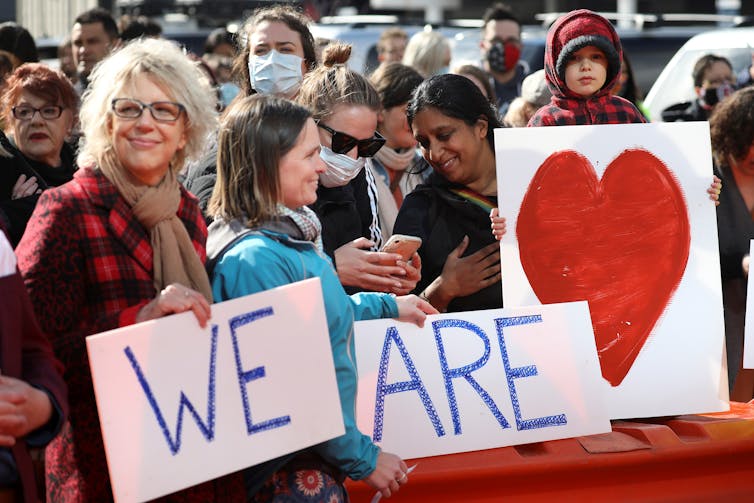 During the killer’s sentencing hearing, people gathered outside the Christchurch High Court to support relatives of the victims.
GettyImages
During the killer’s sentencing hearing, people gathered outside the Christchurch High Court to support relatives of the victims.
GettyImages
Does the commission go far enough?
The commission is on solid ground with its view that separate hate speech offences are appropriate. Only by monitoring the extent of the specific problem can we hope to form the right policies.
Moreover, the international post-World War II consensus on hate speech created an obligation to prohibit the advocacy of hatred by inciting hostility or discrimination on the basis of nationality, race or religion.
At the moment, New Zealand is simply not compliant with this because our law doesn’t criminalise inciting hostility based on religion.
Read more: No rehab and little chance of appeal for the Christchurch terrorist jailed for life without parole
Even so, does this go far enough? If there is evidence that hostility arises also from sexuality, disability or any other grounds, should we not take this opportunity for wider reform?
What should have been known?
Just as the commission’s recommendations for change are not set in stone, nor are its conclusions of fact. Hence, questions of accountability remain open.
Of course, the state’s duty to protect life cannot always overcome the sheer unpredictability of human behaviour. But terrorism has a long history and is far from an unknown quantity. It is one reason we fund intelligence agencies and hand them significant powers to monitor, collect information and infiltrate in order to defuse potential tragedies.
Importantly in this context, the question about systemic fault must reflect not only what was known, but what should have been known.
The fact the police and Security Intelligence Service had not informed themselves adequately about the threat of right-wing terrorism is worrying. Does that lack of focus mean the duty to protect life was not carried out properly?
The end of the beginning
Related to this is the assertion that “scarce counter-terrorism resources” contributed to intelligence failures. The human right to life should not be compromised by inadequate funding. Did austerity play a role in state agencies being unprepared to protect lives?
There is an echo here of the earlier Royal Commission of Inquiry on the Pike River Coal Mine Tragedy. It found the Mine Inspectorate was under-resourced for its role, and the government did not prioritise health and safety.
In this wider context, then, the publication of the Christchurch commission report is an important milestone. But just as we must discuss its recommendations, we must also be able to questions its findings.
It cannot be an end, but must be treated as another step in an important process that we must get right.
Authors: Kris Gledhill, Professor of Law, Auckland University of Technology


















