

Vic, QLD and NSW are managing COVID outbreaks in their own ways. But all are world-standard
- Written by: Hassan Vally, Associate Professor, La Trobe University
It hasn’t been the start to 2021 many of us wanted. In the past three weeks Victoria, Queensland and New South Wales have dealt with fresh COVID outbreaks, but it’s worth remembering each have faced unique challenges, and tackled them in different ways.
Despite their differences, however, all three have been clear about their intention to aggressively suppress transmission, and all have been effective in their responses.
Significant challenges remain, including the vexed issues of how we define hotspots, manage state borders and deal with threats posed by new COVID strains. And of course, how we deliver the vaccine en masse.
But triumphing over the challenges we’ve faced over the past few weeks should give us confidence as we move to the next phase of the pandemic.
Queensland’s precautionary approach
Queensland’s strategy was clear, decisive, and well articulated. As health authorities explained, the Greater Brisbane lockdown was a circuit breaker aimed at limiting interaction and buying time. This allowed contact tracers to do their job and authorities to learn more about the nature of the outbreak.
The fact it involved a new, more transmissible strain posed a significant threat. And it wasn’t clear, at first, how many chains of transmission had been initiated by the hotel quarantine cleaner who tested positive for it.
This was no doubt a cautious response informed by the precautionary principle. Given what was at stake, it was justified.
Greater Brisbane’s three-day lockdown ended at 6pm Monday night, and Queensland has recorded just one case of community transmission in the last four days — the partner of the cleaner, who has been in quarantine since January 7 (though could have been infectious in the community for two days prior).
The threat seems to have been averted for now.
We need to wait out the full incubation period for the cleaner’s more than 350 close contacts to see if there are any more cases connected to her, though all of these contacts are in quarantine, and so pose no threat to the broader community.
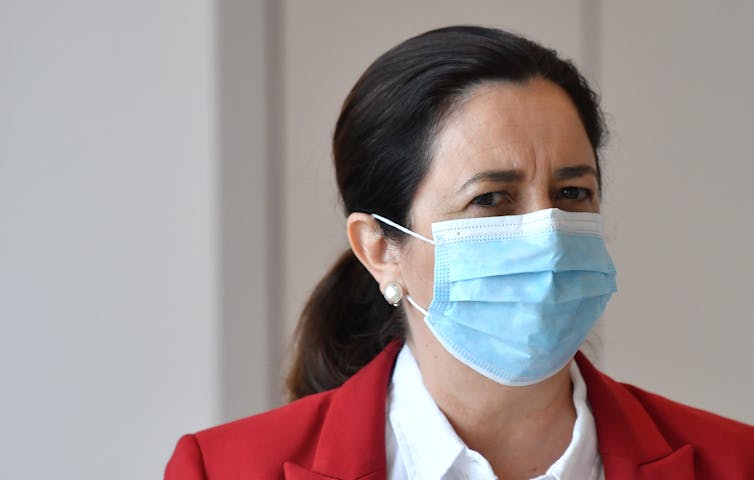 Queensland’s decisive lockdown was justified amid the presence of a more transmissible strain.
Darren England/AAP
Queensland’s decisive lockdown was justified amid the presence of a more transmissible strain.
Darren England/AAP
Victoria showcased its improvement
The Black Rock cluster in Victoria posed a significant risk and required an equally decisive response. It didn’t represent the level of threat Victorians faced at the beginning of its second wave, but given it occurred during Christmas and New Year’s plus the scars Victorians carried from the second wave, the threat couldn’t be underestimated.
Read more: Dear Australia, your sympathy helps, but you can't quite understand Melbourne's lockdown experience
The response to this cluster was rapid and decisive. It allowed the Victorian health department to showcase just how much their response capacities had improved in the previous six months. It was incredibly reassuring to see how quickly the public health team was able to establish links, and how quickly they were able to identify contacts of contacts in order to block chains of transmission.
It was a test they passed, and with six consecutive days of no locally acquired COVID cases, Victorians can breathe a collective sigh of relief — for now at least.
While the rapid closing of the border to NSW was an important element of the response, I remain uncomfortable with the scenes we witnessed at the borders, and the notion of Victorian residents being locked out of their homes. I hope that, as we have seen over the previous 24 hours with the new “traffic light” travel system, the government can continue to refine the way it handles this issue.
New South Wales less risk-averse
New South Wales has always appeared to have a greater tolerance for risk when it comes to COVID than other states. Its response has been characterised by a “test, trace and isolate” approach and a reticence to lock down huge areas of Sydney. Lockdowns have been localised and relatively brief.
Many restrictions, however, are still in place — residents of Greater Sydney, Central Coast and Wollongong, for example, can still only have five visitors to the home, including children, and masks are now compulsory in many places. Hotel quarantine remains a vulnerability and refinements continue to be made, in NSW and elsewhere.
Despite its challenges, time and time again the state has shown it can keep virus transmission under control.
The situation it faced with multiple new clusters over the past three weeks could be considered one of its biggest tests. And for the most part, the state seemed to have a reasonable understanding of chains of transmission.
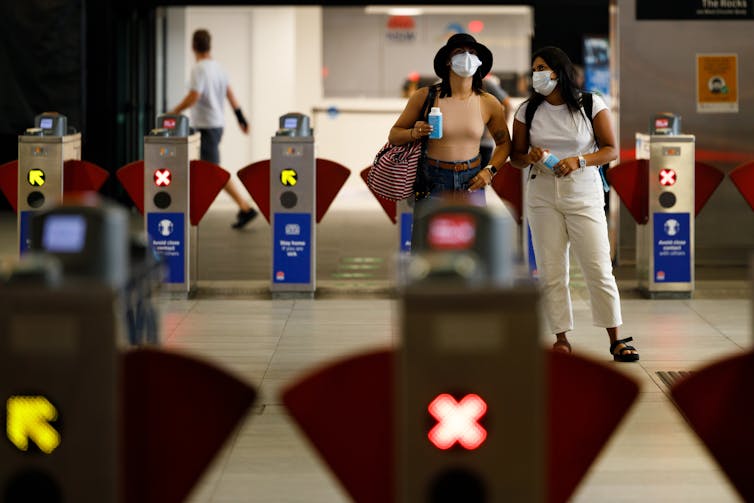 In January, NSW adopted a mandatory mask rule indoors for the first time since the pandemic began. But for the most part, the state has relied on intense contact tracing.
Paul Braven/AAP
In January, NSW adopted a mandatory mask rule indoors for the first time since the pandemic began. But for the most part, the state has relied on intense contact tracing.
Paul Braven/AAP
The way authorities respond to threats must be proportionate, but it’s as much an art as it is a science. Judgement calls must be made, and striking the right balance is not easy when uncertainty is high and luck plays such a huge part.
NSW has seemed to walk this line successfully so far. The latest outbreak did call for more aggressive measures such as a targeted lockdown in the Northern Beaches and the introduction of mandatory mask wearing. Along with testing, tracing and isolating, this has helped bring transmission rates under control.
On the downhill run to the end of this pandemic
There’s still a way to go in the fight against COVID. But unlike other parts of the world, Australia is on the downhill run to the end.
As much as we should be thankful for the good leadership shown by those making decisions, the real thanks is to the community, who have followed the rules and made huge sacrifices to get us where we are now.
Although we will face many challenges over the next year, Australia remains one of the shining lights in the fight against COVID. We are seeing the benefits of our sacrifices now, and will continue to see them for many years to come.
Authors: Hassan Vally, Associate Professor, La Trobe University


















