

the COVID work revolution has increased digital overload
- Written by: Olga Kokshagina, Researcher - Innovation & Entrepreneurship, RMIT University
Are too many online meetings and notifications getting you down?
Online communication tools – from email to virtual chat and video-conferencing – have transformed the way we work. In many respects they’ve made life easier. Without them we could not have made the shift to remote working during the COVID pandemic.
But are we now overly connected?
I and my colleagues have interviewed 120 experts from around the world to get a handle on the effects of 2020’s working-from-home revolution.
What they told us suggests the desire to compensate for the lack of physical interaction is compounding digital overload – the phenomenon that technology researchers Larry Rosen and Alexandra Samuel described in the Harvard Business Review way back in 2015 as perhaps “the defining problem of today’s workplace”.
As Rosen, a pioneer in the “psychology of technology”, explains in The Distracted Mind: Ancient Brains in a High-Tech World, his 2016 book co-written with neuroscientist Adam Gazzaley, our brains have not evolved for media multitasking.
So many technological innovations have enhanced our lives in countless ways, but they also threaten to overwhelm our brain’s goal-directed functioning with interference. This interference has a detrimental impact on our cognition and behaviours in daily activities. It impacts every level of our thinking, from our perceptions, decision making, communication, emotional regulation, and our memories.
This interference is increasing as we embrace ever more tools that facilitate virtual communication and collaboration, always “on” and in touch through a barrage of messages and notifications.
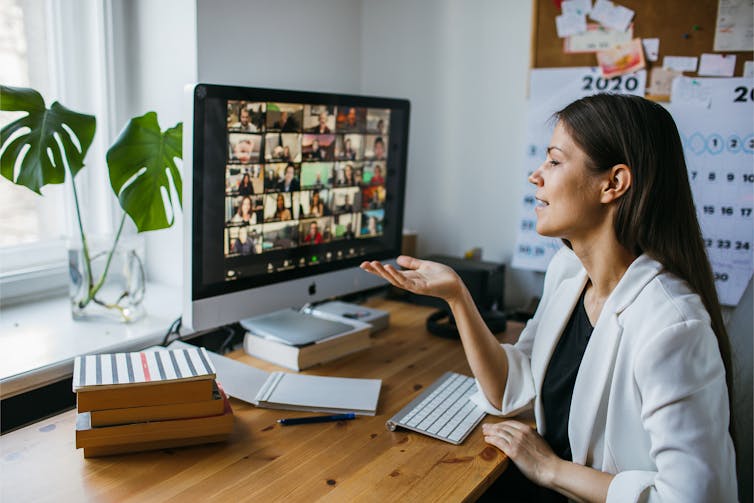 The desire to compensate for the lack of physical interaction is compounding digital overload.
Girts Ragelis/Shutterstock
The desire to compensate for the lack of physical interaction is compounding digital overload.
Girts Ragelis/Shutterstock
Read more: Vital Signs: Shorter meetings but longer days – how COVID-19 has changed the way we work
Using nine tools a day
Our research is part of a global project on the future of work and education involving 14 university, corporate and non-profit partner organisations.
We interviewed managers in the private sector (from start-ups to corporations), the public sector and academia. We talked to each for an a hour about how their work environments had been affected by the pandemic, and how they imagine the future.
Almost all agreed digital overload had increased due to too many digital tools, too much information and too many hours spent in online conferencing.
On average, they reported using nine collaboration and communication tools every day. If that seems excessive, count how many you use. More than likely you have software for writing, email, instant message, calendars, file sharing, conferencing, work organisation and password management. That’s nine just there.
Read more: With management resistance overcome, working from home may be here to stay
More online fatigue
Our respondents also reported increased fatigue from being online all the time, and from being expected to send and respond to messages. As one of interviewee put it, the old problem of lack of information has been overtaken by how to keep up with all the information we are expected to take in and provide.
Online meetings were cited as particularly exhausting. This concurs with research showing the demands of constantly observing ourselves as performers leads to “Zoom fatigue”.
Read more: Hide self: one tip on video conferencing good enough for Matthew McConaughey
3 tips to manage digital overload
You may not have much influence over the number of tools you use. But you can control how you use them. The key is to reduce “goal interference” – anything that interrupts or distracts you from the task in front of you.
Here are three simple principles to manage the load.
1. Switch between tasks less often
Research shows the idea of multitasking is a myth. Maybe we can cope with two things at time, such listening to music while working. But for any task requiring focus we have to make a cognitive switch. Studies show the more we switch, the worse we get at focusing on what’s relevant to the task before us. Make fewer switches to maximise your ability to filter out interference from thoughts about other tasks.
2. Schedule set times for regular tasks
Behavioural experiments show those who check emails just a few times a day report lower stress than those who constantly check throughout the day. Make the effort to do related tasks in set times blocks (say 30 minutes). Give yourself the opportunity to really concentrate. Switch off unnecessary notifications and other distractions.
3. Limit unnecessary communication
Sharing information is important – knowledge is power, after all. But too much information becomes just another distraction. As another adage goes, data isn’t information, information isn’t knowledge, knowledge isn’t understanding, and understanding isn’t wisdom. Information in the digital age is a bit like food. Tens of thousands of years of scarcity has conditioned us to crave it. But abundance means we have to consciously check ourselves from consuming too much.
Changing work culture
These three tips are far from a complete solution, of course. As our interviewees underlined, addressing the problem of digital overload at work requires radical reflection on the temptations of technology – including thinking yet more technology will solve the problem.
Read more: 50 years of bold predictions about remote work: it isn't all about technology
There have been many lessons to learn from 2020.
From our unplanned leap into a work future long predicted would come from digital technology, we have the opportunity to understand the pain points. We’ve had a technological revolution in workplace communication and collaboration. Now must come a cultural revolution.
Authors: Olga Kokshagina, Researcher - Innovation & Entrepreneurship, RMIT University


















