

COVID killed the on-campus lecture, but will unis raise it from the dead?
- Written by Shelley Kinash, Professor of Higher Education, University of Southern Queensland
Throughout the world, COVID-19 health regulations have made the on-campus lecture mostly defunct. And most Australian universities won’t be offering on-campus lectures in 2021.
The Australasian Council on Open, Distance and e-Learning (ACODE) recently published a white paper on lectures, based on survey responses from 43 member universities (91% response rate). About two-thirds indicated they would not be conducting on-campus lectures this year.
University of Southern Queensland (USQ), for example, sent a document to all staff and students announcing on-campus classes, such as tutorials, lab work and small-group seminars, will continue in 2021, with the notable exception of the traditional lecture. At USQ, when didactic content does need to be delivered, it will be done online, in smaller chunks, with student learning activities interspersed.
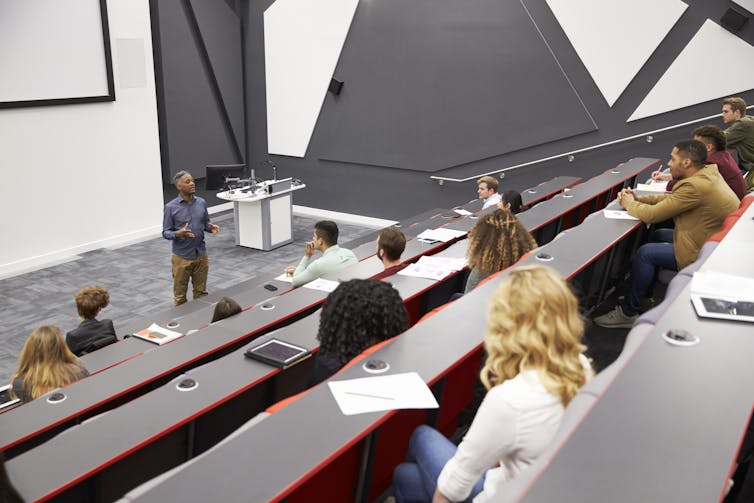 Traditional lectures are often poorly attended and several universities have already decided to abandon them permanently.
Shutterstock
Traditional lectures are often poorly attended and several universities have already decided to abandon them permanently.
Shutterstock
Read more: Videos won't kill the uni lecture, but they will improve student learning and their marks
The lecture was ailing before COVID
Now that COVID-19 has forced universities to cease on-campus lectures, many report that they will not return after the pandemic. Only 23% of ACODE-surveyed universities said they would return to full lecturing.
Times Higher Education reported last month that Curtin, Murdoch and Victoria universities believe in-person lectures are a mode of the past.
Some universities started “killing off” lectures long before the pandemic. In 2012, for example, The Conversation reported the University of Technology Sydney (UTS) was tearing down its lecture theatres.
Many new and redesigned tertiary campuses are not including blueprinted lecture theatres. The University of Tasmania, for example, is in the process of creating the Inveresk Precinct with non-traditional teaching and learning spaces.
Read more: 5 tips on how unis can do more to design online learning that works for all students
Why are lecture theatres on the way out?
Mostly this is happening because there are better ways to learn and to prepare for employment. In 2014, UTS explained its rationale for demolishing lecture theatres was not physical, but educational.
For universities, a primary reason for cancelling lectures is to improve pedagogy or teaching methods. In the ACODE survey, only 7% disagreed with this rationale.
Times Higher Education reported that, by 2013, more than 700 studies had all found lectures are an ineffective teaching approach. There is little empirical evidence to prove that lectures are an optimal way to learn or to develop graduate career skills.
Lectures are passive. They seldom get students to do anything, beyond listening and perhaps taking notes. Lectures fail to foster deep learning and student engagement. The purpose of the lecture is called into question.
Australian students have been voting with their feet. They have continually chosen to forgo lectures, preferring content delivered online.
This learning mode particularly appeals to mature-aged students, who are working while studying and have difficulty fitting long lecture blocks into their schedules. And this description fits a high proportion of university students today.
 University students with busy schedules clearly prefer to engage with much of the traditional lecture content online.
fizkes/Shutterstock
University students with busy schedules clearly prefer to engage with much of the traditional lecture content online.
fizkes/Shutterstock
Read more: Lecture recordings mean fewer students are turning up – does it matter?
Are students or employers concerned?
Early in the pandemic (June through September 2020), i-graduate conducted a survey of Australian domestic and international students. Of the 24,000 respondents, 70% were satisfied with how the universities adapted to COVID-19 and 68% with their overall online learning experience.
While students expressed current satisfaction with online lectures (about 70%), only half thought they should remain. Notably, students were not surveyed about their preference for the online recorded long-form lecture versus alternatives.
A recent FutureLearn survey of just over 1,000 American employers asked: “Are you more likely to hire applicants with online education since the pandemic?” While 75% responded yes, 63% said they would need to “rethink” the hiring process.
But how will students learn what they need to know?
The questions within these surveys are asked in a Shakespearean binary: to lecture, or not to lecture. On-campus or online. The reality is not so simple.
Lectures are not the only approach to university education. Furthermore, the choice of on-campus or online learning is now mostly redundant.
All students spend a lot of their time within online “learning management systems”. Even before the pandemic, curriculum without an accompanying website was rare.
The lecture is still the lecture, whether on-campus, or recorded and posted online. The lecture does not teach any better just because it is digital.
Searching for, planning and booking travel is flourishing online (or at least it was during non-pandemic times). Streaming services have radically changed how people watch television. It is time for universities to catch up to other industries and take full advantage of the opportunities of the internet.
Read more: Universities need to train lecturers in online delivery, or they risk students dropping out
It might be time to let the lecture die, now that other modes of learning and interactions (pedagogies) can thrive.
The University of Southern Queensland, for example, is rolling out a suite of alternative teaching approaches. Most of these are available online. Examples include panel discussions, animated explanations, online experimentation, problem-solving demonstration videos and website hunts.
Such approaches are a sign of the nature of educational change brought forward by the pandemic, which was perhaps long overdue in the higher education sector.
Authors: Shelley Kinash, Professor of Higher Education, University of Southern Queensland

















