

Renewables need land – and lots of it. That poses tricky questions for regional Australia
- Written by: Bonnie McBain, Lecturer, University of Newcastle
Renewable energy capacity in Australia is expected to double, or even triple, over the next 20 years. There is one oft-overlooked question in this transition: where will it all be built?
Many renewable energy technologies need extensive land area. Wind turbines, for instance, cannot be located too close together, or they won’t work efficiently.
Some land will be in urban areas. But in the transition to 100% renewable energy, land in the regions will also be needed. This presents big challenges, and opportunities, for the farming sector.
Two important factors lie at the heart of a smooth transition. First, we must recognise that building renewable energy infrastructure in rural landscapes is a complex social undertaking. And second, we must plan to ensure renewables are built where they’ll perform best.
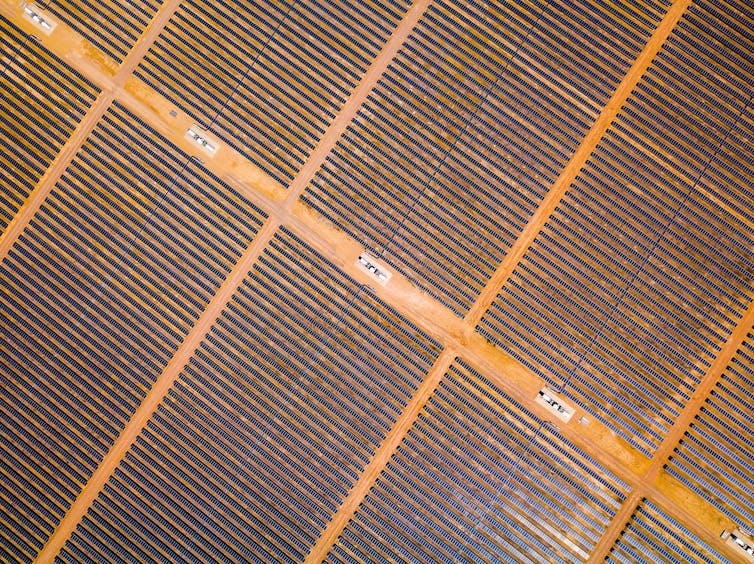 Australia’s renewable energy expansion will require plenty of space – most of it in the regions.
Shutterstock
Australia’s renewable energy expansion will require plenty of space – most of it in the regions.
Shutterstock
Bringing renewables to the regions
My research has examined how much land future energy generation will require, and the best way to locate a 100% renewable electricity sector in Australia.
A National Farmers Federation paper released last week called for a greater policy focus on renewable energy in regional Australia. It said so-called renewable energy zones should “be at the centre of any regionalisation agenda” and that this would give the technology a competitive advantage.
Hosting renewable energy infrastructure gives farmers a second income stream. This can diversify a farming business and help it withstand periods of financial pressure such as drought. An influx of new infrastructure also boosts regional economies.
But successfully integrating renewables into the agricultural landscape is not without challenges.
A wicked problem
Renewable energy enjoys widespread public support. However its development can lead to social conflicts. For example, opposition to wind wind farms, often concentrated at the local level, can be motivated by concerns about:
- perceived health impacts
- changes to the landscape
- damage to wildlife
- loss of amenity
- reduced property values
- procedural fairness.
A proposed A$2 billion wind energy development on Tasmania’s King Island shows the difficulties involved in winning community support. The project was eventually scrapped in 2014, for economic reasons.
Research showed how despite the proponents TasWind using a “best practice” mode of community engagement, the proposal caused much social conflict. For example, the holding of a vote served to further polarise the community, and locals were concerned that the community consultation process was not impartial.
Read more: Against the odds, South Australia is a renewable energy powerhouse. How on Earth did they do it?
The local context was also significant: the recent closure of an abattoir, and associated job losses, had increased the community’s stress and sense of vulnerability. This led some to frame the new proposal as an attempt by a large corporation to capitalise on the island’s misfortune.
The King Island experience has all the hallmarks of a “wicked problem” – one that is highly complex and hard to resolve. Such problems are common in policy areas such as land-use planning and environmental protection.
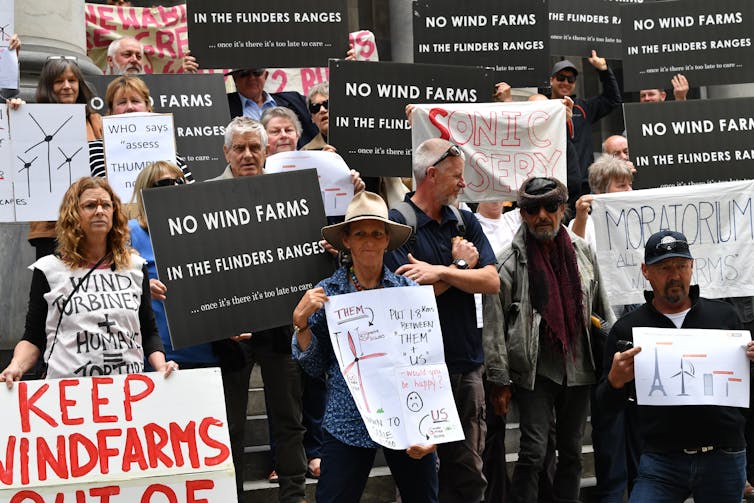 Achieving community consensus on wind farm developments can be challenging.
Daniel Mariuz/AAP
Achieving community consensus on wind farm developments can be challenging.
Daniel Mariuz/AAP
Wicked problems typically involve competing perspectives and interests. Often, there is no single, correct solution that works for everyone. For example at King Island, the abattoir closure did not mean all locals considered the wind energy proposal to be the answer.
When seeking to address complex policy problems, such as building renewable energy in regional areas, the best approach involves:
- collaboration between all affected parties, including people beyond the property where the infrastructure will be located
- relationship-building between all those involved, to allow each to see the other’s perspective
- shared decision-making on whether the infrastructure will be built, and where.
Competition for land is intensifying around the world, especially as the population grows. High consumption levels in the West require ever-more land for resources such as food, and land degradation is rife.
To help alleviate this pressure, renewable energy developments may need to co-exist with other land uses, such as cattle grazing around wind turbines. And in many cases, renewable energy should not be built on the most productive cropping land.
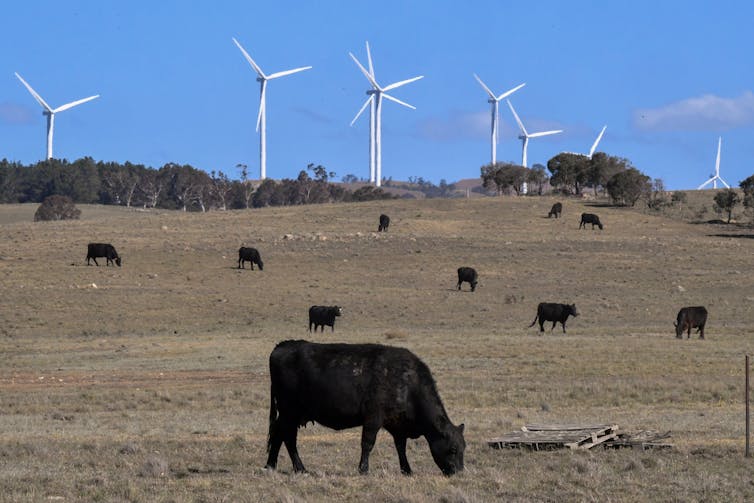 Cattle grazing and wind turbines can co-exist.
Mick Tsikas/AAP
Cattle grazing and wind turbines can co-exist.
Mick Tsikas/AAP
Recipe for success
A successful energy transition will require strategic, long-term planning to determine where renewable generation is best located.
Our research indicates that while many places in Australia have renewable energy potential, some are far better than others. Wind energy is usually best located near the coast, solar farms in arid inland regions and rooftop solar power in densely-populated eastern Australia.
Read more: Explainer: what is the electricity transmission system, and why does it need fixing?
Traditionally, Australia’s electricity grid infrastructure, such as high-voltage transmission lines, has been located around coal-fired generators and large population centres. Locating renewables near this infrastructure might make it cheaper to connect to the grid. But those sites may not be particularly windy or sunny.
Australia’s electricity grid should be upgraded and expanded to ensure renewables generators are located where they can perform best. Such strategic planning is just what the National Farmers Federation is asking for. Improved connectivity will also help make electricity supplies more reliable, allowing electricity to be transferred between regions if needed.
Making renewables do-able
The economic and environmental benefits of renewable energy are well known. But without social acceptance by communities hosting the infrastructure, the clean energy transition will be slowed. There is more work to be done to ensure new renewables projects better respond to the needs of regional communities.
And to ensure Australia best fulfils its renewable energy potential, electricity grid technology must be upgraded and expanded. To date, such planning has not featured prominently enough in public conversation and government policy.
If Australia can overcome these two tricky problems, it will be well on the way to ensuring more reliable electricity, the best return on investment and a low-carbon energy sector.
Read more: People need to see the benefits from local renewable energy projects, and that means jobs
Authors: Bonnie McBain, Lecturer, University of Newcastle


















