

Ancient undersea middens offer clues about life before rising seas engulfed the coast. Now we have a better way to study them
- Written by Katherine Woo, Postdoctoral Fellow, ARC Centre of Excellence for Australian Biodiversity and Heritage, James Cook University
The world’s oceans hold their secrets close, including clues about how people lived tens of thousands of years ago.
For a large portion of humanity’s existence, sea levels were significantly lower (up to 130 metres) than they are today, exposing millions of square kilometres of land. And the archaeological record is clear: people in the past lived on these coastal plains before the land slipped beneath the waves.
Archaeology already tells us these drowned landscapes played significant roles in human history. Major events such as human migrations across the globe and the invention of maritime technology took place along these now-drowned shorelines.
But these sites can be hard to find.
In two papers published this week our team reports on a breakthrough in detecting and excavating one particular type of coastal archaeological site — shell middens — on what is now the seabed.
The rich trove of evidence in these middens offer clues on how people adapted during times of sea-level rise and climate change.
It was long thought shell middens would be unlikely to survive the effects of rising sea levels – or if they had, it would be impossible to distinguish them from natural debris on the ocean floor. Our new findings suggest that’s not necessarily the case.
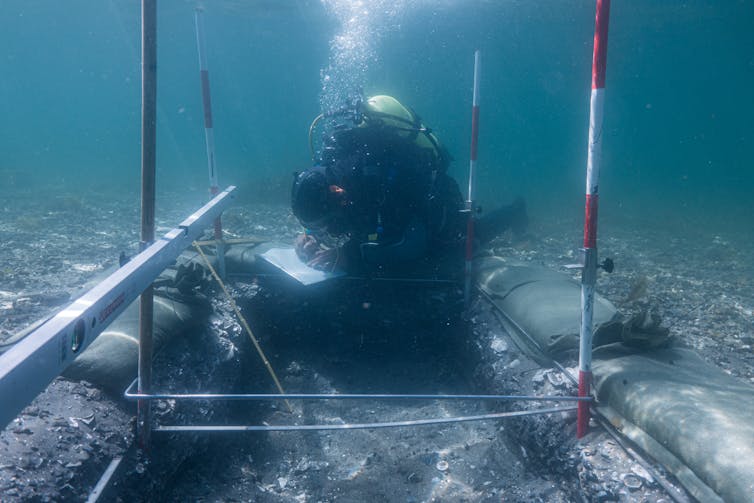 Scuba diver excavating shell midden.
Author supplied.
Scuba diver excavating shell midden.
Author supplied.
A new way to detect and excavate underwater middens
In recent decades, archaeologist have systematically searched the globe for evidence of these submerged cultural landscapes.
However, rough currents and poor visibility can make it difficult to find and record underwater sites.
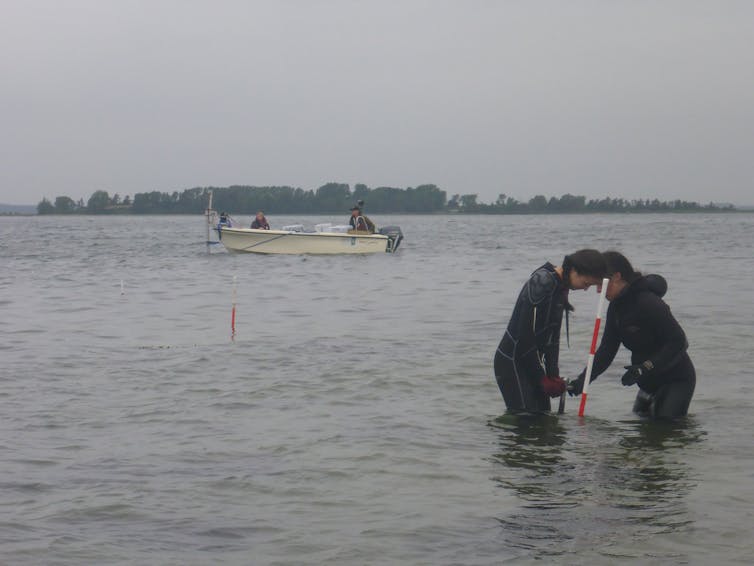 Danish field crew take cores of the sea floor to determine whether middens are present.
In two journal articles published this week, our team has announced new ways of detecting and excavating shell middens from what is now the seabed.
Previously, shell middens were hard to differentiate from natural shell deposits.
But our examination of three shell middens between 7,300 and 4,500 years old – from the Gulf of Mexico, the United States and Eastern Jutland in Denmark – demonstrate how submerged middens not only survive, but retain a distinct “signature” which can be used to separate them from naturally accumulated debris on the sea floor.
By using microscopy, geological and geophysical techniques, 3D reconstructions, and biological and ecological studies, we teased out different strands of evidence that offer new insights into how we might find other midden sites in watery depths around the globe.
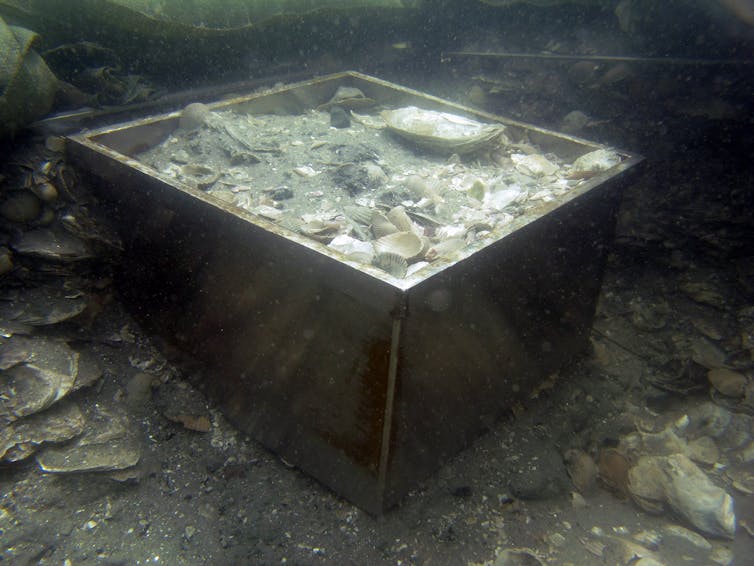 We teased out different strands of evidence that offer new insights into how we might find and excavate other midden sites in watery depths around the globe.
Author supplied.
We teased out different strands of evidence that offer new insights into how we might find and excavate other midden sites in watery depths around the globe.
Author supplied.
Challenging what we thought we knew about ancient coastal communities
What we’ve found so far challenges current ideas about coastal use in the Gulf of Mexico and northern Europe.
In the Gulf of Mexico, there is a gap in midden sites from between 5,000 and 4,500 years ago along the coastline of our study area. New results suggest localised sea-level changes, not lack of occupation, explain that gap.
In Denmark, the discovery of these middens (which are rare in the south) hints this type of site was more common than previously thought. That shifts our understandings of how intensive coastal use may have been between 7,300 and 5,000 years ago.
Importantly, both studies imply our histories of past coastal use may need to be rewritten as more such sites are found. Previously, many archaeologists assumed that people only occupied stable coastal zones. However, in both of our study areas, this was not the case.
Furthermore, older examples of similar middens likely lie offshore in multiple regions. Our new methods can make the search for such sites easier and more efficient.
Clues about adapting to a changing environment
Research at these sites is generating critical information that is beginning to fill in missing pieces of the puzzle of the human past.
Shell middens are complex, culturally significant sites. Some are the result of people discarding food refuse, tools, and other remnants of daily life. In other cases middens are purposefully built for cultural reasons, including burials. Often they are a mix of both.
 In undersea shell middens we can find discarded tools and ornaments, old living surfaces, and in some cultures, human burials.
They thus provide fundamental information about past food choices, tool technology, trade practices, and cultural values. These different types of information allow us to infer how people adapted their cultures over time. They also hint at how people interacted with their surrounding environments even as sea levels rose and the climate changed.
Understanding the past can help us contend with the future
These findings are not just important for our understandings of the past. They have direct and significant impacts on modern people, especially the rights of Indigenous and First Nations people across the globe.
These Nations have long impressed on us their deep connections with marine environments and seascapes. However, recognition of these relationships in western environmental and heritage conservation policies has been slow and deeply inadequate.
These new findings support Indigenous and First Nations people to manage the cultural heritage of their ancestral lands and waters by documenting these relationships into the deep past.
The discovery of these underwater sites, and the promise of more to be found, means industry, developers, archaeologists, and government bodies must reassess how we manage and protect ancient Indigenous heritage in these underwater settings. That is especially true as offshore mining and development accelerates.
Peter Moe Astrup, Curator of Maritime Archaeology at Moesgaard Museum, co-authored this article.
Read more: An incredible journey: the first people to arrive in Australia came in large numbers, and on purpose
Authors: Katherine Woo, Postdoctoral Fellow, ARC Centre of Excellence for Australian Biodiversity and Heritage, James Cook University

















