

Celebrating 10 years of news from experts
- Written by Misha Ketchell, Editor & Executive Director, The Conversation
When the first whispers started to circulate about The Conversation I was working behind the scenes for Media Watch on ABC TV. It was late 2010, and media circles were buzzing with gossip about a mysterious new project involving journalists and academics. At the time it didn’t even have a name.
In just 10 years, The Conversation’s unique approach of publishing news analysis written by experts has taken off across the world, with teams in the US and UK, France, Spain, Africa, Canada, Indonesia and New Zealand. It reaches more than 30 million users each month and employs more than 100 journalists. On the Australian and New Zealand edition alone, we reach 12 million readers each month.
Back in the early days success on that scale was unimaginable. My daily work at Media Watch involved picking apart poor unethical reporting on national TV, a very good way of making enemies of former friends, and keeping the ABC lawyers busy. The job also provided a clear view of systemic problems in the media. I spent countless hours on the phone to experts who had been burnt by their contact with parts of the media.
Sometimes there were honest mistakes. But often academic work was distorted by reporters who had an agenda or simply wanted to sensationalise. Many highly regarded experts were scared off by these experiences and vowed they would never work with the media again. Sadly, many withdrew from public life. Then, one day late in 2010, I got a call from Andrew Jaspan, a former editor of The Age who had recently departed Fairfax and now was working at Melbourne University with the Vice Chancellor Glyn Davis.
We met for coffee and he put a proposition to me: what if we could find a way to get more experts involved in public debate? There is a massive amount of expertise locked up in universities that no one is able to access. All that was needed was a key.
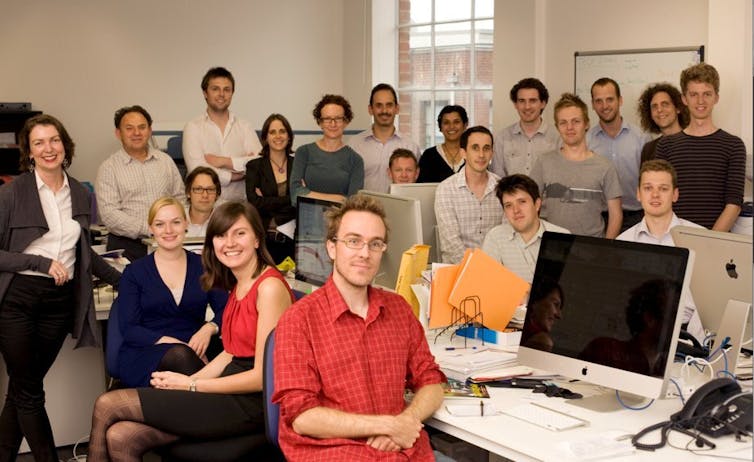
 The Conversation’s original team, March 2011.
The idea couldn’t have come at a better time. I was sick of picking apart other people’s worst work and keen to do something more constructive. Jaspan recounted a conversation he had had with the Nobel Laureate Peter Doherty. Doherty had grown frustrated with being misunderstood and misreported in the media. He’d said, “What if instead of a journalist sitting across the desk firing questions at me, I had someone working with me to help me get my ideas out in a way everyone can understand.”
Jaspan and his co-founder Jack Rejtman took that idea and ran with it, securing seed funding from four major Australian universities, the Victorian Government and CSIRO. What if the whole university was treated just like a newspaper newsroom, staffed by academics instead of reporters? The faculties mapped pretty well to the common newspaper sections or journalist rounds. The faculty of medicine could cover health, architecture would be relevant to what newspapers call urban affairs, law would relate to crime and justice.
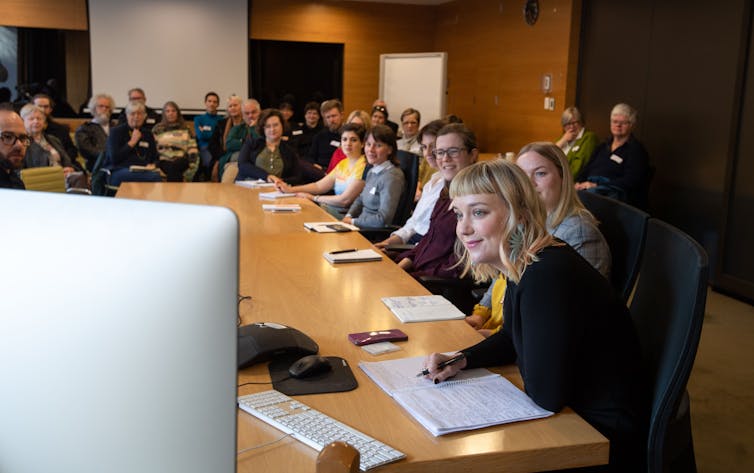
 The Conversation Australia + New Zealand’s Chief of Staff Alexandra Hansen leading a conference for staff and donors in 2019.
The magic of the idea was each academic would be paired with a professional editor who would work with her or him to develop their work and present it in a form that would make sense for curious audiences. No jargon, no acronyms, just really informed analysis, research and commentary delivered directly to a public crying out for something more than a steady stream of bad tabloid puns and morning TV giggles.
Jaspan appointed me to run the newsroom and I left the ABC. Within three months we had put together a team of 12 journalists to launch the project. We were joined by a crack team of web developers and Lisa Watts, an experienced media executive. After a fair bit of debate we settled on a name: The Conversation.
A few weeks later I was kneeling on the floor of a cramped office helping screw together the Ikea tables that would become our newsdesk. We had enough funding to last three years and figured that would be long enough to see if the idea had legs. It was a big leap of faith. We had the entire team of 12 editors sitting around the table phoning academics trying to rustle up stories. “I’m from The Conversation … no, you won’t have heard of it, we haven’t launched yet … would you like to write an article? Could you file it by 4pm today?”
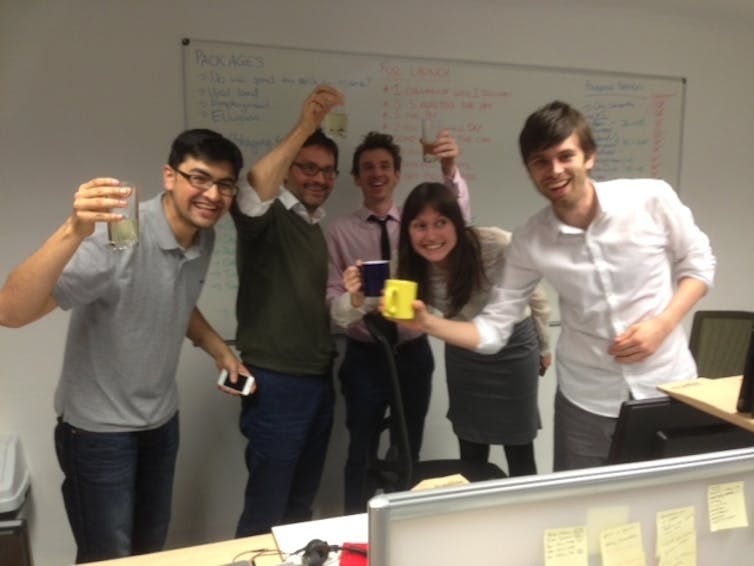
 The Conversation’s UK staff celebrating the opening of their London office in 2013.
The Conversation launched in March 2011 and immediately everyone crowded in front of a Google Analytics screen like frozen campers warming our hands at a fire. At first there was little encouragement, just a few dozen readers at a time. Over the following days each story was getting a few hundred readers. Then one got more than a thousand.
It wasn’t long before we started to get “viral” hits. One of the first was from the Deakin University philosopher Patrick Stokes. He wrote an article under the provocative heading “No, you’re not entitled to your opinion” arguing that climate science deniers did not have an absolute right to have misinformation widely disseminated by the media. In a few weeks the article got 50,000 readers. Then 100,000. Today it has been read more than 2.5 million times.
When we launched The Conversation we made a decision that everything we published would be free to other media outlets to republish. The idea was to rebuild trust between experts and the media and help academics be heard, so it didn’t matter where their work was being read. Soon the Nine newspapers, SBS, The ABC and dozens of others were picking up many of our best pieces. Then something appeared in The Washington Post, then the New York Times.
Soon overseas journalists started expressing interest in creating their own local branches of The Conversation. In 2013 The Conversation launched in the UK, led by Stephen Khan, a former foreign editor at The Guardian. It wasn’t long until there were teams in the US, then France, Africa, Canada, Indonesia, Spain and New Zealand.
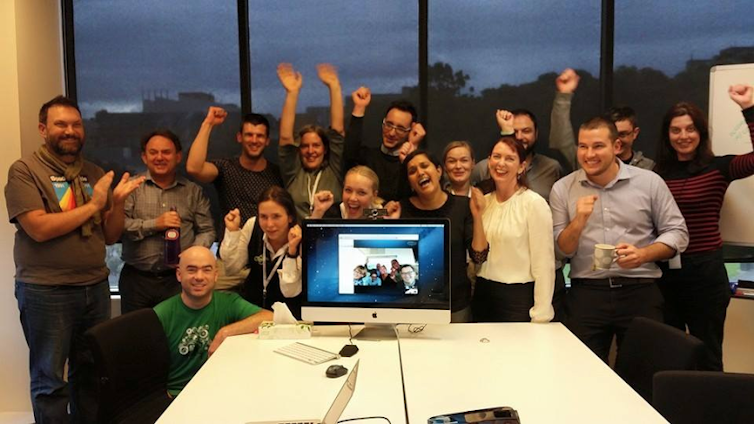
 The Conversation’s Australian and South African staff celebrating the launch of TC Africa in 2015.
In just 10 years The Conversation has gone from an Australian startup to a global network of more than 100 editors. The audience is huge. In 2020 Conversation articles attracted more than 743 million reads globally. It is particularly strong among digitally-savvy younger readers with more than half the audience under 44. The Conversation now receives support from several foundations and funding from almost all the universities in Australia and New Zealand. Each year it seeks donations from readers and in 2020 more than 20,000 people made a contribution.
The Conversation is still a little way off being a household name, but it is a runaway Australian success. It has provided an effective way for many experts to share their ideas publicly, and many who have done so have gone on to build big media profiles. The standard of editing is consistently high – one prominent academic, Dennis Altman, said it’s among the best he has experienced in a long career as a public intellectual.
The Conversation is an idea ahead of its time, fighting fake news for years before Donald Trump first uttered the term. In its short life it has made a significant contribution to the health of our media, checking facts, correcting misinformation and providing a steady stream of reliable content from experts so readers can be better informed about the complex issues we face.
 A cartoon rendering of The Conversation’s team by Multimedia Editor Wes Mountain.
Authors: Misha Ketchell, Editor & Executive Director, The Conversation
Read more https://theconversation.com/the-conversation-story-celebrating-10-years-of-news-from-experts-157593

















