

How The Conversation’s journalism made a difference in March
- Written by Benjamin Clark, Deputy Engagement Editor, The Conversation
Every month, we ask The Conversation authors what happened after we published their articles. Here are some of their stories from March 2021.
Academic knowledge goes viral
The story that garnered the most interest from our audience in March was this piece on how “seriously ugly” Australia will look if the world heats by 3°C this century, by the University of Queensland’s Ove Hoegh-Guldberg and Macquarie University’s Lesley Hughes. It was read 504,100 times!
Tim Stern from Victoria University of Wellington’s article about earthquakes in New Zealand was the second most-read of the month with 336,084 reads. Tim said, “Communicating our science out to a wide audience is part of our job, and your website is an excellent vehicle for this.”
On social media, Leah Ruppaner and Jordy Meekes from University of Melbourne’s piece on gender and flexible work arrangements attracted significant interest. It was included in a popular Instagram video by our Deputy Multimedia Editor Chynthia Wijaya, which became one of our most popular Facebook posts of the month, and was featured by LinkedIn News Australia.
Putting expert-led content in front of policy makers
The articles which most clearly influenced government policy in March were this piece about the COVID crisis in Papua New Guinea from the Burnet Institute’s Brendan Crabb and Leanne Robinson, and this piece about how teachers are expected to ignore their emotions by Curtin University’s Saul Karnovsky.
Brendan wrote to our Assistant Health and Medicine Editor, Liam Petterson: “If today’s positive announcement by the PM is anything to go by… the piece with Leanne and I made quite an impact. Thanks for your interest and tremendous help with the PNG crisis. It really is something that will help a lot of people.”
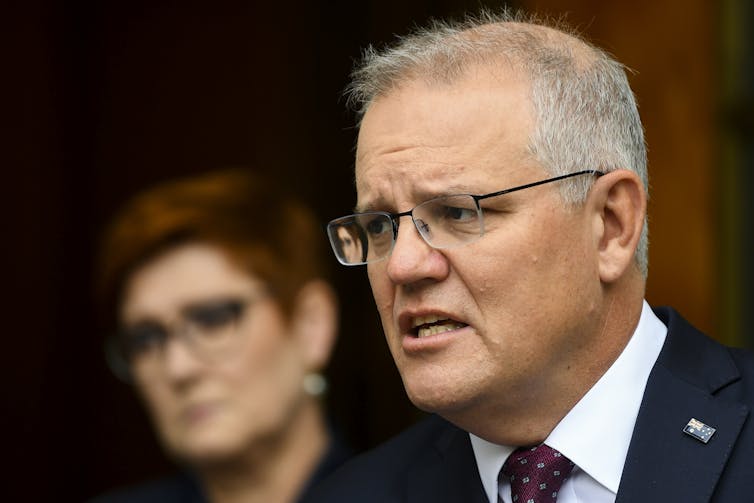 Scott Morrison spoke to the media about the PNG crisis during a press conference at Parliament House in Canberra, Wednesday, March 17, 2021.
AAP/Lukas Coch
Scott Morrison spoke to the media about the PNG crisis during a press conference at Parliament House in Canberra, Wednesday, March 17, 2021.
AAP/Lukas Coch
Meanwhile, Saul was consulted by the Education Department of NSW to inform a project to support teacher wellbeing.
Injecting evidence into discussions of sexual consent, assault and diversity
The issue of sexual consent has been particularly topical lately, after Australia’s federal parliament has been rocked by allegations of rape and sexual misconduct. The Conversation has helped ensure the subsequent public debate includes academic experts who research sex education and sexual crimes.
After Monash University’s Shelly Makleff wrote about sex education, a fellow from Winston Churchill Memorial Trusts contacted her to discuss a potential collaboration. She also provided sex ed resources to teachers in Queensland.
After Curtin University’s Jacqueline Hendriks wrote about consent, she did a number of video and radio interviews, including the Junkee Takeaway, ABC Radio National, and more.
After the University of Notre Dame’s Neeraja Sanmuhanathan wrote about victims of sexual assault, she was invited by a senior lecturer at another university to collaborate on a research grant exploring public messaging gaps. Neeraja was also consulted by Nine News and interviewed on Triple J Hack.
Neeraja wrote to her editor, Liam Petterson:
It was great to work alongside you and be led by you and your team in talking about such an important and sensitive topic. I underestimated the response and hence was surprised at the number of requests that followed. It is an overdue conversation and I am glad we are having it right now.
After the Australian National University’s Maria Maley wrote about sexual harassment and bullying in parliament, she was interviewed by a number of TV shows including the ABC’s 7.30 Report and The Drum, Channel 10’s The Project, Bloomberg TV Hong Kong and more. The article was also discussed on ABC’s Insiders, and was cited by Crikey, The Canberra Times and other outlets.
Sue Williamson from UNSW’s article about Andrew Laming and the efficacy of empathy training led to an interview on ABC TV. She was contacted by two other academics, one of whom asked her to participate in research. The Sydney Morning Herald also contacted Sue about a follow up story.
Finally, after Edith Cowan University’s Helen Joanne Adam provided tips to make school bookshelves more diverse, Story Box Library conducted an audit of their library inspired by her research.
They wrote:
Auditing our library helped us to see where the gaps continue to lie in culturally diverse representation in children’s literature. It also highlighted that even as a socially progressive company, we still have much work to do in dismantling white privilege through the provision of accessible and diverse literature.
Here’s Erin Wamala, a Teacher Librarian at Trinity Grammar School, discussing the importance of diversity and representation in education and children’s literature for Story Box:
International impact
While our social science, psychology and trauma experts were particularly influential on the home front in light of the misconduct crises in Canberra, our science authors made waves overseas. After UNSW’s Shane Keating wrote about waves last year, he was commissioned to write an article for BBC Futures and featured in a BBC World piece. And an earlier article he co-authored about the ozone layer led to a video interview for the National Geographic channel’s TV series “Nature’s Fury”.
BBC World is also planning a video version of Will Cornwell, Casey Kirchhoff and Mark Ooi from UNSW’s article on flora and fauna in the aftermath of Australia’s horrific bushfires.
After Griffith University’s Eric Cavalcanti wrote about a new quantum paradox, he was invited to give seminars at various universities including Cambridge and Harvard.
And a positive peer review from nanna!
Finally, all the accolades in the world cannot compare to a nanna’s approval. After University of Queensland’s Luke Zaphir wrote about combating stereotypes about the unemployed in schools, he was contacted by his own grandmother, who said the piece was well-written. Luke was “pretty stoked she liked it.”
Authors: Benjamin Clark, Deputy Engagement Editor, The Conversation
Read more https://theconversation.com/how-the-conversations-journalism-made-a-difference-in-march-158517

















