

How the water and sewage under your feet could end up flooding your home (and what to do about it)
- Written by Ana Manero, Research Fellow, Australian National University
Recent flooding in the Sydney Basin pushed thousands from their homes and left others facing enormous insurance costs.
These events show how traumatic and costly it can be to live in areas vulnerable to disaster. Too often, socio-economically disadvantaged populations are disproportionately affected.
Some flood dangers, however, can be far less visible – to planners, developers and home-buyers. Sometimes, the danger comes from groundwater beneath the surface.
Earlier this year, for example, residents of the New South Wales town of Stuarts Point were evacuated and decontaminated after sewage spilled into their streets, as septic tanks filled with shallow groundwater.
And across Perth’s Swan Coastal Plain, groundwater damage to buildings, parks, roads and piping has cost local residents millions of dollars in remedial works.
These problems are not inevitable. Our recent report shows how changes to urban planning, building design and construction practices could reduce groundwater risks. That means better outcomes for residents, developers, governments and the environment.
Urbanisation can cause the water table to rise
In many cities around the world, the water table is only a few metres or less below the ground. Groundwater levels tend to naturally rise and fall with winter rains and summer drying, as this UK video demonstrates:
However, urbanisation can cause the water table to rise above its “natural” level.
When we clear bush or farmland for housing, we reduce opportunities for plants to intercept and soak up rainwater. More rain then infiltrates through the soil and causes aquifers to fill up more quickly.
Balancing the short and long-term costs
The urban suburbs most affected by high groundwater are typically newer and cheaper. To attract buyers, developers must keep prices low, but mitigating the risk of groundwater flooding is expensive.
 The streaks of iron staining on the pavement in this Perth suburb show groundwater continues to seep above ground level, even after remediation works.
Authors' own image
The streaks of iron staining on the pavement in this Perth suburb show groundwater continues to seep above ground level, even after remediation works.
Authors' own image
Developers sometimes import and install sand as “construction fill” to elevate the ground level. They may also install drainage to control groundwater levels. These sorts of measures can represent one-third of the price of developing a housing lot.
Such measures on their own, however, don’t solve the problem.
Our recent report for the Cooperative Research Centre for Water Sensitive Cities suggested ways to improve groundwater management on Perth’s Swan Coastal Plain. These findings may help people in other areas dealing with similar problems.
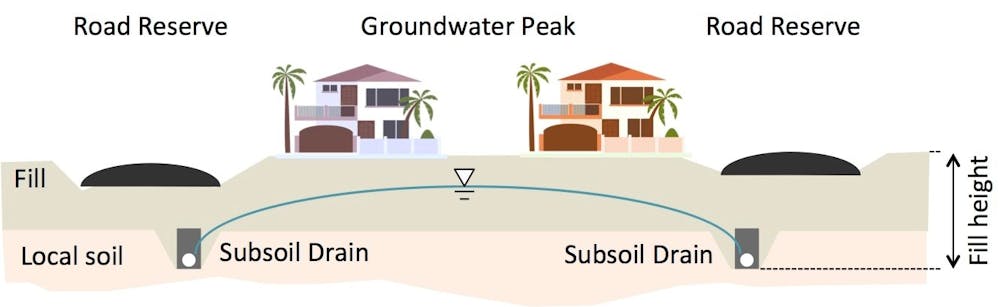 Developers sometimes import and install sand as ‘construction fill’ to elevate the ground level. They may also install drainage to control groundwater levels.
Created by the authors
Developers sometimes import and install sand as ‘construction fill’ to elevate the ground level. They may also install drainage to control groundwater levels.
Created by the authors
Obstacles and opportunities for change
First, we identified three key obstacles:
the data needed to predict how groundwater will respond to new developments is not always available
local authorities may struggle to find the human and technical resources to fully assess proposals for managing groundwater
business-as-usual designs for new developments are not usually resilient enough to cope when water tables rise.
Deeper problems are generated by the planning process. In Western Australia, high groundwater and waterlogging does not preclude land from being zoned for urban development.
Developers are also not required to address water management in detail until later stages of planning, by which time they may have already made substantial investments. This creates its own risks.
Water management plans at the subdivision level are addressed on a case-by-case basis by local authorities. That makes it difficult to determine and reduce cumulative impacts on flood risk at regional scales.
We also identified ways to improve housing development in high groundwater areas. For example, groundwater could be drained, diverted and used for direct irrigation in the drier months.
“Lightweight” or “highset” homes and floodable public open spaces could also help reduce groundwater risks. Incentivising such improvements would benefit the public and the environment.
 Parts of Perth are affected by high groundwater.
Shutterstock
Parts of Perth are affected by high groundwater.
Shutterstock
Policy change is needed — and, in some places, already underway
There’s also an urgent need to update planning policies to consider groundwater flood risk and how the cumulative impacts of development affect that risk. Fortunately, change is already underway in many places.
Such policies are being proposed in Sydney (via updates to a NSW government planning document called the Flood Prone Land Package).
In Britain, the UK Environment Agency requires mapping of groundwater-flooding regions, and discourages development in these areas.
In the United States, cities in the San Francisco Bay area are developing metrics to assess vulnerability to groundwater flooding as sea levels rise. Pierce County in Washington state is updating its flood management plan to address persistent groundwater flooding.
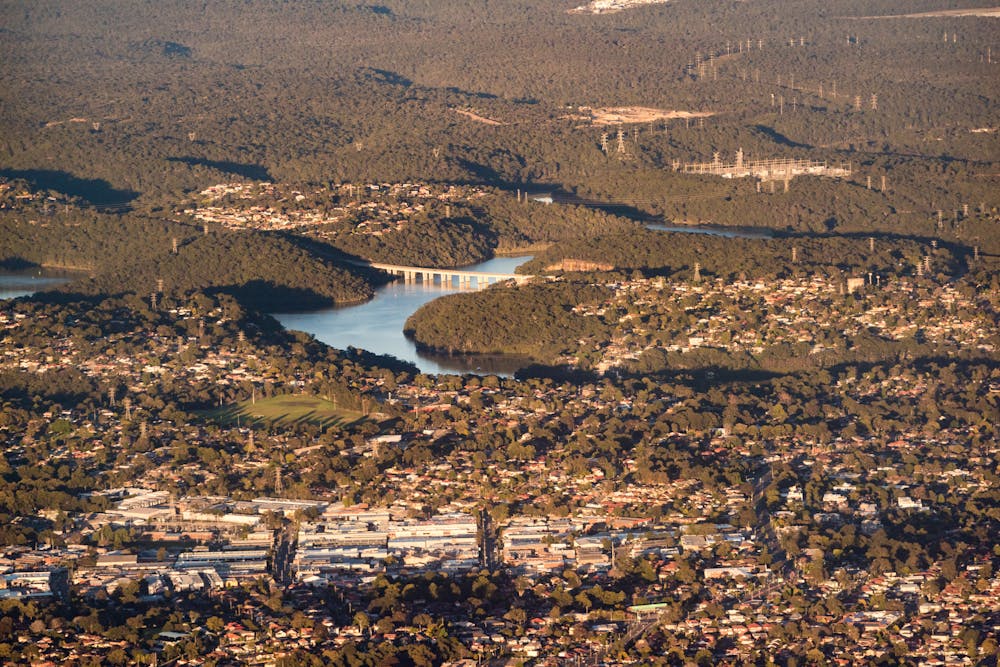 Planning policies to better consider flood risk are being proposed in Sydney.
Shutterstock
Planning policies to better consider flood risk are being proposed in Sydney.
Shutterstock
A legacy of liveable, resilient and equitable cities
Expanding our cities into environmentally vulnerable areas will only aggravate environmental injustice, as disadvantaged populations are forced to pay the price of poor planning policies.
Preventing such structural injustice requires planners be aware of all forms of environmental risk, including from groundwater.
We must address flooding risks early in the development process, and apply best practices from design to construction when high groundwater land is being developed.
This will require boldness from governments, consultancies, developers and financiers. The payoff will be a legacy of liveable, resilient and equitable cities.
Greg Claydon, a member of the Board of Directors at CRC for Water Sensitive Cities, contributed to this article. This story is part of a series The Conversation is running on the nexus between disaster, disadvantage and resilience. You can read the rest of the stories here.
Authors: Ana Manero, Research Fellow, Australian National University

















