The Australian zombie horror Cargo is burdened by its own gravitas
- Written by: Ari Mattes, Lecturer in Media Studies, University of Notre Dame Australia
Since the 1970s, some of the best horror films have been made in Australia. Something about the vastness of the continent, and its geographical remoteness from the northern and western hemispheres, lends itself to the kind of existential explorations of alienation that underpin the best examples of this genre.
Peter Weir’s The Cars That Ate Paris (1974) remains one of the great horror comedies, viciously lampooning small-town Australian life. Russell Mulcahy’s Razorback (1984) fully embraces the surreal-gothic potential of the Australian landscape, and the intense terror of Wolf Creek (2005) must have caused at least a few backpackers to reconsider their trips here.
But only one zombie film of note springs to mind, the Spierig Brothers’ brilliantly inventive Undead (2003). Ben Howling and Yolanda Ramke’s recent Cargo, released in Australian cinemas and to Netflix today, is another one. Whereas the Spierig Brothers approached the genre with energy and mirth, Cargo is a much more sombre affair, favouring dramatic realism and an understated visual approach over the garishness more typical of the films of the genre.
The result is mixed. The first half hour is brilliant, slowly building up tension and suspense, but once the narrative kicks into full gear, the film becomes far less satisfying. It’s not that it’s a bad film, it is moderately enjoyable, but given the renowned cast – it stars Martin Freeman, Susie Porter (excellent in a limited role) and legend of the Australian screen, David Gulpilil – and the potential of the genre in an Australian context, it could have been a lot better.
The narrative follows Andy (Freeman), a man who has to kill his wife Kay (Porter) after she turns into a zombie in the opening part of the film, as he travels across country with baby daughter Rosie on his back (his “cargo”) and befriends a teenage girl, Thoomi (Simone Landers). His wife bites him before he dies, so he knows he has only 48 hours remaining as a human, after which he will become one of the intestine eaters (there is an appropriately gross amount of blood and guts in this).
His mission, in his remaining time as a human, is to get Rosie to the group of Aboriginal people to whom Thoomi is also returning. This group have returned to a “traditional” way of living off the land, and are best equipped to repel the zombies. They are presided over by cleverman Daku (Gulpilil), who appears from time to time looking ghostly and saying little. There’s a touch of the noble savage myth about this whole subplot, and the images of blackfella magic are frequently accompanied by mystical-sounding music.
The most interesting encounters in the film are between Andy and Toomi and the several brain-eaters that populate the Australia of the future, but, unfortunately, these are few and far between. Instead, the action is driven by their encounters with several stock Australian film characters.
There’s the ethereal-woman in the outback, Lorraine, who seems too delicate to live in such an environment (played by Caren Pistorius in a wooden performance). There’s tough-as-nails Etta (Kris McQuade), an outback school teacher with a heart of gold. And there’s delusional tyrant Vic (played by Anthony Hayes, in a one-note and stilted performance) who is preparing to control Australia’s natural resources once order is restored. He gets his kicks doing really bad things like kidnapping Indigenous people and keeping them locked in cages in order to attract zombies who he then massacres for sport.
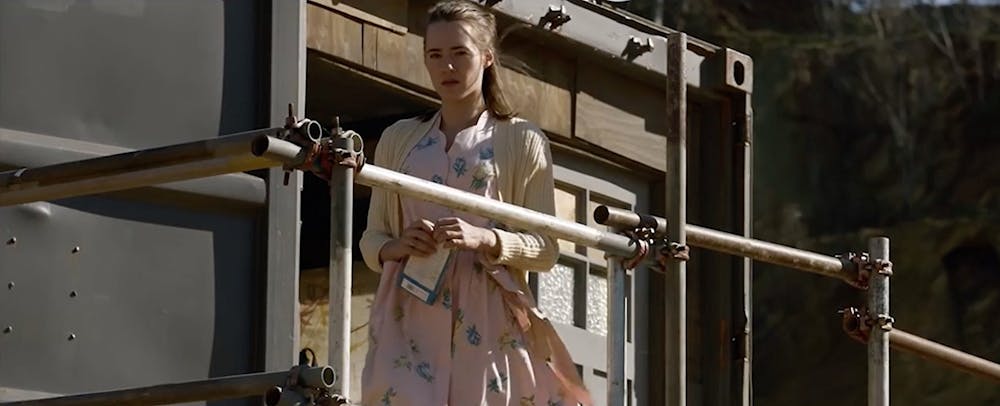 Caren Pistorius as the ethereal-woman in the outback, Lorraine.
Addictive Pictures, Causeway Films, Head Gear Films
Caren Pistorius as the ethereal-woman in the outback, Lorraine.
Addictive Pictures, Causeway Films, Head Gear Films
These are cliches, indeed, but this shouldn’t matter for this kind of genre film. And yet, with Cargo it does. Because it seems to be straining so hard for a sense of gravitas (built through its dramatic verisimilitude and realist style), these cliches become terribly visible and disrupt the viewer’s pleasure. It’s like the filmmakers have deliberately not embraced the ludicrous potential of the subject matter and there is thus an uncomfortable tension between its sombre tone, the absurdity of its premise, and the flatness of its cliched narrative.
The American zombie film, emerging in its contemporary form with the George Romero films beginning with Night of the Living Dead (1968) is generally considered a critique of consumerism in the post-Vietnam era, and the most interesting element of Cargo is its attempt to reimagine the genre in an Australian context that reflects anxieties about the land and its destruction.
The film features scenes, for example, of abandoned fracking sites, and the fact that the whole thing becomes a kind of battle between a power-hungry mining type and Indigenous people could have provided grounds for incisive social and political commentary. But the treatment is unnecessarily sentimental, and it doesn’t feel like there’s any genuine emotional potency by the end. Even the sweeping panoramic shots of the Australian landscape feel contrived and unimpressive, almost like stock drone footage taken from an online tourist commercial.
Alas, Cargo seems like a made-for-Netflix movie – it makes sense, in this context, that it is premiering on Netflix – watchable but also forgettable, after its dazzling opening third. It was developed, furthermore, from a short film that went viral, and like a lot of films made from shorts (or from Saturday Night Live sketches), it feels like it lacks the legs to sustain the length of a feature.
Cargo is worth watching, particularly for fans of horror cinema, but its aesthetic will be best served, I suspect, by the small screen.
Authors: Ari Mattes, Lecturer in Media Studies, University of Notre Dame Australia
Read more http://theconversation.com/the-australian-zombie-horror-cargo-is-burdened-by-its-own-gravitas-96786