

A year after New Zealand's first COVID-19 lockdown, discrimination and racism are on the rise
- Written by: Jagadish Thaker, Senior Lecturer, School of Communication, Journalism and Marketing, Massey University
More than two in five New Zealanders (41%) say incidents of racism have increased during the COVID-19 pandemic, according to a national survey carried out in February and March this year.
The experience of racism is skewed towards Māori, Pasifika and people of Asian descent, about half of whom say racism has been on the rise, compared with about a third of European New Zealanders.
Of the 1,083 survey participants, more than half (52%) say racism has remained the same and 7% say it has decreased.
Discrimination and racism
The pandemic has led to a global increase in anti-Asian hate. At the same time, ethnic minorities are also disproportionately affected by severe disease and deaths due to COVID-19. Death rates among minority ethnic groups were two or more times greater than for the white population in the United Kingdom. In New Zealand, Māori and Pasifika were about two times more likely to die of COVID-19.
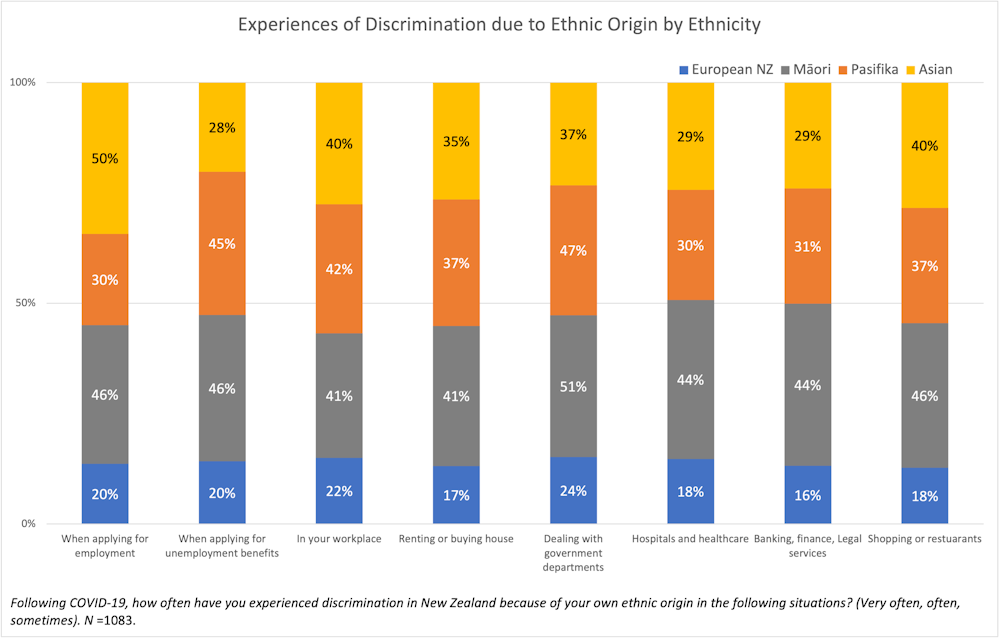
About two in five respondents said they have witnessed other people discriminate against individuals because of how they looked or spoke English. About a quarter reported experiencing discrimination due to their ethnic origin in a variety of contexts, including at government departments, workplaces, when dealing with the commercial sector and when accessing health care.
Māori and Pasifika reported experiencing discrimination most often when dealing with government departments.
Read more: Māori and Pasifika leaders report racism in government health advisory groups
People of Asian descent reported experiencing discrimination most often when applying for work, in their workplace, and when shopping or visiting restaurants.
 The survey results align with the New Zealand Human Rights Commission’s recent survey. Four in ten (39%) of the 1,904 respondents have experienced discrimination since the start of the COVID-19 outbreak. Māori and ethnic Chinese reported most instances of discrimination.
Negative online comments or abuse targeting people like them was the most prevalent, followed by instances of staring and increased physical distancing in public places.
Attitudes towards immigration
In our survey, many New Zealanders showed favourable attitudes towards immigrants. More than 80% of survey respondents said the contribution of immigrants from the UK to New Zealand’s economy and culture has been very or somewhat good.
A majority also said immigrants from other countries have contributed positively to New Zealand, including those from South Africa (74%), Fiji (71%), China (66%) and India (64%).
However, there was strong support to reduce or stop immigration following COVID-19. More than three in four somewhat or strongly supported reducing immigration from countries that have managed their response to the coronavirus poorly, such as the United States.
A majority also supported reducing or stopping immigrants and tourists from China, and more than three in five (64%) also supported (somewhat or strongly) reducing or stopping international students from countries such as China.
More than six in ten (61%) supported reducing or stopping immigration from all countries — a result slightly lower than a similar national survey conducted in June and July 2020 (69%).
In the past, New Zealand has consistently ranked among countries most accepting of migrants. It is possible the opposition to immigration may subside as the world recovers from the pandemic.
Racism is no joke
The Human Rights Commission received more than 100 complaints about racism following the first COVID-19 lockdown. In response, it launched the Racism is No Joke campaign to address racism towards Chinese and other Asian communities.
It also launched the Voice of Racism website to provide real examples of racist statements New Zealanders have experienced or witnessed.
Read more:
Everyday racism fuels prejudice and hate. But we can challenge it
Discrimination and racism triggered by COVID-19 are likely to compound disproportionate economic and mental health impacts among minorities. They may also affect the uptake of COVID-19 vaccination among at-risk groups due to experiences of racism in healthcare settings.
Racism is an everyday experience for many ethnic minorities. But we can challenge it through dialogue and cooperation, and by establishing relationships with people who are different from ourselves to reduce prejudice.
The survey results align with the New Zealand Human Rights Commission’s recent survey. Four in ten (39%) of the 1,904 respondents have experienced discrimination since the start of the COVID-19 outbreak. Māori and ethnic Chinese reported most instances of discrimination.
Negative online comments or abuse targeting people like them was the most prevalent, followed by instances of staring and increased physical distancing in public places.
Attitudes towards immigration
In our survey, many New Zealanders showed favourable attitudes towards immigrants. More than 80% of survey respondents said the contribution of immigrants from the UK to New Zealand’s economy and culture has been very or somewhat good.
A majority also said immigrants from other countries have contributed positively to New Zealand, including those from South Africa (74%), Fiji (71%), China (66%) and India (64%).
However, there was strong support to reduce or stop immigration following COVID-19. More than three in four somewhat or strongly supported reducing immigration from countries that have managed their response to the coronavirus poorly, such as the United States.
A majority also supported reducing or stopping immigrants and tourists from China, and more than three in five (64%) also supported (somewhat or strongly) reducing or stopping international students from countries such as China.
More than six in ten (61%) supported reducing or stopping immigration from all countries — a result slightly lower than a similar national survey conducted in June and July 2020 (69%).
In the past, New Zealand has consistently ranked among countries most accepting of migrants. It is possible the opposition to immigration may subside as the world recovers from the pandemic.
Racism is no joke
The Human Rights Commission received more than 100 complaints about racism following the first COVID-19 lockdown. In response, it launched the Racism is No Joke campaign to address racism towards Chinese and other Asian communities.
It also launched the Voice of Racism website to provide real examples of racist statements New Zealanders have experienced or witnessed.
Read more:
Everyday racism fuels prejudice and hate. But we can challenge it
Discrimination and racism triggered by COVID-19 are likely to compound disproportionate economic and mental health impacts among minorities. They may also affect the uptake of COVID-19 vaccination among at-risk groups due to experiences of racism in healthcare settings.
Racism is an everyday experience for many ethnic minorities. But we can challenge it through dialogue and cooperation, and by establishing relationships with people who are different from ourselves to reduce prejudice.
Authors: Jagadish Thaker, Senior Lecturer, School of Communication, Journalism and Marketing, Massey University


















