Could a simple pill beat COVID-19? Pfizer is giving it a go
- Written by Peter Wark, Conjoint Professor, School of Medicine and Public Health, University of Newcastle
While the focus has been largely on vaccines, you might have also heard Pfizer is trialling a pill to treat COVID-19.
It almost sounds too good to be true. Indeed, the results are very preliminary — but it’s a promising approach.
Where most antiviral agents we’ve tried to treat COVID-19 target the inflammatory and immune response resulting from infection, Pfizer’s pill directly targets SARS-CoV-2 — the virus itself.
Mounting our defence against the virus
Much of the illness associated with COVID-19 is due to the intense inflammatory and immune response that can occur with an infection. The most successful treatments so far have targeted this overzealous immune response.
Taken early in the disease, the inhaled corticosteroid budesonide has been shown to reduce the development of more severe disease.
In people hospitalised with COVID-19 requiring oxygen, the oral corticosteroid dexamethasone reduces the likelihood of death.
In the most severe cases — COVID patients admitted to ICU — the anti-inflammatory tocilizumab administered intravenously gives a person a better chance of survival.
But these treatments don’t target SARS-CoV-2 itself; just the consequences of infection. Directly targeting the virus has proven to be more difficult.
Targeting SARS-CoV-2
A virus like SARS-CoV-2 must enter a host cell to reproduce. It does this using its spike protein (a protein on the virus’ surface) to attach to the cell, and then it uses the cell’s own proteins to gain entry.
Once inside the cell, SARS-CoV-2 removes its outer coat and releases its viral RNA (ribonucleic acid, a type of genetic material). This acts as a template, allowing the virus to replicate, and then infect other cells. At any point of this life cycle the virus could be vulnerable to an intervention.
SARS-CoV-2 carries an enzyme, 3C-like protease (3CLpro), which plays a crucial role in the replication process. This protease is almost identical to the protease used by the SARS-CoV-1 (SARS) virus, and similar to the protease used by the Middle Eastern Respiratory Virus (MERS).
So a drug that could effectively target 3CLpro and prevent virus replication could be beneficial against multiple known coronaviruses, and possibly any that emerge in the future.
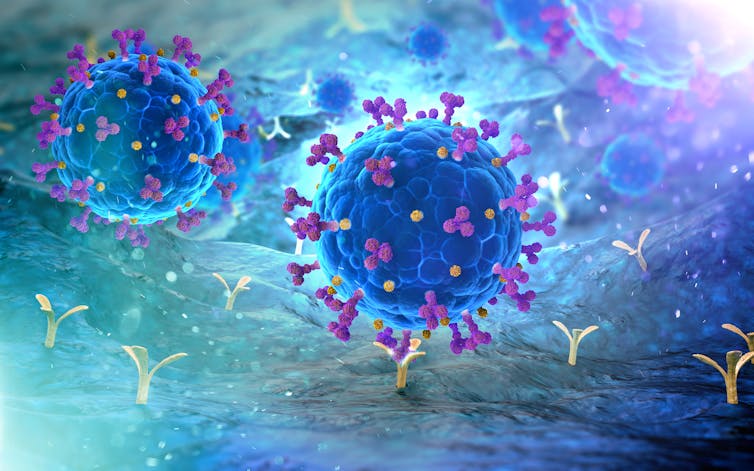 SARS-CoV-2 uses its spike protein to attatch to a host cell.
Shutterstock
SARS-CoV-2 uses its spike protein to attatch to a host cell.
Shutterstock
Protease inhibitors have been successfully used to treat other viral infections, especially chronic infections such as HIV and hepatitis C.
They were put forward early in the pandemic as a possible treatment for COVID-19. But the HIV drug lopinavir-ritonavir was shown in two clinical trials to be ineffective, with drug levels probably too low to work against SARS-CoV-2. While a higher dose might be effective, it would also likely produce more side effects.
Scientists also proposed a repurposed antiviral drug, remdesevir, originally developed to treat Ebola. Remdesivir delays the ability of the virus to replicate its RNA.
Initial case reports appeared promising and saw the US Food and Drugs Administration approve the drug for emergency use. But the results of randomised controlled trials in hospitalised patients with severe COVID-19 were disappointing.
Although there was a reduction in duration of illness for patients who survived, it didn’t significantly reduce a person’s chance of dying.
Read more: Ivermectin is still not a miracle cure for COVID-19, despite what you may have read
Of course, neither of these agents were designed specifically to target SARS-CoV-2. But in 2020, Pfizer/BioNtech identified a small molecule — PF-00835231 — that blocks the SARS-CoV-2 3CLpro protease. It was originally designed against SARS-CoV-1, but the enzyme in the two viruses is almost identical.
PF-00835231, both alone and in conjunction with remdesevir, appears to reduce the replication of a range of coronaviruses including SARS-CoV-2 in cells in the lab. It also reduced viral replication in a number of animal models, with no adverse safety signals. But it’s important to note this research hasn’t yet been peer reviewed.
What now?
Pfizer/BioNtech are taking two drugs to clinical trials for COVID-19: PF-07304814, an intravenous injection for use in patients hospitalised with severe COVID-19 and PF-07321332, an oral agent, or pill, that could potentially be used earlier in the disease. Both are formulations of a 3CLpro inhibitor.
These phase 1 trials, which began in March, represent the earliest stage of drug development. These trials select healthy volunteers and use different doses of the drugs to establish their safety. They also look at whether the drugs elicit sufficient responses in the body to indicate they could be effective against SARS-CoV-2.
The next step would be phase 2 or 3 trials to see if they improve outcomes in COVID-19. Usually this process takes years, but as the pandemic continues to rage globally, Pfizer says it will do this in a matter of months, if phase 1 trials are successful.
Read more: How the Pfizer COVID vaccine gets from the freezer into your arm
The application of antiviral agents in acute COVID-19 has been difficult and unrewarding. Though results are at this stage preliminary, these agents by Pfizer/BioNtech are promising. They could be used early in disease, especially in people poorly protected by vaccination or in those who haven’t been vaccinated.
They could also be used as a means of prevention, to contain outbreaks in exposed people. They should be effective against all the SARS-CoV-2 variants of concern, as well as against other known and possibly emergent coronaviruses.
The Pfizer CEO’s recent suggestion the pill could be available by the end of the year is probably a long shot. But the pandemic has shown us what’s possible in the realm of swift scientific advances, and we’ll watch this space with interest.
Authors: Peter Wark, Conjoint Professor, School of Medicine and Public Health, University of Newcastle
Read more https://theconversation.com/could-a-simple-pill-beat-covid-19-pfizer-is-giving-it-a-go-160988