

see how the diets of Tasmanian devils can wear down their sharp teeth to blunt nubbins
- Written by Tahlia Pollock, PhD candidate, Monash University
Tasmanian devils are expert scavengers, with strong jaws and robust teeth that give them the notorious ability to eat almost all of a carcass — bones and all. Scientists have even found echidna spikes in their poo.
But regularly crunching through bone comes at a cost: extreme tooth wear. In our new study, we analysed the skulls of nearly 300 devils, and show how regularly crunching through bones wears a devil’s teeth down from sharp-edged weapons to blunt nubbins.
Tasmanian devils are endangered and their wild population is continuing to decline. A key part of conserving this marsupial is by maintaining healthy and happy devils in captivity.
Understanding how their food affects their teeth can help us see if captive devils have the same types of tooth wear as their wild counterparts, and look for signs of any unusual or harmful wear.
Is there anything a devil won’t eat?
Tasmanian devils are the largest marsupial carnivore alive today. As scavengers, they occupy a unique niche in the Australian ecosystem by disposing of dead animal carcasses.
 Captive Tasmanian devils are given a variety of foods to replicate what they’d find in the wild. This photo was taken during a carcass feed at Healesville Sanctuary.
Zoos Victoria, Author provided
Captive Tasmanian devils are given a variety of foods to replicate what they’d find in the wild. This photo was taken during a carcass feed at Healesville Sanctuary.
Zoos Victoria, Author provided
Devils are highly opportunistic and can eat many different types of prey. While their favourites are the carcasses of native mammals such as wombats and wallabies, they’ll also eat reptiles, amphibians, birds, fish, and even insects.
We know this because we find hair, feathers, scales, small bones, claws and more in their poo.
Almost nothing is off limits to devils — they’ll even have a go at a stranded whale given the chance. Although devils prefer to scavenge, they’re also accomplished hunters.
Read more: Tassie devil facial tumour is a transmissible cancer
But due to a transmissible cancer, devil facial tumour disease, wild numbers of these remarkable marsupials have plummeted by around 80%.
Right now, 45 Australian zoos and wildlife sanctuaries, plus an island and a fenced peninsula, are collaborating to maintain a healthy population of disease-free devils. It’s important for these institutions to provide captive animals with the right kinds of food for their health and to help make their future release back to disease-free wild locations successful.
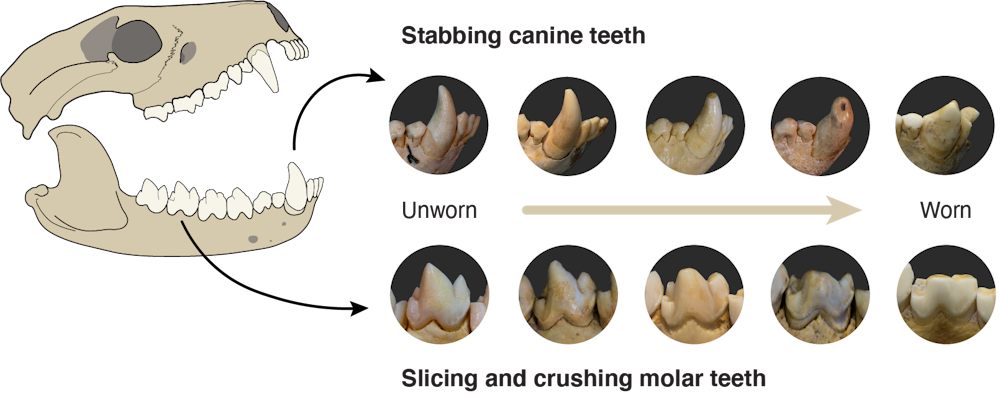 Devils naturally wear their teeth down from sharp points and edges to blunt, almost flat surfaces by regularly eating bones.
Tahlia Pollock, Author provided
Devils naturally wear their teeth down from sharp points and edges to blunt, almost flat surfaces by regularly eating bones.
Tahlia Pollock, Author provided
This is especially crucial for carnivores, who rely on tough foods to help them develop strong jaws.
Like hyaenas, but stronger
The types of food an animal eats will wear their teeth down differently. For example, big cats such as lions prefer to eat the softer parts of a carcass, like flesh or organs, and leave the bones behind.
Spotted hyaenas, however, will happily eat the bones. As a result, hyaenas have incredibly high tooth wear compared with lions.
This might not hinder the hyaena or devil as much as you might think. Both have very strong jaws that can compensate for the loss of sharp teeth. In fact, devils have the strongest bite force per body weight of any living mammal.
In the interactive below, you can check out 3D models of devil skulls to get a better idea of how much their teeth wear down.
Comparing wild and captive diets
By comparing the tooth wear of wild and captive devils, we can see if captive animals are encountering enough hard foods in their diets.
In the Save the Tasmanian Devil Program — an initiative of the federal and Tasmanian governments — captive devils are given a variety of small and large foods at different times, replicating what they’d find in the wild.
We found no signs of different or harmful tooth wear in captive devils, and they showed much the same patterns and types of wear as wild devils.
Read more: Meet Moss, the detection dog helping Tassie devils find love
However, we noticed captive devils wore their teeth more slowly than those in the wild. This may be due to eating higher quality food, such as carcasses that were fresh, whole, and yet to be scavenged.
This means captive institutions are doing a good job of providing devils with the right types of food for their teeth and encouraging wild behaviours.
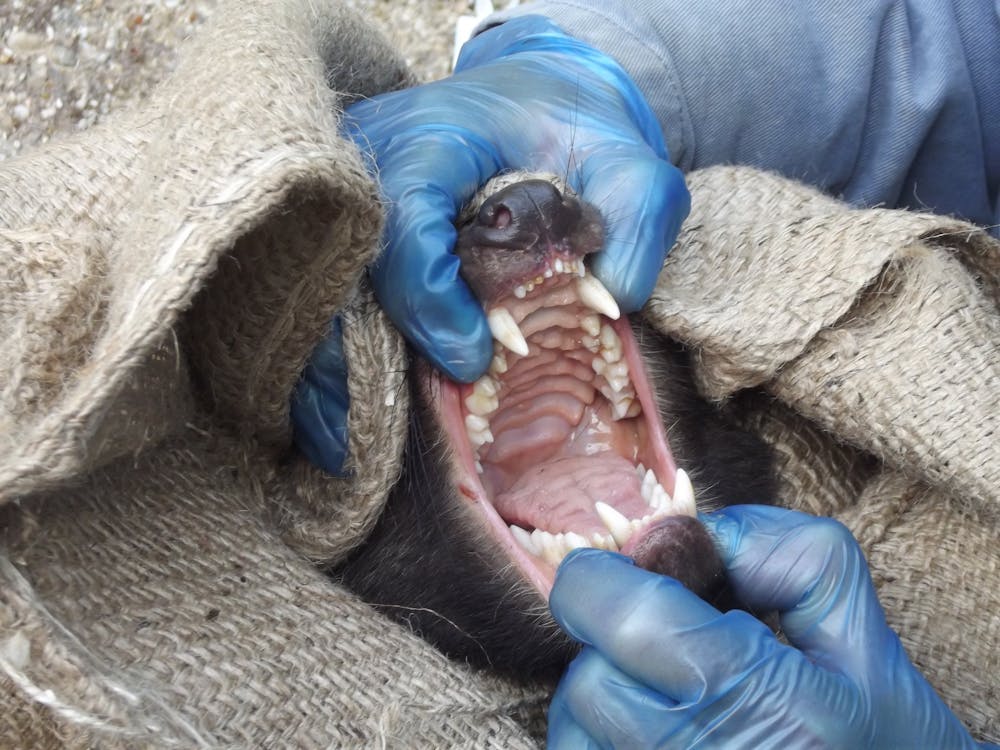 Part of the health check for wild devils involves looking at their teeth. This particular devil has nice sharp tips and edges on their canines and molars.
Marissa Parrott/Zoos Victoria, Author provided
Part of the health check for wild devils involves looking at their teeth. This particular devil has nice sharp tips and edges on their canines and molars.
Marissa Parrott/Zoos Victoria, Author provided
Collecting data about Tassie devils after they’ve been released confirms this. In 2012 and 2013, devils were released onto Maria Island in Tasmania after being born and raised for around a year in captivity.
Encouragingly, these devils kept the behaviours required to scavenge and hunt prey, and had diets similar to wild devils.
How you can help save Tasmanian devils
Our research is one small, but promising, piece in the overall puzzle. While captive research and breeding programs help conserve the Tasmanian devil, there are ways you can help, too.
Because they like to scavenge the carcasses of dead animals, road kill is especially tempting for devils. But being so close to the road is dangerous and road mortality is the second-biggest killer of wild devils.
So take care on the roads to help wildlife, especially if driving at night. And if you’re in Tasmania and see a devil that’s been hit on the road, log it in the Roadkill TAS app.
This will help identify road kill hotspots and protect this impressive, but endangered, species.
Authors: Tahlia Pollock, PhD candidate, Monash University

















