

Money is frequently offered to redress wrongs — what does it achieve for victims and justice?
- Written by: Kathleen Daly, Professor of Criminology and Criminal Justice, Griffith University
The federal government has just launched a A$378 million scheme for Stolen Generations survivors in the Australian Capital Territory, Northern Territory and Jervis Bay. At the same time, the Czech Republic has passed legislation offering payments to women, mostly from the Roma community, who were sterilised without their consent.
Last month, the Boy Scouts of America reached a US$850 million agreement with thousands of child sex abuse survivors.
These are recent examples of what we term “money justice”. This is how organisations and nations seek to redress wrongs by offering money to victims.
But if, as victims say, money cannot recompense a wrong, why is money sought by victims and offered as justice? More generally, what does money achieve (or not achieve) as justice and for victims?
What is money justice?
Money justice — sometimes referred to as compensation, redress, reparations — permeates our everyday life. We hear daily about victims and their family members seeking or receiving payments to remedy wrongs.
The major mechanisms of money justice are civil justice awards or out-of-court settlements for personal or cultural harms, and redress programs or payment schemes.
Money is paid to victims of terrorism and violent common crime, those victimised by civil conflict and political repression, or for historical injustice and institutional abuse. Consider the payments to Australian victims and families of the Bali bombings or London terror attacks, German payments to Holocaust survivors, and state schemes for violent crime such as sexual assault and robbery.
How much can victims receive?
One aim of money justice research is to map and compare payments to victims of diverse wrongs, and identify inequalities in payments. But when it comes to civil justice, the research task is nearly impossible because average payments are secret.
We may see a headline about the total amount decided in an out-of-court settlement — for example, the A$35 million to young people in Northern Territory detention facilities. But we will never know what, on average, individuals received, nor how much was deducted from the $35 million for legal fees and costs. The cost, meanwhile, is borne by taxpayers.
 The Catholic Church in Australia has made thousands of payments to child abuse victims.
James Ross/AAP
The Catholic Church in Australia has made thousands of payments to child abuse victims.
James Ross/AAP
Except for court-determined awards, which are a tiny share of civil justice outcomes, little is known about average payments and their range. This year, we published an article on what Australian Catholic Church bodies (archdioceses, dioceses and institutes) paid for claims of child sexual abuse. We found a huge range in the civil litigation cases (from A$11,000 to A$1.5 million) and the Towards Healing redress scheme (from about A$4,200 to A$184,000).
We were only able to compute and publish these figures because the child abuse royal commission had used its powers to seek data from the various authorities.
The money justice paradox
Despite the many forms it takes — and the many victims who seek it — money payments may not be interpreted as “justice” when received by victims.
We call this the money justice paradox. How can a sum of money, however large, compensate for a loss of life or health? Victims also ask why their loss was “worth” less than that of others, when comparing payments. For these reasons, money may fail as justice to victims.
Turia Pitt spoke to the Seriously Social podcast about her experience of seeking money justice. In 2011, Pitt was caught in a grassfire during an ultra-marathon. She suffered horrific burns to 65% of her body, leading to more than 200 medical procedures. As she explains:
At the end of the day, we settled out of court. I wasn’t happy with the money, but then no amount of money would ever be able to compensate me for what I’d been through.
Legal history and ‘balancing’ a wrong
We hypothesise one reason money may fail as justice is that it no longer contains the sense of “balancing” the wrong, as it did thousands of years ago, when the relationship between retribution and recompense was closely tied.
Then, the pain suffered by a victim was met with an equivalent, painful loss to an offender. Many will be familiar with the concept of “an eye for an eye”. At the time, a complementary concept of the “value of an eye for an eye” co-existed. Depending on the crime, a victim could demand payment in valued goods or money instead.
As legal systems evolved, this close connection became separated with dual systems of civil and criminal justice. Today, civil justice (“money damages” in lieu of punishment) is no longer associated with an equivalent painful loss for a wrongdoer, and it cannot achieve the “balance” or true recompense it once did.
Read more: Morrison government sets up redress scheme for survivors of Stolen Generation in territories
So, why does society persist with justice through money?
Money as the only option
The wheel of money justice is set in motion by civil justice, law firms, organisational defendants, and insurance companies. Money is all that is on offer.
For civil justice, law firms are motivated to focus on money because it supports their practice. Administrative schemes, such as those for victims of violent crime or institutional abuse, are a lower-cost version of civil justice. Here too, money is the principal element, although schemes may also offer support for medical and counselling costs.
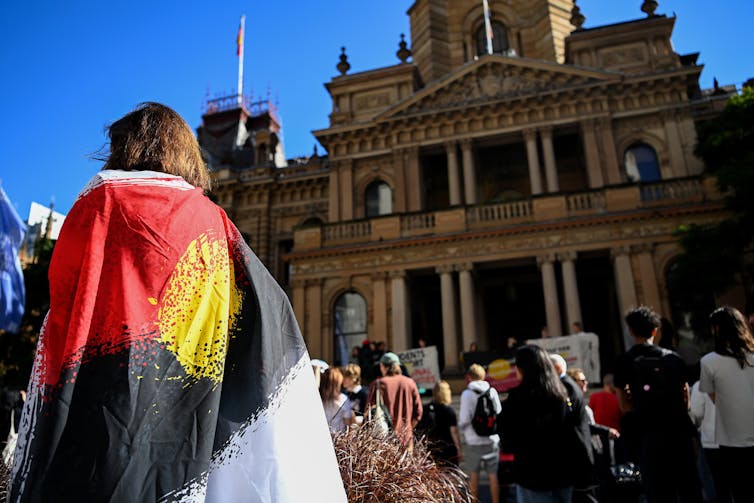 Stolen Generations survivors in the ACT, NT and Jervis Bay are now eligible to receive money under a new scheme.
Bianca De Marchi/ AAP
Stolen Generations survivors in the ACT, NT and Jervis Bay are now eligible to receive money under a new scheme.
Bianca De Marchi/ AAP
Victims may seek and accept money for wrongs because that is what’s offered. We would not say money is the most important element for justice from victims’ perspectives. They may have other objectives, such as wrongdoers accepting responsibility and organisational change, but these are rarely realised. In time, and understood symbolically, money may offer survivors validation and vindication.
Money also has practical benefits. It can relieve financial stress, improve daily life, pay for medical and dental care, and enable visits to family and friends.
A complex experience
Victims’ experiences of money justice highlight its complexity. For example, Pitt found going to court to be difficult and confronting. But she also described her settlement as a punctuation point in her recovery process:
For me it was freeing because once we reached a settlement we could look towards the future and not be stuck in our past anymore. So even though [the court process] was taxing, exhausting, all of those things … I think it helped us on our journey.
This same complexity was revealed in a 2018 study on sexual assault victims who applied to Queensland’s payment scheme for victims of violent crime. Almost all gave financial reasons for applying — such as the need to relocate or medical and counselling costs. They felt uncomfortable doing so because they did not want to appear to be chasing money.
But after they received the payment, half said the money was public acknowledgement that what had happened to them was wrong. So, after receiving the money, it was a symbolic form of justice, although this was not the reason they applied.
Beyond the headlines
As money justice continues to permeate society, we need to understand it better. This involves going behind the splashy headlines to find out what victims will, on average, receive in their bank accounts.
It also means using clear language. Terms such as “compensation” and “reparations” typically refer to money, so let’s skip the niceties and call them a money payment.
The wheel of money justice is greased by insurance premiums and tax revenues, which ordinary citizens pay for. So, we all have a vested interest in understanding payment amounts and inequalities, and we should be asking who gets what, and why.
As we continue to research the complexities of money justice, it is important to emphasise that money is not the only way to acknowledge victims. Truth commissions, memorialisation, the return of property, and apologies can all can have great significance.
Kathleen Daly also talks about money justice on the Seriously Social podcast by the Academy of the Social Sciences in Australia.
Authors: Kathleen Daly, Professor of Criminology and Criminal Justice, Griffith University


















