

Why do our ears pop?
- Written by: Chris Brennan-Jones, NHMRC Research Fellow, Telethon Kids Institute, University of Western Australia
This is an article from Curious Kids, a series for children. The Conversation is asking kids to send in questions they’d like an expert to answer. All questions are welcome – serious, weird or wacky!
Hi Curious Kids, My name is James and I live in Melbourne and I’m 10 years old. Why do our ears pop when we reach a certain altitude? - James, age 10, Melbourne.
Hi James. What a great question.
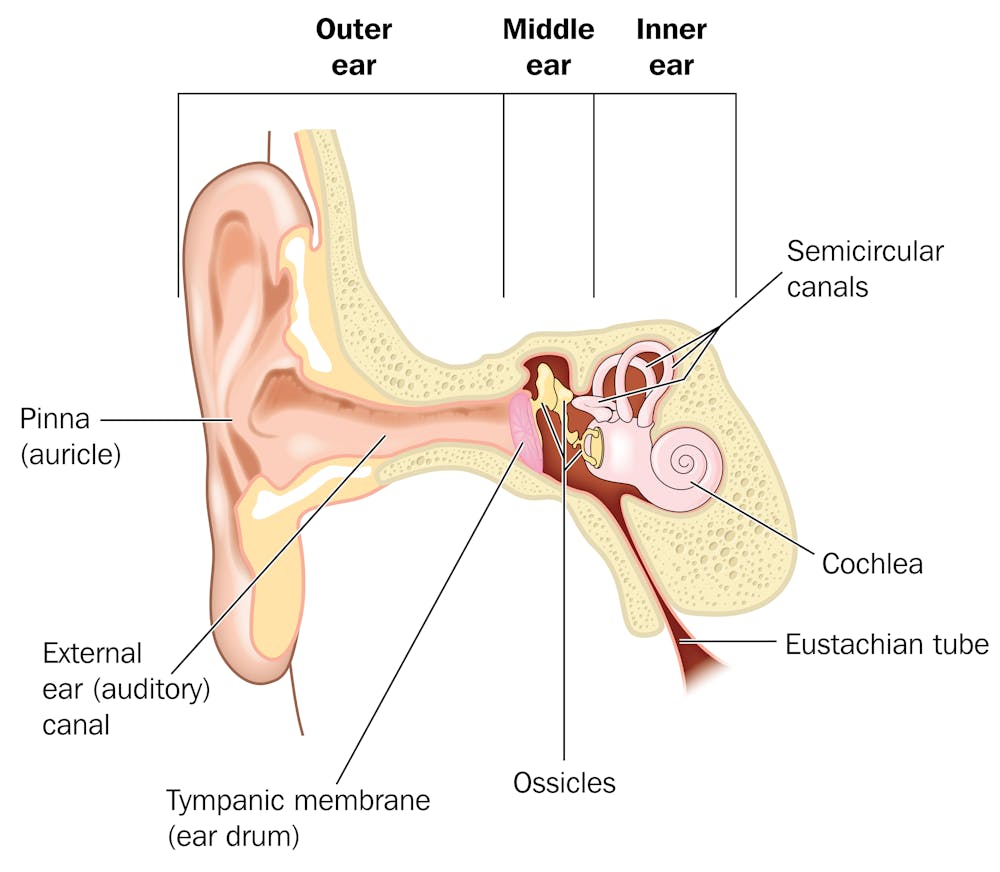
There are three key sections of our ear – the outer ear, the middle ear and the inner ear. Your question relates to the middle ear and the area around the ear drum.
The middle ear space is pretty airtight, although air can pass into and out of this space by the opening and closing of the Eustachian tube (the tube that links the middle ear to the back of the throat). Most of us can do this by yawning or opening our jaws, which often results in our ears “popping”.
 Can you ‘pop’ your ears by yawning? It’s all about the Eustachian tube.
Shutterstock
Can you ‘pop’ your ears by yawning? It’s all about the Eustachian tube.
Shutterstock
Your ears pop because of the pressure difference between the air outside and the air inside your middle ear space. I’ll explain how that works.
Read more: Curious Kids: How does an echidna breathe when digging through solid earth?
You have a small amount of air sealed in the middle ear space. And then there’s all the rest of the air outside, in the atmosphere.
Normally the air pressure inside the middle ear and in the atmosphere are very similar, or at least not different enough to cause you any trouble. As you increase in altitude (either in a car going up a hill, going up in a lift, or taking off in an aeroplane) the air pressure in the atmosphere decreases, making the air “thinner”, while the air pressure in the middle ear remains relatively unchanged.
This puts pressure on your eardrum as the air pressure in the middle ear expands relative to the air around it. This expansion causes not only the discomfort you feel before your ears “pop”, but also makes it harder to hear things, because the pressure on your eardrums makes the sound harder to transmit.
There is no specific altitude at which your ears pop, and during quick ascents, like during an aeroplane take-off, you may have to equalise or “pop” your ears a few times to keep up with the pressure changes.
Other times, like on a slow walk up a hill, your ears may equalise themselves without you even noticing.
Read more: Curious Kids: where does money come from?
The reverse can happen when you are descending in an aeroplane or going down a hill. The air in the atmosphere increases in density through the descent, while the air pressure in the middle ear space remains low like it was at the higher altitude.
This forces pressure on the eardrum and causes it to retract inwards (instead of bulging outwards on ascent) until your ears pop to make the pressure between the middle ear and the atmosphere more equal.
You can have some trouble if you are doing a significant ascent or descent and have a cold or an ear infection.
The mucus from a cold or ear infection can block the Eustachian tube, making it hard to equalise your ears properly. This can make your ears ache from even small changes in altitude and the eardrum is pushed inwards (on descent) or outwards (on ascent).
Babies and young children often have blocked Eustachian tubes – this may be one reason they don’t like flying.
Hello, curious kids! Have you got a question you’d like an expert to answer? Ask an adult to send your question to us. They can:
* Email your question to curiouskids@theconversation.edu.au * Tell us on Twitter
 CC BY-ND
Please tell us your name, age and which city you live in. You can send an audio recording of your question too, if you want. Send as many questions as you like! We won’t be able to answer every question but we will do our best.
CC BY-ND
Please tell us your name, age and which city you live in. You can send an audio recording of your question too, if you want. Send as many questions as you like! We won’t be able to answer every question but we will do our best.
Authors: Chris Brennan-Jones, NHMRC Research Fellow, Telethon Kids Institute, University of Western Australia
Read more http://theconversation.com/curious-kids-why-do-our-ears-pop-97259


















