

The earthquake that rattled Melbourne was among Australia's biggest in half a century, but rock records reveal far mightier ones
- Written by: Mark Quigley, Associate Professor of Earthquake Science, The University of Melbourne
An earthquake that struck near Melbourne today is one of the largest in Australia since instrumental seismic records began. However, the geological record of ground-breaking fault ruptures tells us much larger earthquakes have occurred across the continent. Some of these earthquakes would have been witnessed by Australia’s Indigenous peoples.
Several quakes were felt near Melbourne today, the largest of which was recorded at a magnitude of 5.8. A magnitude 4.7 aftershock happened about 15 minutes after the main shock, which was at 9:15am local time. A typical aftershock sequence could go on for weeks to years. Aftershocks went on for about 40 days following the Thorpdale, Victoria earthquake of magnitude 5 in 2021.
In Australia we get magnitude 5.8-6.0 or greater earthquakes, on average, once every four to 20 years. The highest since instrumental records began in Australia was the magnitude 6.6 quake in the Western Australia town of Meckering in 1968.
Earthquakes are considered a low probability, high consequence hazard — the rate of earthquakes is low compared to our seismically active neighbours in New Zealand, PNG, and Indonesia, but we have vulnerable infrastructure such as unreinforced masonry buildings that present a risk.
Read more: 'Like tearing a piece of cheese': here's why Darwin was rocked so hard by a distant quake
How this quake compares
There are some big quakes in our recent past.
There was a magnitude 5.3 quake in 2018 in Western Australia.
Near Uluru in 2016, there was the Petermann earthquake, which had a magnitude of 6.1.
The largest in the record since instrumental records began in Australia was in 1988; it was part of the Tennant Creek series of quakes in the Northern Territory, and that was magnitude 6.5.
Then there was the aforementioned one in 1968 in the WA town of Meckering; that was 6.6.
But the geological record tells us we have had earthquakes in Australia’s deeper past that were much, much larger — possibly up to magnitude 7.0 and beyond.
The energy released by a magnitude 7.0 quake is 32 times larger than the energy from a magnitude 6.0 quake.
For each one point up the scale, the amount of energy released is about 32 times greater.
Why are quakes of this strength not common in Australia?
Compared with places like New Zealand and Indonesia, large quakes are not common in Australia. That’s because Australia is in the middle of a tectonic plate so what we call the “strain rate” — the rate at which energy builds up due to plates pushing against each other — is slow.
Indonesia is on a plate boundary, so the strain rate — the rate at which the Earth is being deformed — is much higher. That energy is released mainly through earthquakes.
Even though Australia is in the middle of a plate, strain can nevertheless build up over time — and eventually needs to find release.
Australia is moving northwards as part of the Indo-Australian tectonic plate, which is colliding with the plate near PNG and Indonesia, and that is pushing back — building up strain. New Zealand is also imposing a force onto the Australian plate.
A quake like today’s would normally cause a lot of damage
A magnitude 5.8 earthquake is a big deal. If such a quake occurred directly under one of our major cities, we could expect billions of dollars of damage and fatalities.
In many parts of Australia, such as Melbourne, earthquakes are felt at greater distances than in countries like New Zealand, because our crust is stiffer. Seismic waves travel more efficiently through Australian crust.
In Melbourne, the soft sediment south of the CBD and in other areas likely caused the seismic waves to slow down but also amplify. The seismic waves get bigger and can cause more damage when they are in soft sediments.
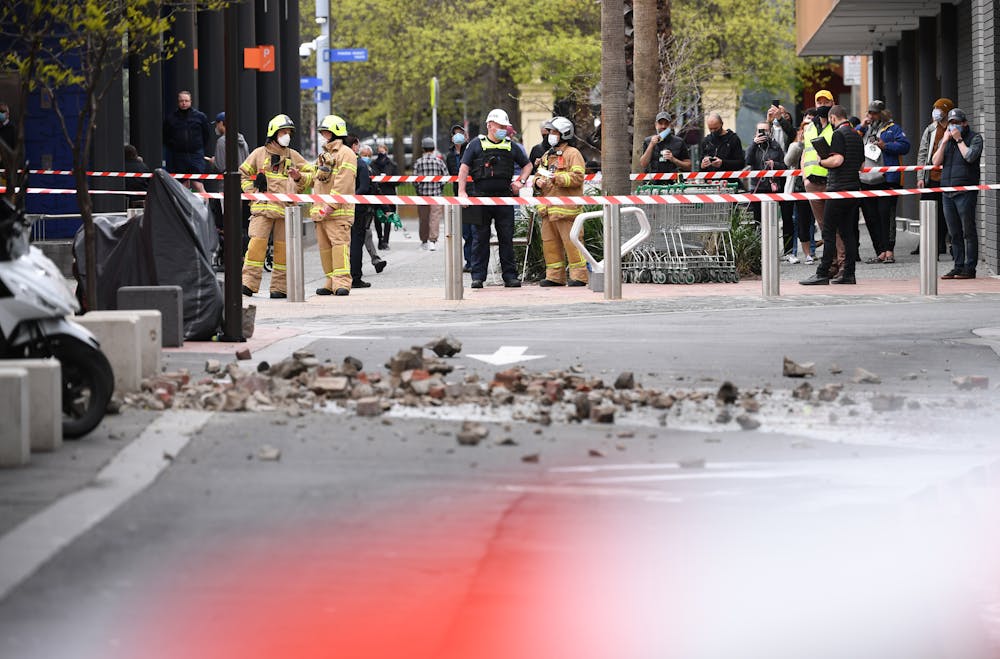
The scenes of toppled brickwork reflect the seismic energy that has travelled quite effectively 130km from the source of the tremor (which is reported to be near Mansfield).
They have almost certainly been amplified by the soft sediments, and the direction of the waves may make certain buildings more vulnerable than others.
Crucially, Melbourne has many buildings that are highly vulnerable to quake shaking: buildings with big overhangs, buildings that are unreinforced, or those that have been weathering away for decades without repair.
The sort of shaking that wouldn’t cause damage in other locations is causing damage in places like Melbourne.
Read more: 10 years since the Darfield earthquake rocked New Zealand: what have we learned?
Authors: Mark Quigley, Associate Professor of Earthquake Science, The University of Melbourne


















