

In the 19th century, a man was busted for pasting photos of women's heads on naked bodies ... sound familiar?
- Written by Jessica Lake, Research Fellow, Australian Catholic University
A new app can turn anyone into a porn star against their will. All you need is a photo and deep fake artificial intelligence technology will swap the person’s face into an adult video.
According to the MIT Technology Review the app breaches “an ethical line no other service has crossed before”.
Deep fake websites have existed since 2017 and research estimates 90-95% of videos produced are non-consensual porn or image-based abuse. The vast majority of victims are women.
However, while deep fake technology might be new, the problem certainly is not. Since the beginning of photography, men have been taking and sexually exploiting women’s images without their consent.
The method and tools might change, but the inclination to sexually abuse women by manipulating images has not. Addressing this problem — through law, technology or culture — means acknowledging its long and tenacious history.
‘Undraped Women’
The invention of photography in the 1830s radically altered the nature of portraiture. Images of individuals became more lifelike. They could also be captured, reproduced, manipulated and disseminated more easily.
In 1888, one of New York’s professional photographers, 30-year-old Le Grange Brown, was accused of showing and selling photographs of “undraped women” in local saloons. Brown had taken portraits of hundreds of young high society ladies during various social events and then cut and pasted their heads to images of naked women.
Sound familiar?
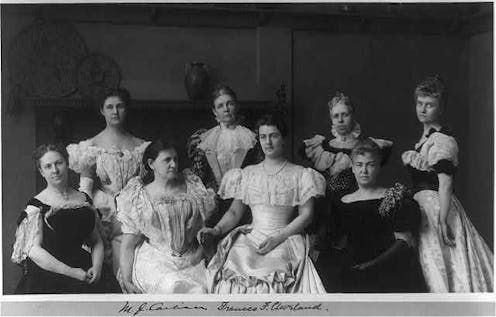
Due to this and other high-profile incidents, such as the unauthorised use of US first lady Francis Cleveland’s photograph on pharmaceuticals and tobacco, debate began about the problem of women’s images being taken and used without their consent.
As a result, in 1888, a bill to “protect ladies” was introduced to the US House of Representatives to prohibit the use of the portraits of “females” for advertising and trade purposes, without their consent in writing. It was vehemently opposed by groups of professional photographers and did not pass.
An article from the Ladies Home Journal in 1890 subsequently warned:
While the great majority of professional photographers are men of honour and responsibility […] women should always know the standing of the man to whom they entrust their negatives […] The negative once in his possession (if he is so disposed), he had the means of causing them great mortification by using it for base purposes.
‘Pretty girls’ and a ‘delightful pastime’
The capture and use of women’s photographs without consent intensified with the release of New York entrepreneur George Eastman’s Kodak camera in the 1880s.
Small, simple to use and cheap, the Kodak camera transformed photography into a “delightful pastime” for the ordinary man. Styled as a “detective camera”, due to its ability to be easily hidden from sight, it also led to a boom in surreptitious photography.
Newspaper articles and marketing materials employed hunting and shooting metaphors, framing amateur photograph as an aggressive, masculine hobby. “There are no game laws for those who hunt with a Kodak,” declared one advertisement.
More often than not, it was men capturing the images of unwilling or unsuspecting women. An 1889 New York Times article described amateur photographers as “young knights of the camera” and “pretty girls” as their “natural prey”:
If the young lady refuses he will perhaps strive to get her picture when she is not on guard just out of spite.
‘Common property, circulated from hand to hand …’
In 1890, comic opera star Marion Manola had her photograph surreptitiously snapped by a theatre manager and professional photographer while performing on Broadway.
She wore an (at the time) revealing costume of tights, and the image was turned into an erotic postcard. Manola took the men to court. She did not want to be depicted as a sexual object, to become, in her words:
common property, circulated from hand to hand, and treasured by every fellow who can raise the price demanded.
Manola’s case was used as an example by jurists Samuel Warren and Louis Brandeis when they argued for a new legal “right to privacy” in their landmark Harvard Law Review article that same year.
In 1903, as a result of another case involving the unauthorised use of a woman’s photograph, the New York Legislature enacted the first right to privacy in the US and across the common law world, including Australia and the United Kingdom.
A mutating problem
The sexual exploitation of women’s images by men is not just something that emerged with the internet, apps and smart phones. It is a persistent cultural problem.
Laws – such as privacy rights and those criminalising image-based abuse – can provide victims with redress and justice.
However, until men’s sense of entitlement to use and abuse women’s bodies for the purposes of vengeance, spite, gratification or profit is tackled, this problem will simply evolve or mutate with each new technology.
Read more: AI can now create fake porn, making revenge porn even more complicated
Authors: Jessica Lake, Research Fellow, Australian Catholic University

















