

Meet the prehistoric eagle that ruled Australian forests 25 million years ago
- Written by: Trevor H. Worthy, Associate Professor, Vertebrate Palaeontology Group, Flinders University
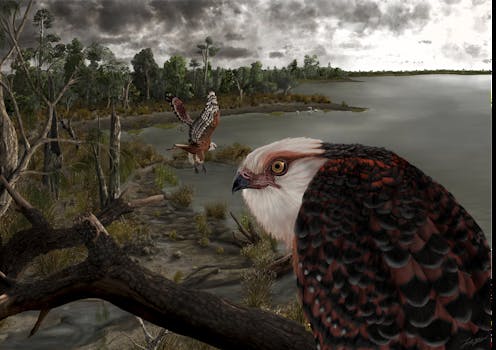
The parched deserts of the South Australian outback were once a rainforest filled with a rich variety of birds and animals. Now, thanks to a new fossil discovery, we know the apex predator of this lush ecosystem was a newly discovered eagle that lived 25 million years ago.
We discovered the fossil remains of this species, named Archaehierax sylvestris, in prehistoric sediments at Lake Pinpa, 400 kilometres north of Adelaide.
The fossil, unearthed in March 2016, is described in a newly published paper in the journal Historical Biology.
It is one of the most complete raptor fossils from this time period found anywhere in the world. It comprises 63 bones, which is truly exceptional; most fossil birds are named on the basis of just a single bone.
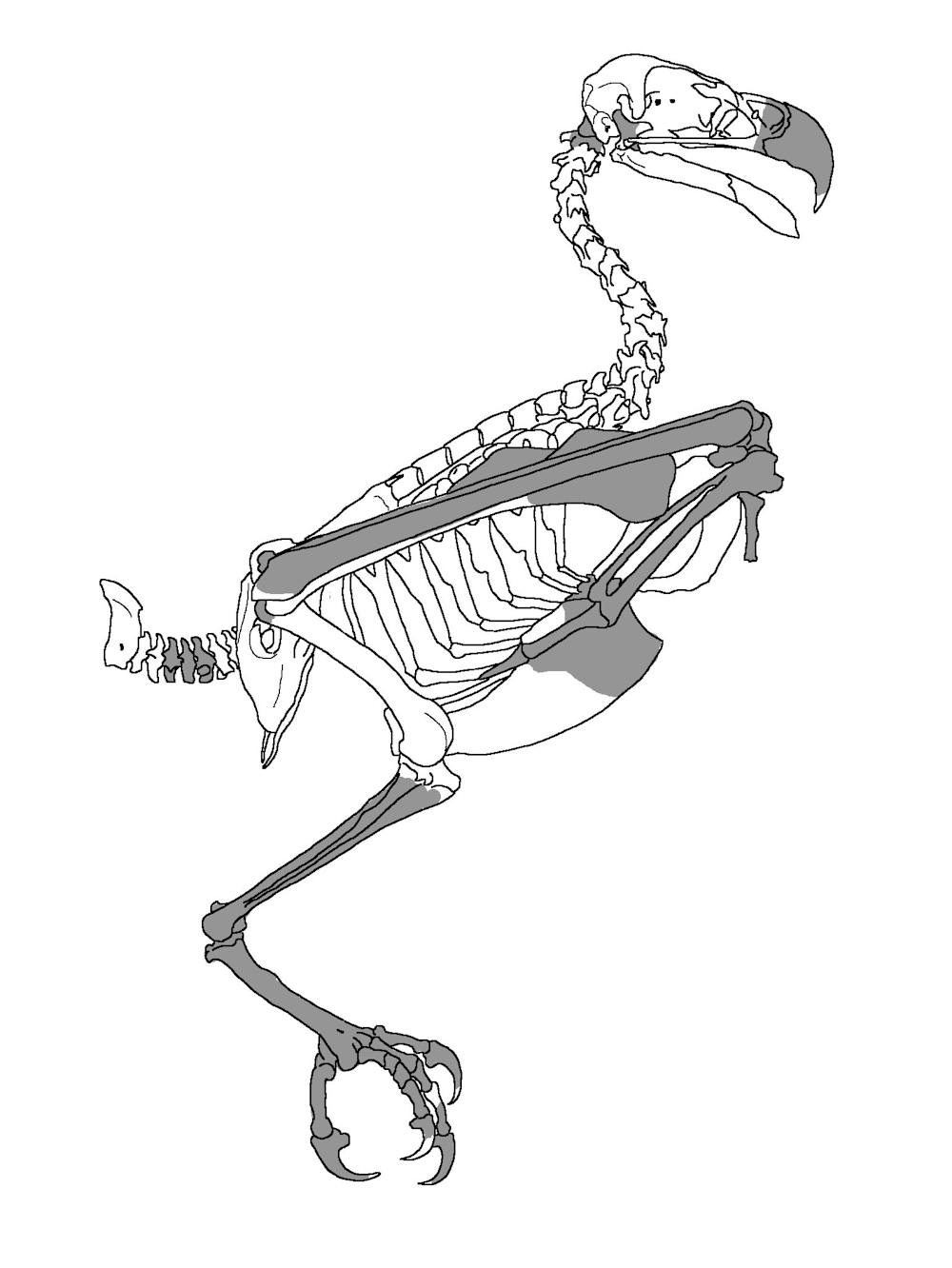
We have named it Archaehierax sylvestris, meaning “ancient hawk belonging to the forest”. It was slightly smaller than a wedge-tailed eagle, with talons spanning 15 centimetres that allowed it to grab prey the size of a koala or possum. And it had short, robust wings adapted to fly within the cluttered confines of a forest, rather than to soar through the skies.
With its relatively short wings and long legs, this eagle was likely an ambush hunter, waiting for unwary prey to approach, rather than a soaring forager. In the forest, it probably preyed on medium-sized marsupials. But from a high perch, it would also have made forays over the lake where it could catch ducks and flamingos.
Read more: Ancient bilby and bandicoot fossils shed light on the mystery of marsupial evolution
Fossil treasure trove
Since the 1970s, the barren, salt-crusted sediments in South Australia’s arid north have yielded a range of bone fragments, teeth, and other fossils of the animals that lived there — many of which would have been prey for Archaehierax.
These fossils include a host of mammals, ranging from wombat ancestors the size of a small cow, through a range of tree-dwelling herbivores such as possums and koalas, to small terrestrial carnivores no bigger than a mouse.
These animals lived around a large lake where crocodiles and turtles abounded, and freshwater dolphins played.
Waterbirds were abundant, including cormorants, several types of flamingo, four species of duck, and Presbyornis, a bizarre long-legged fowl that went extinct elsewhere in the world 20 million years earlier. Many smaller forest birds such as songbirds, parrots and rails are also known, but most are not yet described.
Global eagle family
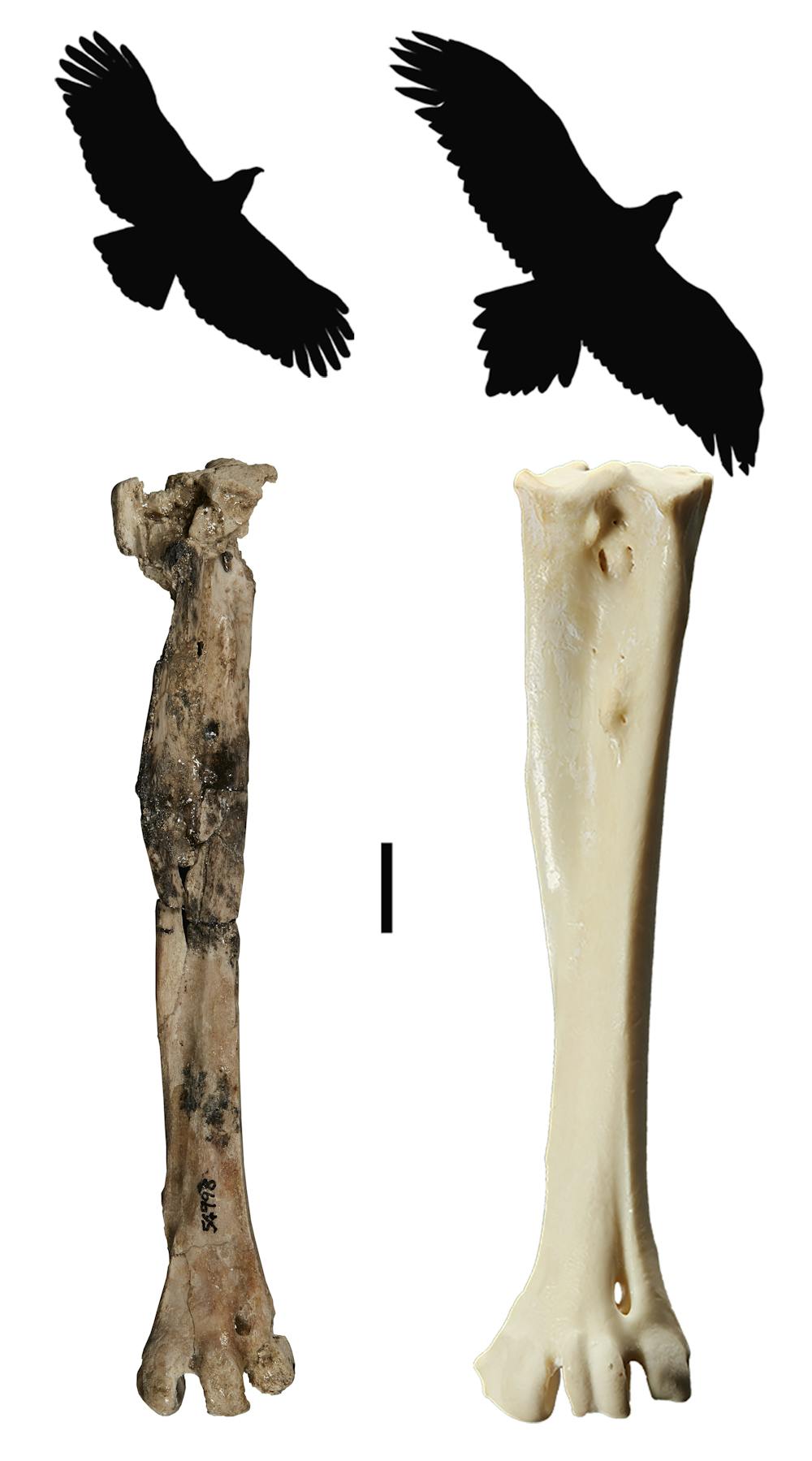 Left tarsometatarsus (lower leg bone) of the fossil raptor Archaehierax sylvestris, beside Aquila audax (Wedge-tailed Eagle). The fossil was distorted during burial so the top half is rotated 90 degrees to the lower half. Silhouettes show relative sizes of these birds. Scale bar represents 10 millimetres.
Ellen Mather, Author provided
Left tarsometatarsus (lower leg bone) of the fossil raptor Archaehierax sylvestris, beside Aquila audax (Wedge-tailed Eagle). The fossil was distorted during burial so the top half is rotated 90 degrees to the lower half. Silhouettes show relative sizes of these birds. Scale bar represents 10 millimetres.
Ellen Mather, Author provided
Archaehierax was clearly a member of the raptor family, which includes most hawks and eagles. But its bones differed in many ways from all other raptors, including similar-aged ones from elsewhere in the world.
Archaehierax sylvestris was not the only raptor we found at Lake Pinpa. Isolated bones show a smaller eagle also lived in these forests, but the fossils are too fragmentary to give this species a name.
There is another fossil raptor known from deposits at Riversleigh World Heritage Area in northwest Queensland. Pengana robertbolesi is a few million years younger than Archaehierax, and not closely related to the Pinpa bird. It was adapted to capture prey in holes in trees.
Our analysis suggests Archaehierax was probably not closely related to any living raptor. Rather, it represented an ancient lineage that split off near the base of the raptor family tree. This is consistent with previous genetic analysis suggesting most living groups of hawks and eagles evolved only in the past 20 million years — roughly 5 million years after Archaehierax lived and died.
Previously, raptor fossils as ancient as 25 million years old were only known from Europe and North America. Archaehierax sylvestris and its smaller contemporary show that Australia was an important geographic location in the early global evolution of raptors.
Australia is already widely understood to be a cradle of evolution of songbirds, and our island continent doubtless played a similar role in the evolution of other types of birds too.
Read more: Meet the giant wombat relative that scratched out a living in Australia 25 million years ago
These raptors and the earliest songbirds lived in temperate rainforests. Back then, the area around what is now Lake Pinpa was located more than 1,100km south of where Adelaide is today, at a latitude equivalent to present-day Fiordland at the southwestern tip of New Zealand.
In the 25 million years since, continental drift has carried Australia and the fossils north at 6 centimetres per year (the speed at which your fingernails grow), travelling more than 1,500km.
The rainforest where these birds lived is now the arid outback. And there are almost certainly many fossils awaiting discovery there that will tell us more about how Australia’s unique birds evolved.
Authors: Trevor H. Worthy, Associate Professor, Vertebrate Palaeontology Group, Flinders University


















