

Modern Australian
Men's Weekly

.

The English language dominates global conservation science – which leaves 1 in 3 research papers virtually ignored

  • Written by Tatsuya Amano, Australian Research Council Future Fellow, The University of Queensland

The English language dominates global conservation science – which leaves 1 in 3 research papers virtually ignored

English is considered the language of international science. But our new research reveals how important scientific knowledge in other languages is going untapped. This oversight squanders opportunities to help improve the plight of the one million species facing extinction.

We reviewed almost 420,000 peer-reviewed papers on biodiversity conservation, published in 16 languages other than English. Many non-English-language papers provided evidence on the effectiveness of conservation measures, but they are often not disseminated to the wider scientific community.

History shows many valuable scientific breakthroughs were originally published in a language other than English. The structure of a Nobel Prize–winning antimalarial drug was first published in 1977 in simplified Chinese, as were many of the earliest papers on COVID-19.

Evidence-based conservation is crucial for tackling the Earth’s biodiversity crisis. Our research shows more effort is needed to transcend language barriers in science, maximising scientific contributions to conservation and helping save life on this planet.

woman with clipboard inspects plants
Research findings in non-English papers can provide valuable insights. Shutterstock

Conservation game-changer

Most scientists speak English as a first or second language. And many academic reward programs are skewed towards getting published in international English-language journals.

But important evidence in biodiversity conservation is routinely generated by field conservationists and scientists who are less fluent in English. They often prefer publishing work in their first language – which for many, is not English.

More than one-third of scientific documents on biodiversity conservation are published in languages other than English. However, such knowledge is rarely used at the international level.

Take, for example, the Intergovernmental Science-Policy Platform on Biodiversity and Ecosystem Services (IPBES). Analysis of the IPBES biodiversity assessment reports has found 96% of references cited are written in English.

Clearly, tackling any global challenge, including the biodiversity crisis, hinges on tapping into the best available knowledge, whichever language it’s produced in. Our translatE project aims to overcome the language barriers to improve this information flow.

As part of the project, we screened 419,679 peer-reviewed papers published in 16 non-English languages between 1888 and 2020 across a wide range of fields. These spanned biodiversity, ecology, conservation biology, forestry and agricultural science, to name a few.

We found 1,234 papers across the 16 non-English languages that provided evidence on the effectiveness of biodiversity conservation interventions. To put this in perspective, the Conservation Evidence database, which documents global research into the effectiveness of conservation actions, holds 4,412 English-language papers.

The rate of publication of relevant studies is increasing over years in six non-English languages: French, German, Japanese, Portuguese, Russian and simplified Chinese.

Among the non-English-language studies we found were a Spanish study on alleviating conflicts between livestock farmers and endangered Andean mountain cats in northern Patagonia, and a Japanese study on the relocation of endangered Blakiston’s fish owls.

Such findings might have valuable insights for human-nature conflicts and threatened bird management in other parts of the world.

owl in icy water
A Japanese study on Blakiston’s fish owls was among the relevant non-English papers the authors identified. Shutterstock

Most English-language evidence on what works in conservation relates to Europe and North America. In some highly biodiverse regions where conservation is needed most, such as Latin America, evidence is desperately lacking.

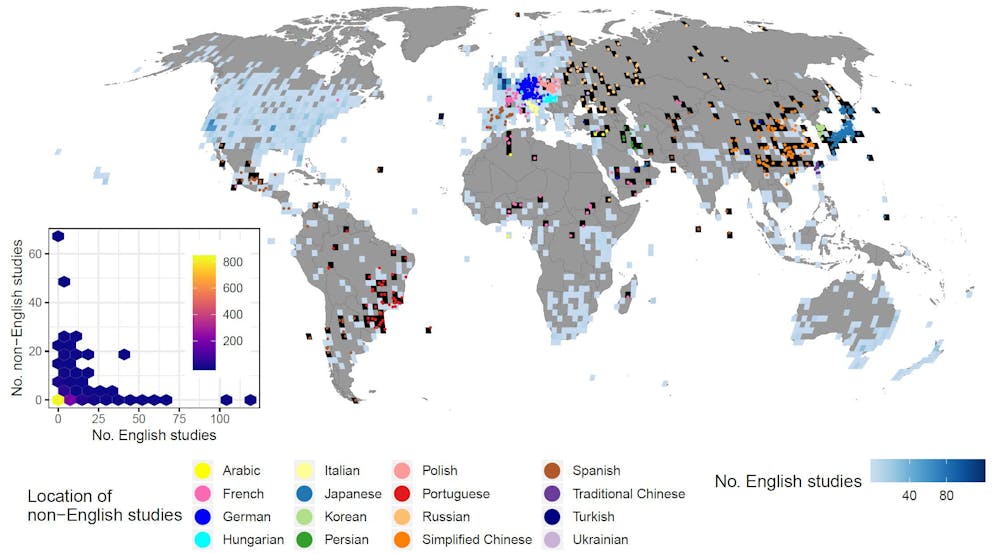
Research in languages other than English is especially common in regions where English-language studies are scarce, such as Latin America, Russia and East Asia (see figure below).

Many non-English studies also involve species for which studies in English are few or non-existent. Incorporating non-English studies would expand scientific knowledge into 12-25% more geographic areas and 5-32% more species.
Read more: Human progress is no excuse to destroy nature. A push to make ‘ecocide’ a global crime must recognise this fundamental truth

The location of 1,203 non-English-language studies testing the effectiveness of conservation interventions, compared to English-language studies. Amano et al. (2021) Tapping into non-English-language science for the conservation of global biodiversity. PLOS Biology.

Tapping global knowledge

Making the best use of non-English-language science can be a quick, cost-effective way to fill gaps in English-language science.

Our research recommends more effort to synthesise non-English-language studies, and making this knowledge available in English so it can be disseminated to a global audience.

And research projects should seek to involve native speakers of different languages. For our research, we worked with 62 collaborators who, collectively, are native speakers of 17 languages.

To have the best chance of halting Earth’s extinction crisis, we must harness the skills, experience and knowledge of people from around the world.

We also urge wider disciplines to reassess the untapped potential of non-English science to address other global challenges.

Read more: 'The pigs can smell man': how decimation of Borneo's ancient rainforests threatens hunters and the hunted

Authors: Tatsuya Amano, Australian Research Council Future Fellow, The University of Queensland

Read more https://theconversation.com/the-english-language-dominates-global-conservation-science-which-leaves-1-in-3-research-papers-virtually-ignored-168951

The Ultimate Guide to Automating Your Weekend Yard Chores

We all look forward to the weekend as a chance to unwind after a long week of work. You probably picture yourself relaxing on the patio with a cold ...

How Ignoring Regular Car Servicing Can Lead to Costly Repairs

Owning a car gives you a sweet sense of freedom and comfort. You can go wherever you want, whenever you want. But with that freedom comes responsibili...

Someone Trips at Your Fundraiser. Now What? Understanding Public Liability for NFPs

Three months of planning. Volunteers giving up their weekends. Sponsorships chased, catering sorted, tables decorated. And then, about an hour into ...

Stainless Steel Tube: A Complete Specification Guide for Engineers, Project Managers, and Industrial Buyers

Few materials in the industrial and manufacturing world are as universally relied upon — or as frequently misspecified — as stainless steel tube...

How to Choose the Right Barber Shears Scissors for Professional Results

Since a barber is only as good as their tool, choosing the right barber shear scissor must not be taken lightly. Most barbers end up buying the first ...

Why Commercial Construction Companies Play A Critical Role In Modern Urban Development

Urban development requires highly organised planning, engineering expertise, and professional construction teams capable of delivering complex build...

Essential Features for Comfortable Family Caravan Trips

Choosing the right van for family travel requires careful consideration of how the space will be used on a daily basis. Families have specific needs...

Chatswood Tutor: Helping Students Achieve Academic Success With Personalised Learning

Education plays a crucial role in shaping a student’s future, and many students benefit from additional academic support outside the classroom. A pr...

How External Consulting Can Guide Enterprise IT Strategy and Procurement

Internal IT teams carry deep operational knowledge, but that familiarity can create blind spots in strategic decisions. An external IT consultant br...

Why Sports Nutrition Australia Is Important for Performance and Recovery

Athletes and fitness enthusiasts place significant demands on their bodies during training and competition. Maintaining energy levels, supporting mu...

How Body Contouring Bundoora Helps Improve Shape And Confidence

Modern aesthetic treatments have made it possible to refine body shape without the need for invasive surgery. One of the most popular non-surgical o...

Why Plantation Shutters Are a Stylish and Practical Choice for Modern Homes

Window coverings play a major role in the comfort, privacy, and overall design of a home. Homeowners often look for solutions that provide both visu...

Why a Retractable Hose Reel Is Essential for Efficient Water Management

Managing hoses efficiently is important for both residential and commercial environments. Whether watering gardens, cleaning outdoor areas, or maint...

Best Ways to Trade In Your Old Tech for Cash in Australia

Upgrading your mobile is exciting, but many Australians are left wondering what to do with the device they no longer use. Instead of leaving it in a...

Why Doctors in Bundoora Play an Important Role in Community Health

Access to quality healthcare is essential for maintaining a healthy lifestyle and managing medical conditions effectively. Visiting experienced doctor...

Backyard Aesthetics Decoded: Mediterranean, Coastal, Retro, Rustic, and Beyond

Backyard design has come a long way from a patch of lawn, a barbecue in the corner, and a few chairs chosen purely for practicality. Today, outdoor ...

What Stops a Home From Feeling Flat-Pack Generic

There is nothing wrong with convenience. Flat-pack furniture, fast styling decisions, and online checkouts have made it easier than ever to furnish ...

5 Best Dental Clinics in Beecroft, NSW

The best dental clinics in Beecroft, NSW are Beecroft Smiles Dental Surgery, Beecroft Elegant Dental Clinic, McConnell Dental, Dentistry for Life, a...
















