

We can't stabilise the climate without carbon offsets – so how do we make them work?
- Written by: Alison Reeve, Deputy Program Director, Energy and Climate Change, Grattan Institute

Carbon offsetting has been in the news lately after a report raised concerns about the integrity of the federal government’s offsetting scheme, the emissions reduction fund.
Offsetting refers to reducing emissions or removing carbon dioxide from the atmosphere in one place to make up for emissions in another. Done well, it lowers the costs of reducing emissions. Done badly, it increases costs and gives us false confidence about our progress towards net zero emissions.
It’s a difficult part of the climate change conversation worldwide and, because of past problems, there’s understandable cynicism about its potential.
The Grattan Institute has just released a new report on the role of offsetting in achieving net zero targets. In it, we show even with strong policies to reduce emissions wherever possible, Australia is going to need offsetting — potentially lots of it — to reach a target of net zero emissions.
What is offsetting?
Offsetting is often done through a system of credits or offsets — units that represent one tonne of emissions reductions achieved, or one tonne of carbon dioxide removed from the atmosphere.
For example, a mining company with a net-zero target might be able to partially reduce its emissions through adjusting its operations, but could find it still has emissions that are too expensive or technically impossible to reduce.
In this case, it might buy an “offset” to cover these emissions. The offset could come from another company with plenty of options to reduce emissions (such as a landfill owner), or it might come from an activity like tree-planting.
Why carbon offsetting is a touchy subject
Offsetting raises strong views. Some see it as an excuse for polluting companies to delay reducing emissions. Others say it destroys the fabric of rural communities because it encourages farmers to turn farming land into places for tree-planting and other carbon-storage activities.
Some international schemes have been criticised for crediting offsetting activities that aren’t “additional”. This refers to activity that would have happened anyway, such as rewarding a landholder for maintaining vegetation that was never going to be cleared, or rewarding a manufacturer for investing in low-emissions technology when that would have occurred regardless.
Australia’s emissions reduction fund has also been criticised on these grounds.
It has also been criticised for the baselines against which offsets are measured and projects receiving credit for activity that hasn’t yet occurred and may never.
Read more: Direct Action not giving us bang for our buck on climate change
All public policy that relies on incentives must grapple with the question of whether an activity is “additional”. It is a hard problem, and it may never be fully solved.
But when it comes to offsetting, it matters, because one of the roles of offsetting is to lower the cost of reducing emissions. In other words, if you can reduce your emissions more cheaply than I can using current technology, it makes sense for me to pay you to do so while I wait for technology costs to come down.
As the chart below shows, if there are too many emissions reduction or removal activities that are credited but didn’t actually happen (“hollow” offsets), then we get a false sense of progress towards net zero. Someone ends up overpaying, so the progress we do make costs more.
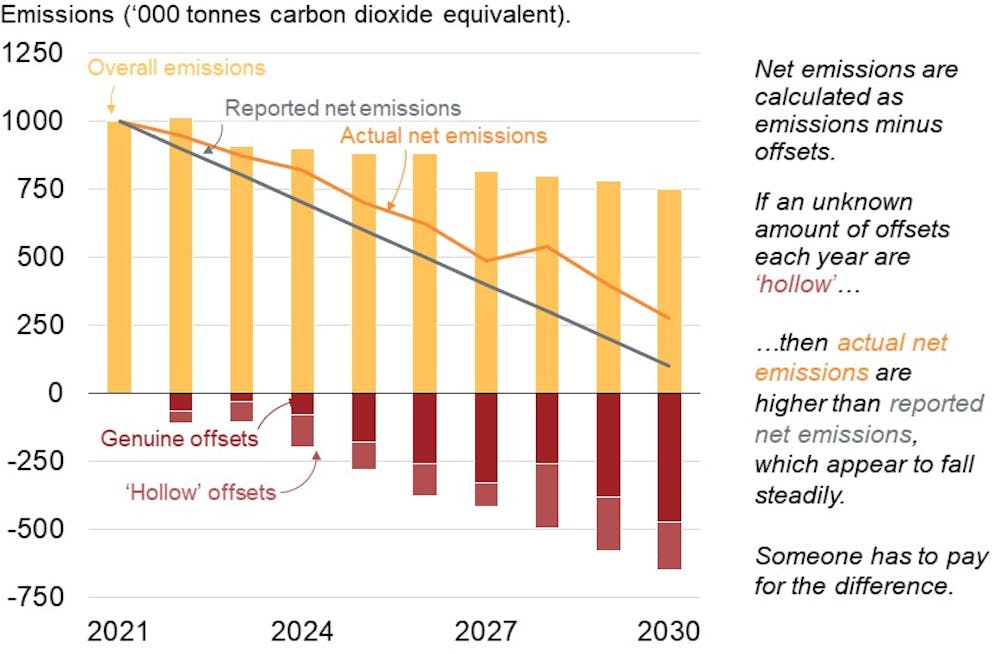 Poor integrity makes the cost of reducing emissions higher.
Grattan Institute
Poor integrity makes the cost of reducing emissions higher.
Grattan Institute
This limits the market’s effectiveness. If buyers aren’t sure they’re getting what they pay for, they won’t pay as much. This pushes prices down, which limits the number of producers willing to do offsetting, because they won’t be paid as much.
More profoundly, these hollow credits give a dangerous false sense of security that emissions are reducing at a particular rate, when in fact they aren’t.
Still, we will need more carbon offsets
Most offsetting in Australia is done by reducing emissions. But as we get closer to net zero, these offsetting options will disappear. There will literally be fewer emissions to reduce, and those that remain will be more difficult and more expensive to eliminate.
Read more: 5 reasons why the Morrison government needs a net-zero target, not just a flimsy plan
Even with strong policies to reach net-zero emissions in time, Australia will need offsets for hard-to-abate emissions sources, such as aviation, cement and beef cattle. The only option to deal with these emissions will be to offset them by deliberately removing carbon dioxide from the atmosphere.
Australia has plenty of land for planting trees to draw down carbon dioxide from the atmosphere, but we don’t have plenty of water or productive soil, and we’ll have even less as the climate warms.
Governments should invest in research and development and early-stage technology development, such as direct-air carbon capture and storage. While these technologies are very expensive and might not work at scale, it would be better to find that out now than in 2050.
Most importantly: governments should put in place stronger policies to reduce emissions. The earlier reports in the Grattan Institute’s Towards Net Zero series have recommendations for cutting emissions from transport, industry, and agriculture.
Every tonne of greenhouse gas going into the atmosphere is contributing to global warming and climate change. The tonne we don’t emit is the tonne we don’t have to offset.
 Cattle is a major source of emissions in Australia.
Shutterstock
Cattle is a major source of emissions in Australia.
Shutterstock
Offsetting needs integrity
Clearly, we need offsetting to reduce emissions — but only if it’s done with integrity. In our latest report, we explain how to make this happen.
We recommend the federal government returns to its original commitment made in 2014 to review every method for creating offsetting units in the emissions reduction fund, every four years. It should allocate additional resources to do this, with independent experts.
International rules to underpin integrity and trade in offsetting units should be settled at the next month’s international conference on climate change (COP26) in Glasgow.
If negotiations drag on, we recommend the federal government put in place rules around the export of Australian offsetting units anyway, to stop potential integrity issues emerging.
Both these actions will show the government is serious about maintaining integrity in its offsetting units. Regular reviews may find problems are minimal – that would be a good outcome.
But if there’s widespread perception that offsetting is some sort of dodgy cheat, then the government will find it even more difficult to use it as a policy tool. So being transparent about problems and moving to fix them quickly is the best solution.
Authors: Alison Reeve, Deputy Program Director, Energy and Climate Change, Grattan Institute


















