

Why are birds' eggs colourful? New research shows it's linked to the shape of their nests
- Written by: Kiara L'Herpiniere, PhD Candidate, Wildlife Biologist, Macquarie University
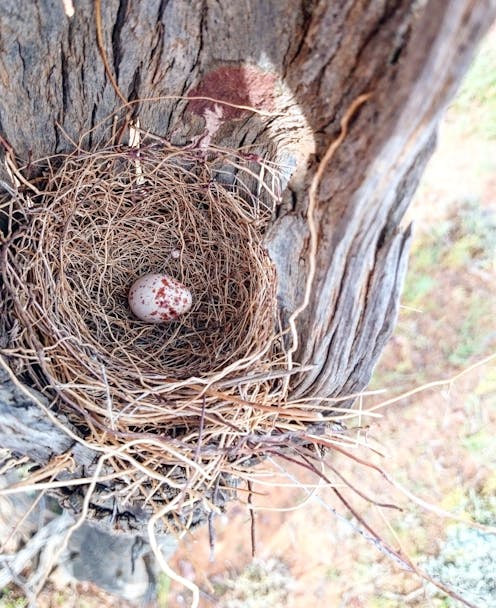
Of all the vertebrates on Earth – that is, animals with backbones – birds are the only ones that lay colourful eggs. Scientists are still unsure why, but new research brings us a step closer to finding out.
In a study published today in the journal Evolution, my colleagues and I reveal how the colours of songbird eggs diversified alongside the evolution of “open cup” nests, more than 40 million years ago.
Why are eggs colourful?
Scientists are not entirely sure why birds lay such colourful eggs. Current theories fall into two main categories.
The first is that colour helps protect the eggs from environmental factors such as extreme cold or rain. Eggs with darker pigments heat up faster and maintain heat longer than white eggs. Pigments have also been shown to help strengthen thinner eggshells.
Eggshells can show areas of thinning, usually when the female’s diet is lacking calcium. This can often result from the use of pesticides, including DDT, in the wild — as they can dissolve or contaminate otherwise nutritious food such as snail shells.
Females have been shown to deposit pigments in the same spots where a shell is thinner (and more prone to breaking) — a bit like covering it with plaster. This may reinforce the shell and help keep it structurally sound.
We know the pigments are produced in the female’s uterus during the shell’s formation, but it’s still not known how different colours and complex patterns are applied to the shell while the egg is still inside the female.
Read more: Hot as shell: birds in cooler climates lay darker eggs to keep their embryos warm
The second theory is that colour provides a survival advantage, either by camouflaging the eggs from predators or parasites, or by signalling the female’s reproductive fitness to potential partners. More colourful eggs, particularly blue, signify that the mother is healthy and can spare resources for her babies.
How is the colour made?
All the colours we see in bird eggs stem from just two pigments, one brown and the other blue. Different concentrations of these two pigments create the vast range of egg colours we see today.
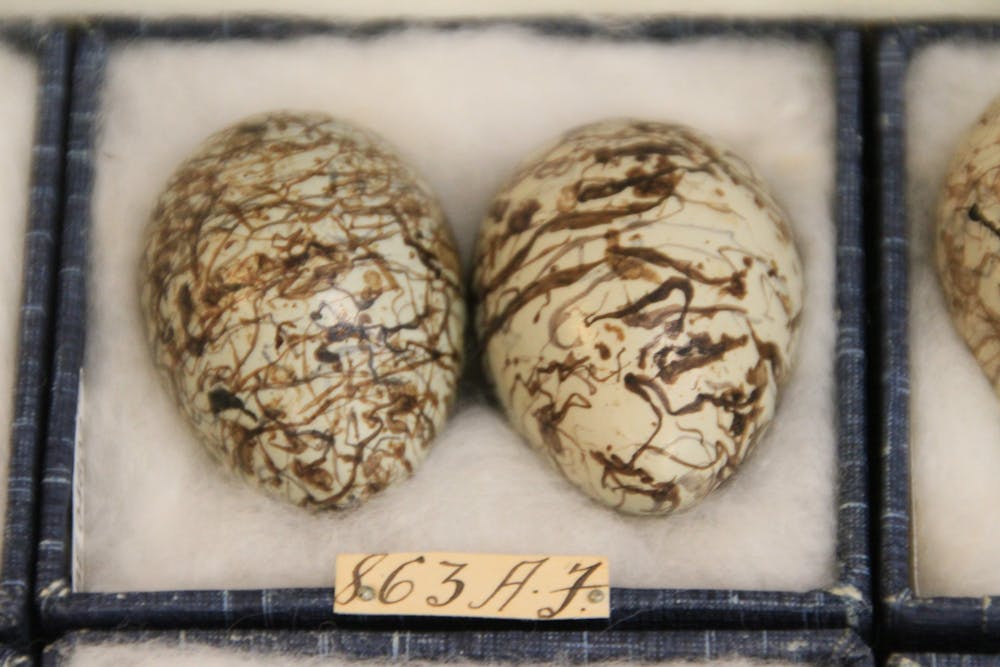 Some eggs have intricate and delicate patterns. We still don’t know how the female birds apply the pigments to the eggshell in this way.
Author provided
Some eggs have intricate and delicate patterns. We still don’t know how the female birds apply the pigments to the eggshell in this way.
Author provided
Until 2017, scientists believed laying colourful eggs was a trait unique to birds. But as it turns out, the same pigments can be found in fossilised dinosaur eggs too.
Researchers also found a link between dinosaurs’ nesting behaviour and egg colour. Specifically, they discovered dinosaurs that laid their eggs in partially open nests (rather than burying them like crocodiles) had colour in their eggshells.
Nest-building through time
Until about 40 million years ago, songbirds built complex dome-shaped nests with insulated walls and roofs. Over time, however, they evolved the ability to create the open cup nests we see more commonly today.
Birds exhibit fantastic dexterity when building nests. Using only their beaks and feet, they can weave an array of nests ranging from relatively rudimentary designs to substantial, intricately woven structures.
The nests must have enough structural integrity to hold both the eggs and the weight of an incubating parent without being punctured. They must also stay intact while parents move around, hatched chicks start wriggling, and during rainfall and harsh winds.
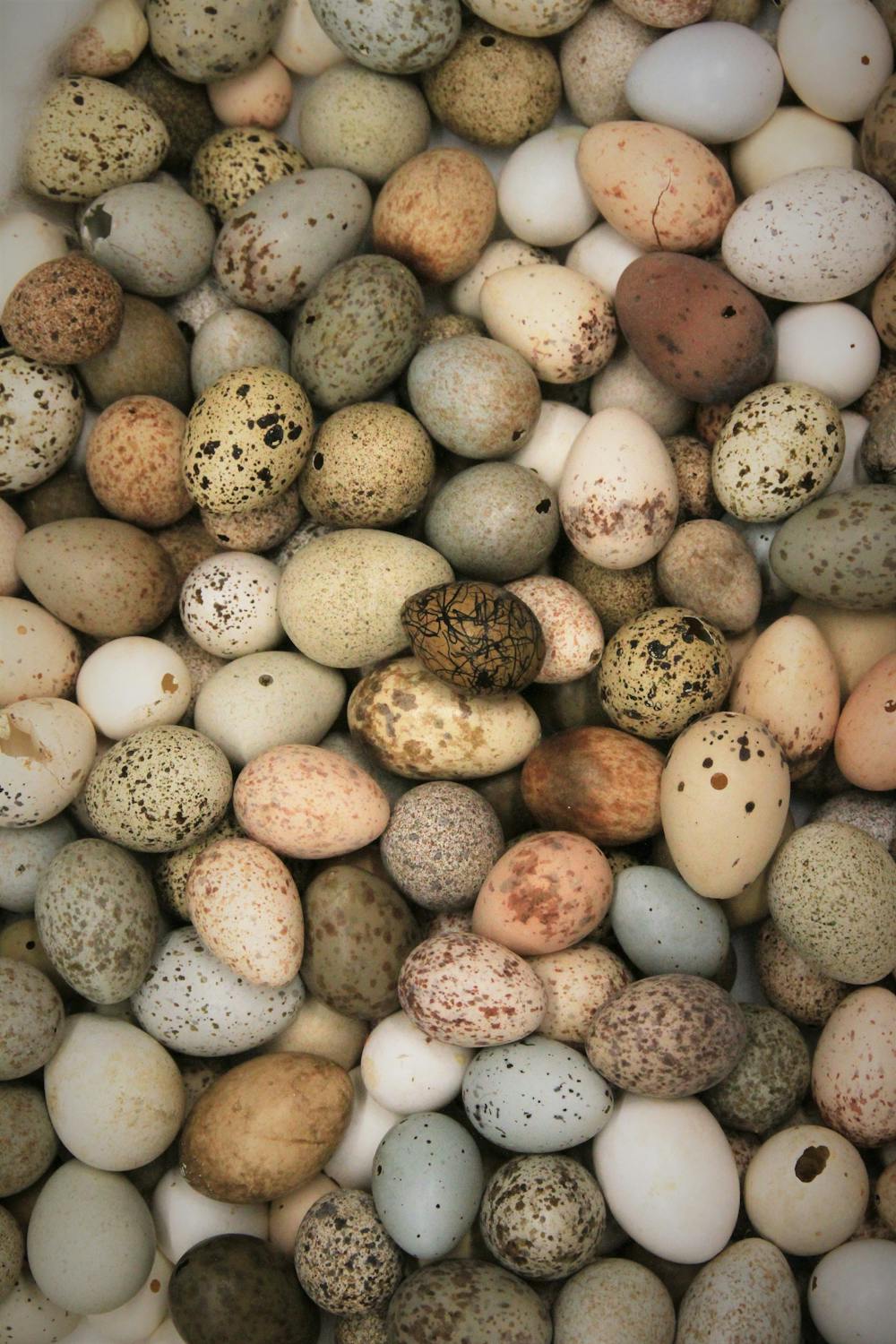
Now, our research has found a link between eggshell colour and changes in nest construction. Specifically, birds have gone from laying a narrower range of coloured eggs (mainly white or dark brown) in closed dome nests, to a wider variety of colours (white, pink, olive, blue, pink and brown) in cup nests.
The transition to cup nests means the eggs are exposed when the incubating parent leaves to forage. During these foraging bouts, eggs are much more vulnerable to falling outside the temperature range needed to survive.
If they get too cold or hot, the embryos die. They’re also more exposed to passing predators looking for a snack.
Parasitic cuckoos lay their eggs inside other birds’ nests, and match their eggs to those already in the nest. Perhaps colour started playing an essential role in host parents’ evolutionary attempts to thwart the cuckoos?
Back when nests were mostly closed, and eggs hidden, the host wouldn’t have needed to produce colourful eggs to distinguish them from the cuckoo’s. Similarly, cuckoos wouldn’t have needed to match their eggs with the host’s.
Our research found that laying colourful eggs is a flexible trait, and was lost and regained multiple times during songbirds’ evolutionary history. Moreover, birds that evolved to make cup nests lost and regained this trait twice as many times as birds that still make closed nests today.
Onward, upward
In the 1800s naturalists had a fascination with birds’ eggs, and it became common to own extensive egg collections. The ultimate goal for collectors, other than prestige, was to have as many different species as possible.
Today, collecting specimens is quite understandably illegal. But those old collections do come in handy.
 Today, it’s illegal to collect or trade native bird eggs in Australia without a permit.
Author provided
Today, it’s illegal to collect or trade native bird eggs in Australia without a permit.
Author provided
For our work, we were able to draw on extensive egg collections donated to museums in Australia. We measured the egg colours of more than 250 different species of Australian songbird, took photographs, and analysed them against their evolutionary histories.
Many of the eggs from museum collections also come with geographical locations. We’re grateful to early naturalists for making extensive notes on where, when and how they collected each clutch.
Moving forward, we want to use this data to investigate how climatic variables interact with egg colour — as well as whether a female’s diet impacts egg colour. Egg-citing stuff!
We would like to acknowledge the Traditional Owners of the land from which these eggs were taken, and pay our respects to the Elders, past and present and emerging.
Authors: Kiara L'Herpiniere, PhD Candidate, Wildlife Biologist, Macquarie University


















