

The Last Man explore loss at a time of mass grief
- Written by: Erin Harrington, Senior Lecturer in English and Cultural Studies, University of Canterbury
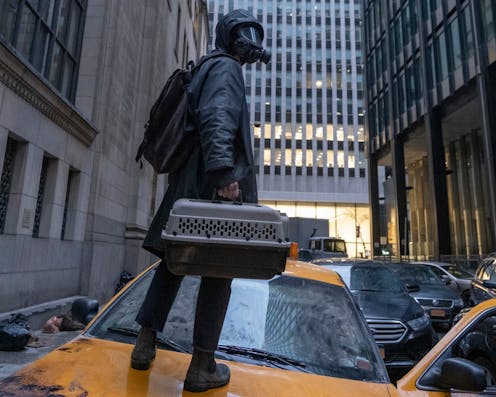
It is a remarkable coincidence that both New Zealand black comedy Creamerie and American post-apocalyptic drama Y: The Last Man have arrived on our screens in the middle of a global pandemic. Both are shows about the aftermath of plagues that kill off the male population.
Both were well into production by the time COVID-19 hit, the latter adapting a critically acclaimed DC Comics series by Brian K. Vaughn and Pia Guerra. Both are led and entirely directed by women – a strong statement in a significantly male-dominated industry.
And as dystopian narratives, they also tap into some significant areas of current social and political interest. These include anxieties about gender roles, and how we deal with loss and grief at a global scale.
Dystopian stories are very effective at exploring the fractures and inequities in our everyday lives by throwing up scenarios in which dreams of a better world have become nightmarish. They take present conditions and challenges and extrapolate them into a society that is deeply recognisable, but more extreme than our own.
Whether they are horrific or comedic, they expose and often satirise the real-world conditions, such as political trends or environmental inaction, that already facilitate oppression and destruction. They act as both thought experiment and warning.
Apocalyptic narratives, too, foreground the best and the worst of us. Although the “end of the world” might be triggered by a sudden calamity – plague, war, a supernatural event – these stories are more concerned with what happens next.
They ask: what happens when the things that structure our everyday lives are stripped away? How can we learn to live in these new conditions? And are we as much of a threat to one another as the catastrophe itself?
Both TV shows engage with these questions, although to different ends and with very different tones.
Divisions and the ‘double shift’
The sudden death of all mammals with a Y chromosome in Y: The Last Man is only the first in a series of rolling disasters – not least the logistical problem of dealing with the physical remains of half the population.
The series is very interested in the ripple effects of gender inequality, especially in the workplace. This exposes how much our societies remain structured along roughly binary lines, despite significant attempts to move towards a more equitable and egalitarian society.
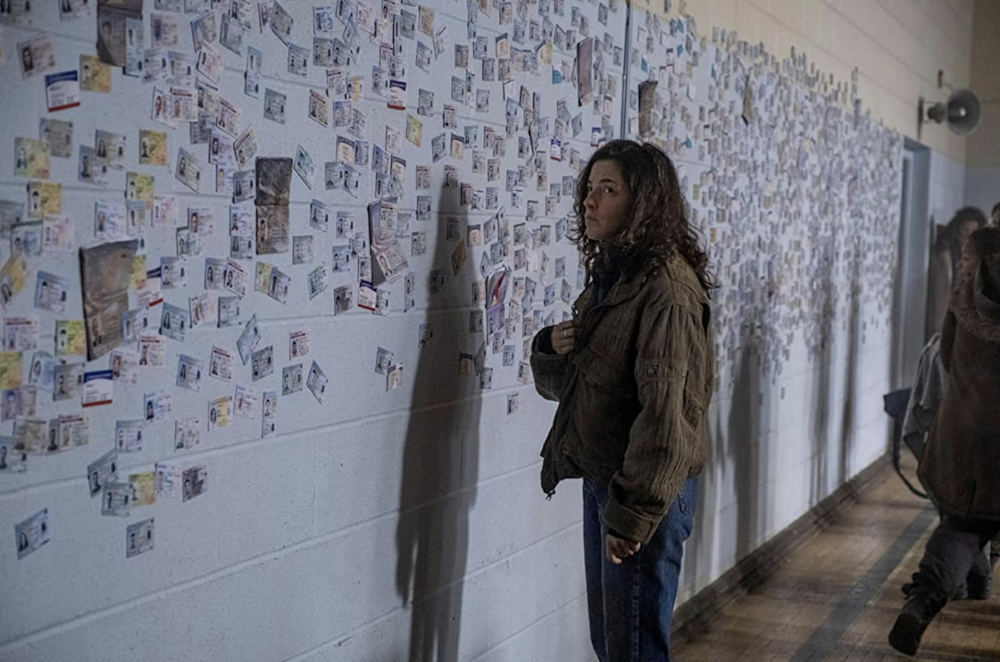
In early episodes the former Congresswoman and newly minted President Jennifer Brown (Diane Lane) struggles to govern. The United States’ critical infrastructure, which was staffed almost entirely by men, has collapsed.
Without water, power or food, people are beginning to riot, but there aren’t enough police or military personnel to keep the peace. Because men still dominate decision-making roles, a skeleton crew of female politicians and civil servants is left to salvage civil society.
In a moving scene, Brown tries to persuade one of the only remaining female nuclear engineers to help restore the power grid. Brown reminds her how hard it has been to always be the only woman in the room – and the burden that she now bears because of this.
 The cover of an issue of graphic novel version Y: The Last Man, created by Brian K. Vaughan and published by Vertigo, later DC Comics.
Wikimedia Commons, CC BY
The cover of an issue of graphic novel version Y: The Last Man, created by Brian K. Vaughan and published by Vertigo, later DC Comics.
Wikimedia Commons, CC BY
But power struggles swiftly emerge. The overnight erasure of gender privilege only exacerbates other sources of inequity, such as race and class. There is also an ideological clash between Brown and more politically conservative women, notably the Machiavellian former First Daughter Kimberley, played by Amber Tamblyn.
Their insidious emphasis upon the importance of traditional gender roles and so-called “family values” sits uncomfortably against scenes, pre- and post-disaster, where women struggle to deal with their domestic and professional roles. We are reminded that social inequity is deeply tied to child-bearing and rearing.
Far from critiquing women’s professional ambitions and reproductive choices, the series’ domestic scenes illustrate powerfully the damaging “double shift”: the large amount of invisible, underappreciated and unpaid domestic labour undertaken by women.
This is a problem not just for women, but society at large – made worse when the survival of the species relies on sperm banks and willing mothers.
Read more: Are we living in a dystopia?
A feminist utopia
Reproduction is also central to Creamerie’s satirical project. Eight years after the emergence of the virus – illustrated through a gory, slo-mo montage set ironically to a dreamy cover of What A Wonderful World – we seem to be in a feminist utopia.
The new society is overseen by blonde, charismatic Lane (Tandi Wright), leader of a hyperfeminine, Goop-like organisation. Education and healthcare are free, and menstruation leave is mandatory. Thanks to the survival of sperm banks, women enter a lottery to be artificially inseminated so they may re-populate the world with their daughters.
Rebel Alex (Ally Xue), grieving mother Jamie (JJ Fong), and perky rule-follower Pip (Perlina Lau) live together on an organic dairy farm. Crisis hits when Pip accidentally runs over a man – potentially the last man alive. He believes there are other survivors, which would upend this new way of life.
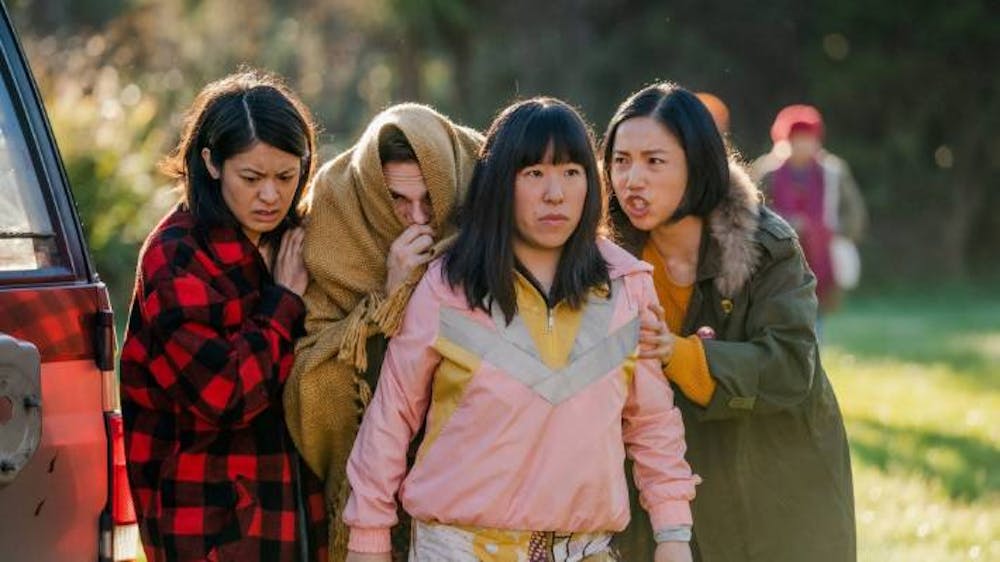 In New Zealand comedy Creamerie, the new world sans men is run by the leader of a hyperfeminine, goop-like organisation.
SBS on Demand
In New Zealand comedy Creamerie, the new world sans men is run by the leader of a hyperfeminine, goop-like organisation.
SBS on Demand
The premise inverts many of the tropes laid bare in the reproductive horrors of The Handmaid’s Tale and its many imitators, which similarly foreground natalist policies.
Instead, Creamerie is wickedly funny and playful. Its bougie wellness cult operates with silken voices, performative kindness, and what appears to be the veneration of female collectivity.
However, we soon witness the classist, racist, heteronormative, and individualistic tendencies at the heart of this new society, which satirises the predatory nature of the wellness industry.
We are also faced with difficult questions about the fate of those men who might remain – how they too might be objectified and commodified for their reproductive potential.
Read more: The Handmaid's Tale: no wonder we've got a sequel in this age of affronts on women's rights
A world grappling with cataclysm
Although they differ considerably in tone, both shows are united in their exploration of loss and trauma. This reflects the rising number of recent series, films, books and games that feature inexplicable mass casualty events and ecological cataclysm.
In a world grappling with a climate disaster, and now a brutal pandemic, it is natural to turn to art to explore how we might live when our lives are braided with inconsolable grief.
Ultimately Creamerie and Y: The Last Man ask us how we suffer losses that are too great for words, and whether we cope with tears, connection, or gallows humour.
Creamerie is available to stream on SBS on Demand, and Y: The Last Man is currently streaming on Binge.
Authors: Erin Harrington, Senior Lecturer in English and Cultural Studies, University of Canterbury


















