

NZ's government plans to switch to a circular economy to cut waste and emissions, but it's going around in the wrong circles
- Written by: Hannah Blumhardt, Senior Associate at the Institute of Governance and Policy Studies, Te Herenga Waka — Victoria University of Wellington
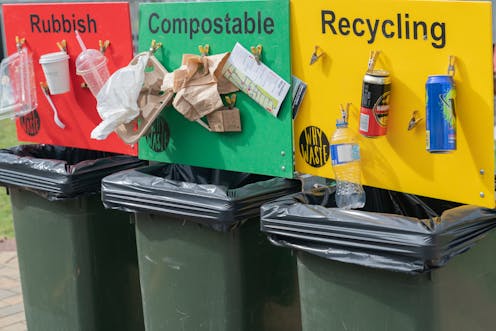
The New Zealand government is currently developing plans to address two crises — climate change and waste — and to embrace a circular economy. But it has no clear path for how to do this. The resulting muddle is watering down the potential of a circular economy to bring lasting change.
Public consultation is underway to develop an emissions reduction plan, following the Climate Change Commission’s advice on carbon budgets towards New Zealand’s 2050 net-zero target.
Another consultation document proposes to overhaul the country’s waste strategy and legislation.
Both documents intend to move Aotearoa towards a circular economy — one that limits waste and pollution, keeps products in use, and regenerates natural systems to protect, not pillage, natural resources.
But the government’s plans for circularity are fragmented, contradictory and uncoordinated. They fail to confront the business-as-usual drivers of the linear economy or to enhance collaboration.
New Zealand needs a dedicated Crown agency to champion a low-waste, low-emissions circular economy.
Read more: What a sustainable circular economy would look like
The need for circularity
New Zealand is one of the most wasteful countries in the OECD. Waste is not only a pollutant but the dead end of a linear supply chain that emits greenhouse gases at every step along the way.
Roughly half of global emissions come from producing and consuming stuff. Every bit of waste represents embodied emissions lost to the economy.
Circular practices preserve this embodied energy by keeping products and materials in use. This slows down global extraction of natural resources, from mining to tree-felling. The less is extracted, the more waste and emissions are reduced.
Currently, just 8.6% of the global economy is circular. This figure must double by 2032 to keep us on track to limit global warming to 1.5℃.
Doubling the circularity of New Zealand’s economy would mean transforming production and consumption systems. Today, much of what we make and buy is inherently linear.
In a circular economy, products are built to last and designed for repair. Organics are composted to replenish soils. Business models favour sharing over individual ownership, and reuse over single use.
This seismic shift in economic direction demands coordination across sectors, strong leadership and a shared understanding of the circular model. The government must collaborate with those already practising circularity and reconfigure the rules to wind down linear practices.
Lack of a whole-of-system approach
The consultation documents do not tell a shared circular economy story. The waste strategy focuses on end-of-product-life processes such as waste management, litter and recycling; the proposed emissions reduction plan discusses business models and innovation.
The waste proposal suggests the Ministry for Business Innovation and Employment (MBIE) will eventually bind everything together in a “separate and broader circular economy strategy”, but this risks creating a bigger tangle.
The confusion is not surprising. The government’s work on circularity has been splintered between the Ministry for the Environment and MBIE. The agencies’ organisational cultures and priorities differ and they have not connected their thinking for a whole-of-system approach.
Critical elements of the circular economy are falling through the cracks in the silos, particularly the part about economic transformation. Increasing corporate responsibility for waste is the hottest potato no one wants to touch.
Read more: How businesses could cut plastic waste with a track and trace system
The consultation documents propose few upstream policy interventions to trigger product redesign or new business models that reduce waste and emissions. Instead, they focus on using or disposing of waste after it’s been produced, which presumes, rather than challenges, linear inefficiencies.
All the wrong circles
Despite responsibility being the central theme of the waste proposal, it makes nobody responsible for waste creation because it never analyses where waste comes from. Instead, it emphasises improved waste management and anti-littering laws. This lumps responsibility at the end of the pipe, on individuals and councils who cannot influence waste baked into the system further upstream.
Furthermore, product stewardship is ring-fenced to “end-of-life” activity, neutralising its potential to redistribute responsibility further up product supply chains.
The emissions reduction plan does not fill this gap, apart from some promising initiatives for the construction sector. The connection it draws between circularity and climate abatement mostly relates to organic waste rather than overall production and consumption. Despite considering the potential for new business models to address climate change, product stewardship is barely mentioned.
Instead, it views circular innovation through the lens of the “bioeconomy”, where waste-derived biomass is converted into bioenergy and new products. But a bioeconomy depends on continued waste generation, which is arguably non-circular. It also contradicts the waste proposal’s suggestion to discourage waste-to-energy “downcycling” through levies.
Read more: Why municipal waste-to-energy incineration is not the answer to NZ's plastic waste crisis
A circular economy with no driver
The government cannot achieve circularity alone, but has no cogent plan for collaboration.
Supporting community groups and local enterprises does not appear a government priority. Both documents describe circularity and innovation as future states, yet many organisations already implement circular and zero-waste practices and are potential partners.
A Te Tiriti-based partnership is fundamental for economic transformation. The Climate Change Commission described the circular economy as aligned with a Māori worldview. Organisations like Para Kore show Māori leadership in advancing zero waste and circularity.
While the emissions reduction plan promises meaningful partnership with Māori, the waste proposal does not. This is a missed opportunity. New waste legislation could protect Māori decision-making rights and rangatiratanga over natural resources.
Rather than charting a clear path to a circular economy, the government is proliferating documents that perpetuate a business-as-usual approach where communities, councils and government run around in the wrong kinds of circles, cleaning up after industry.
The problem isn’t a lack of good ideas. But these ideas aren’t properly filtered or organised, important elements and key partners are missing and nobody’s in the driver’s seat.
Moving Aotearoa away from silos and towards a circular economy requires a dedicated Crown agency with a Te Tiriti-compliant governing structure. This agency could champion circularity, resource efficiency and conservation across the system, from resource extraction to product disposal.
Authors: Hannah Blumhardt, Senior Associate at the Institute of Governance and Policy Studies, Te Herenga Waka — Victoria University of Wellington


















