

after a 90-year campaign, Gardens of Stone is finally protected
- Written by: Hannah Della Bosca, PhD Candidate and Research Assistant at Sydney Environment Institute, University of Sydney
In the rocky upland wilderness of Wiradjuri Country two hours west of Sydney lies a new protected area with a nine-decade-long history of dogged environmental activism: the Gardens of Stone.
Last month, the New South Wales government officially recognised the Gardens of Stone as a State Conservation Area within the National Parks estate. First proposed in 1932 and with a small portion of the area designated as National Park in 1994, this decision will see more than 30,000 hectares finally protected.
The government has also earmarked the region for ecotourism. With its epic gorges, the globally unique hanging swamps of Newnes Plateau, craggy cliff ravines and slot canyons, this 250-million-year-old geological landscape is a paradise for adventurers.
But more than anything, the Gardens of Stone is, as stalwart campaigner Julie Favell puts it, a “storybook of nature”. This is no simple story, but one of a generational mining community on the brink of social change and an often thankless, hard-won battle for ecological recognition in the heart of coal country.
Read more: 4 unexpected places where adults can learn science
Sandstone towers and rare wildlife
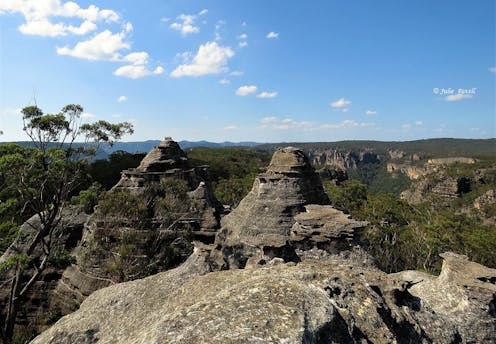
Towering sandstone and iron-banded pagoda formations are what you’d most likely find on a Gardens of Stone postcard. These intricately weathered structures breach the eucalyptus canopy and cluster on a cliff, like a cross between the temples of Angkor Wat and a massive beehive complex.
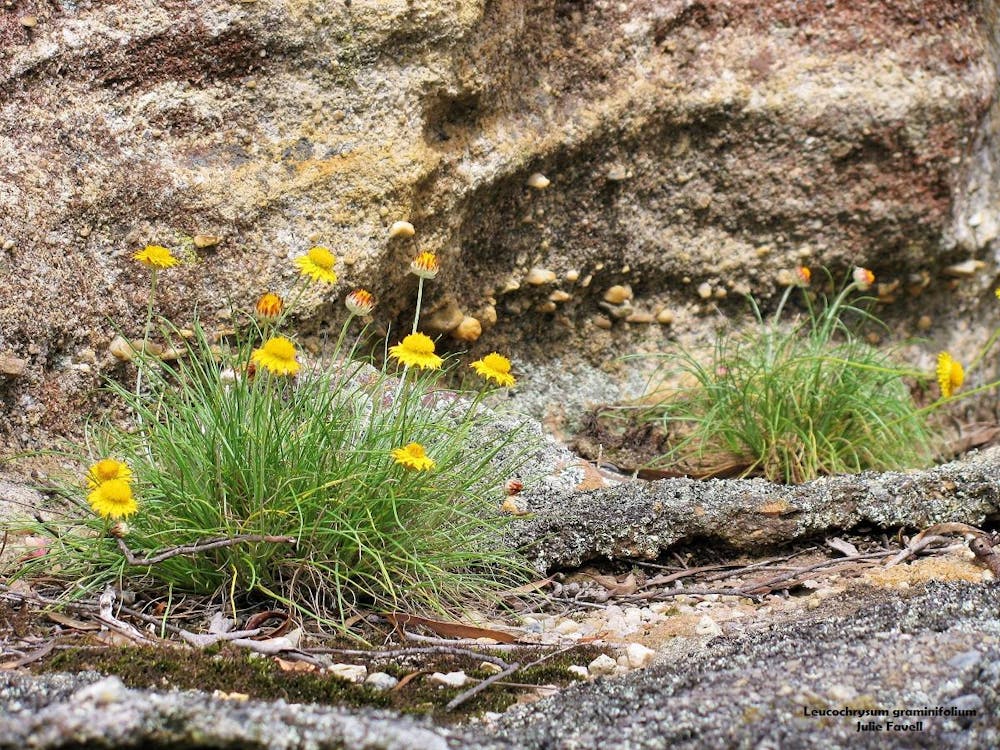
The Lost City, Newnes Plateau, in Lithgow.For close and curious observers, there are also smaller, less dramatic icons. Rare wildflowers abound, including countless native orchids and the pagoda daisy, which grows only in rocky crags. In fact, the park is home to more than 40 threatened species, including the regent honeyeater and the spotted-tail quoll.
A humble jewel of the Gardens of Stone is its endangered upland peat swamps. Resembling a meadow clearing, up close these swamps form watery spongescapes that function as both kitchen and nursery to hundreds of local species. Inhabitants include the endangered Blue Mountains water-skink and giant dragonfly.
These upland swamps on sandstone are found nowhere else in the world, and they play a critical role in regional water and climate resilience, as they store carbon and mediate flooding and drought.
A rocky battle
The environmental features of the Gardens of Stone are so intertwined with local, state and national conservation efforts that to tell the story of one is to tell the story of the other.
Local environment groups have worked relentlessly to demonstrate the geological heritage of the pagodas in the face of open cut mining. They have documented the impacts of mining on swamps and waterways, tried to hold companies accountable for their destruction, and recorded the presence of many hundreds of previously undocumented plant and animal species in an effort to have the area’s value formally recognised.
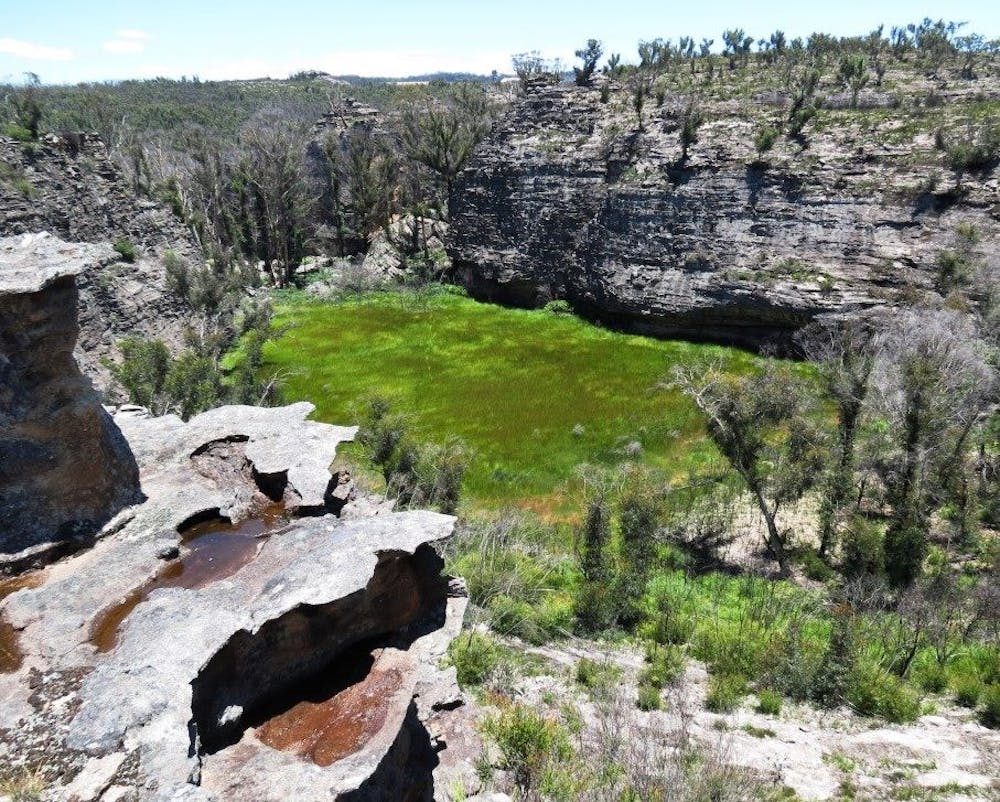 Gooches Crater swamp, ringed by cliffs and pagodas.
Julie Favell, Author provided
Gooches Crater swamp, ringed by cliffs and pagodas.
Julie Favell, Author provided
This long campaign has also been the subject of legal battles in the courts of NSW. The last two decades in particular have seen, for example, countless petitions, public events, environmental testing and monitoring projects, and the task of sifting through technical mining documents with each new mining proposal.
Two mines are currently in operation within the conservation area, with an extension to an existing site proposed. The most significant impacts from mining in recent decades have been sandstone cracking, causing swamps to dry out and die, and disruptions to upland water flows and regional water quality.
 Lithgow Environment Group’s Chris Jonkers in a swamp damaged from nearby mining.
Julie Favell, Author provided
Lithgow Environment Group’s Chris Jonkers in a swamp damaged from nearby mining.
Julie Favell, Author provided
Conserving the Gardens of Stone has been an uphill battle in overcoming indifference and opposition.
At the local level, environmental impacts from mining were derided as inconsequential in the face of mining employment, with campaigners bearing the brunt of distrust and hostility from pro-coal locals towards their perceived interference.
At the state level, hard-won environmental protections were overthrown in favour of mining approvals. In 2017, the NSW government weakened laws to allow mining extensions that impacted Sydney’s drinking water quality, with likely damage to legally protected swamps within the Gardens of Stone not addressed.
Due to existing mining developments, the extended Gardens of Stone isn’t officially designated as a National Park, but is instead a “conservation area”. This means any new developments, such as extensions to mines, must use processes that support conservation requirements.
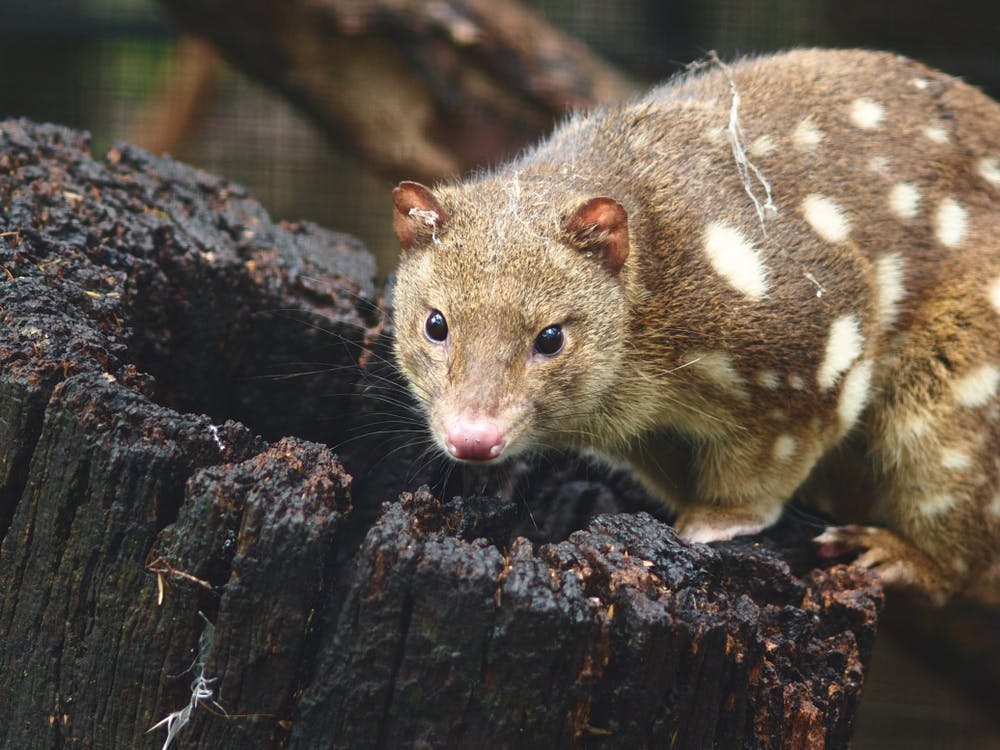 Spotted-tail quolls are one of the rare species living in the Gardens of Stone.
Shutterstock
Spotted-tail quolls are one of the rare species living in the Gardens of Stone.
Shutterstock
Transitioning away from coal
Hopefully, encouraging responsible developments will avoid further ecological damage and help enable a smoother economic transition away from coal in the coming decades.
Despite Australia’s national climate strategy remaining entrenched in coal, local coal prospects are winding down. This seems heralded by last week’s demolition of Wallerawang Power Station just outside the new conservation area.
Read more: How to transition from coal: 4 lessons for Australia from around the world
The new conservation area comes with a A$50 million investment, and will see hundreds of thousands of visitors flocking to explore a range of proposed new attractions. Chief among these will be the Lost City Adventure Experience, featuring Australia’s longest zipline and an elevated canyon walk, as well as a rock-climbing route and a six day wilderness track. These attractions are expected to create an extra 200 jobs.
This new pivot towards ecotourism provides an example of a strategic and environmentally just transition pathway for the coal community in practice.
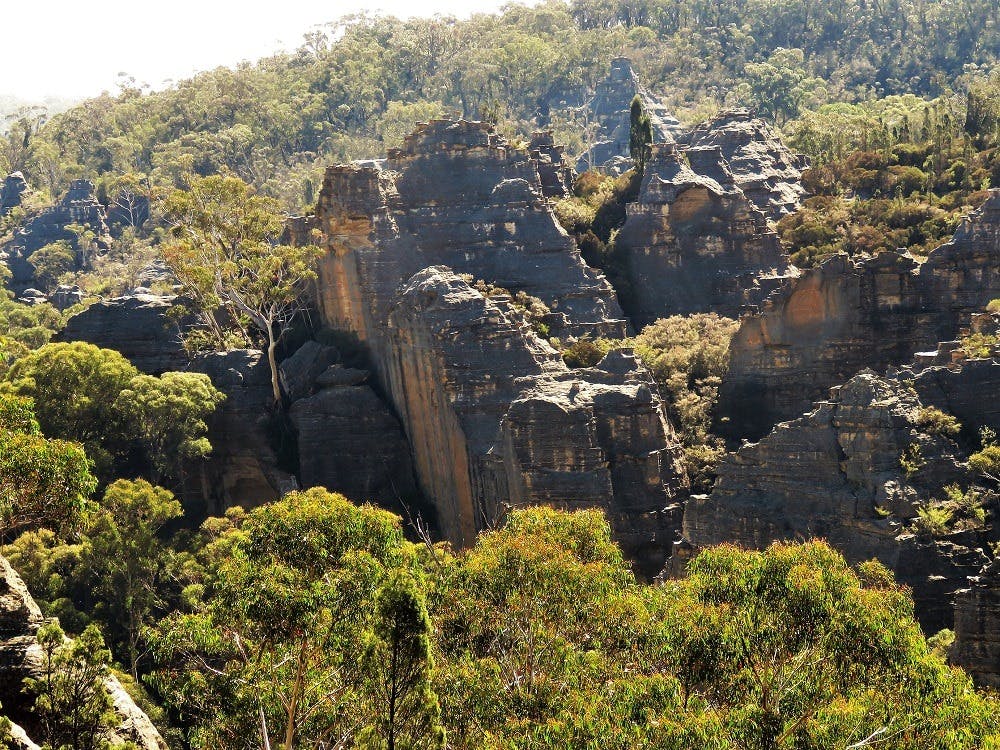 Pagodas at Newnes in the Gardens of Stone.
Julie Favell, Author provided
Pagodas at Newnes in the Gardens of Stone.
Julie Favell, Author provided
The Gardens of Stone victory may reflect a new dawn of negotiation that could mark an end to the often antagonistic view of conservation as a threat to local livelihoods in this area.
This victory and vision belongs squarely with its environmental campaigners, some of whom have given over 30 years of sustained and dedicated effort to make it a reality.
As the world’s attention is increasingly turned towards climate action, the success of this campaign may provide the surge of momentum we need for a more sustainable future.
Read more: The Blue Mountains World Heritage site has been downgraded, but it's not too late to save it
Authors: Hannah Della Bosca, PhD Candidate and Research Assistant at Sydney Environment Institute, University of Sydney


















