Farmers shouldn't have to compete with solar companies for land. We need better policies so everyone can benefit
- Written by Madeline Taylor, Senior Lecturer, Macquarie University
When it comes to solar energy, Australia has a huge natural advantage with an abundance of sun and vast, flat expanses of land. This makes it relatively easy to build solar farms across the continent.
Some proposed projects, however, overlap with arable land. As a result, solar companies and farmers are often in competition, with conflicts already arising in Canberra, Queensland and Wagga, the South Riverina and Greater Hume in New South Wales.
But these are familiar battlegrounds. Such tension has played out over many decades with agricultural communities facing serious environmental, social and health impacts from coal and coal seam gas projects.
We can avoid history repeating itself if we urgently set the right policies and laws in place. The pressing task for law and policymakers now is to ensure Australia’s clean energy transition sees solar development occur with co-benefits for local communities, and protects productive agricultural land.
Rising tension
Australia has the highest average solar radiation per square metre of any continent in the world. This has led the federal government to aim for ultra-low cost solar production in its long-term plan to reduce emissions.
Likewise, Labor’s recent announcement of 43% emissions reduction target by 2030 relies heavily on increased renewable energy.
Read more: Renewables need land – and lots of it. That poses tricky questions for regional Australia
But right now, the state and territory governments are leading Australia’s clean energy revolution, rolling out crucial “Renewable Energy Zones”, often within or near agricultural regions.
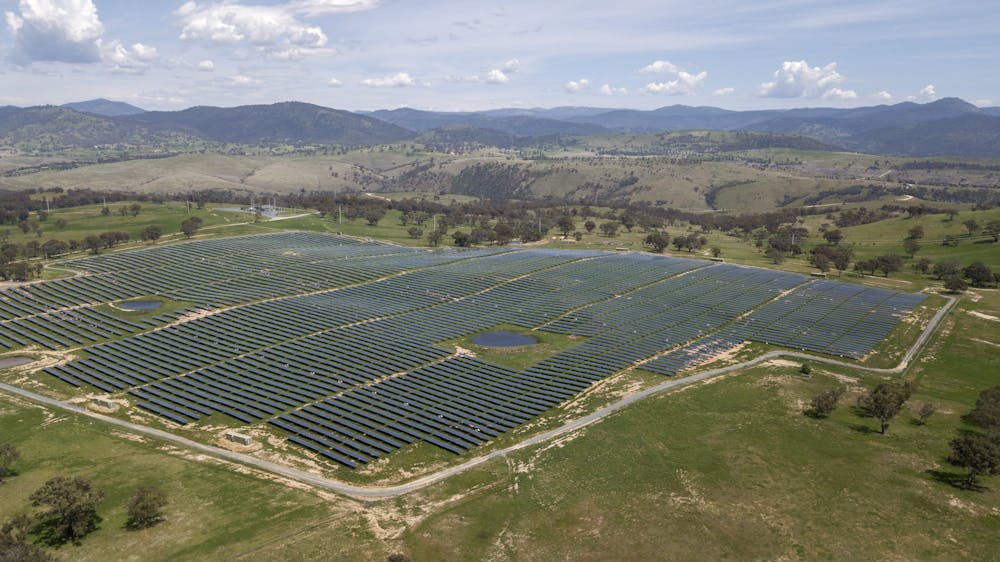
Agricultural land is flat, cleared, and sometimes situated near existing power infrastructure and distribution networks. Such conditions are ideal for solar farms, which can require up to 2-3 hectares per 1 megawatt (MW) of solar energy.
Clean energy companies must avoid the development mistakes of the fossil fuel industry or risk losing their social licence.
In fact, rising tension between agricultural communities and solar companies has led the NSW government to recently consider restricting solar and wind farm developments in regional towns.
Some communities who have experienced the impacts of coal seam gas, such as the Darling Downs, are particularly sensitive to the potential impacts of any new energy development. This includes aquifer contamination, damage to the surrounding environment and ecosystems, and the displacement of communities.
Read more: Against the odds, South Australia is a renewable energy powerhouse. How on Earth did they do it?
Now, these communities are once again being asked to negotiate land access and compensation arrangements for solar farms. Vast solar farms may mean arable land can no longer be used for growing crops.
The main problem is the twin policy objectives of accelerating renewable energy development and preserving sensitive land uses aren’t woven into legal precedent in some states.
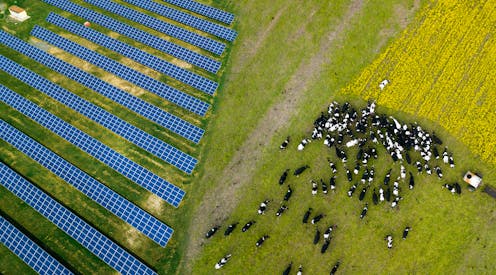
 We can avoid further tension between agriculture ad solar companies with effective co-sharing policies.
AP Photo/Jim Mone
We can avoid further tension between agriculture ad solar companies with effective co-sharing policies.
AP Photo/Jim Mone
For example, in Queensland, local councils usually need to assess the merits of a new solar farm project by default, rather than assess them “against a range of other existing uses or matters such as agriculture”.
What co-benefits could look like
Experiences in Victoria show a better alternative. Two Victorian tribunal cases assessed solar farm proposals on agricultural land from companies PowerVault Mildura and Helios Volta. The tribunal emphasised the need for “co-location” as a foundational policy pillar to balance the overall community benefit.
The Victorian government has also taken steps to create best practice guidelines for renewable energy companies to deal with agricultural land loss. This includes protecting high-quality soils and strategic agricultural land.
Read more: People need to see the benefits from local renewable energy projects, and that means jobs
But it’s not just about managing loss of land. Best practice regulation could lead to a range of benefits for farmers, from electricity benefits in the local community to sustainable farming practices.
For one farmer in Dubbo, installing 56,000 solar panels provided crucial shade and condensation to help grass stay green for sheep grazing during drought. Likewise, solar energy from Sundrop Farms in South Australia powers a desalination unit, which produces pure water to irrigate crops.
How over 50,000 solar panels provided shade and green grass for a farmer’s sheep during drought.So what needs to happen now?
Governments should incentivise and prioritise renewable energy and storage facilities on rehabilitated land, such as land previously used to develop coal, gas or other minerals. Agricultural land should be selected only if no alternative sites are available, or if co-location is possible.
An excellent example of this is the recent site selection of a 150MW battery earmarked for construction at the previous Hazelwood power station in Victoria’s Latrobe Valley.
Another is Kidston in regional Queensland, where an abandoned gold mine was transformed into the world’s first solar and pumped hydro system.
An old mine in outback Queensland becomes a renewables goldmine.As the world surges towards net-zero emissions, coal and gas will be rapidly phased-out. Solar and wind are now the cheapest form of energy generation and are already outcompeting coal and gas in the electricity grid.
The clean energy revolution will create endless economic and job opportunities for regions. Australia could lead the world in renewable energy and other clean industries such as renewable hydrogen.
But we need strategic and holistic planning to ensure the transformation of our energy system strikes the right balance for both our champion industries - renewable energy and agriculture.
Authors: Madeline Taylor, Senior Lecturer, Macquarie University