

The ring trees of Victoria's Watti Watti people are an extraordinary part of our heritage
- Written by: Jacqueline Power, Lecturer, University of Tasmania
In the forests of Watti Watti Country of north-west Victoria, you can find trees, typically ancient river red gums, with their branches trained by the Watti Watti people to form rings. There is little knowledge about these marker trees beyond the community, and they are currently afforded little in the way of formalised heritage protection.
Watti Watti (sometimes spelled Wadi Wadi) Elder Aunty Marilyne Nicholls describes family and community connections to the river red gum forests along the Murray in the following way:
Often we visit to pay respect to the sacred sites that are earthed on the land among the red gum trees. In the forest are some really old red gum trees that are known as markers and often can be seen near a heritage site. These huge old red gum trees have massive trunks and big branches that are joined together to make a ring.
Read more: Explainer: the importance of William Barak’s Ceremony
These significant trees would have had their young, supple branches fused together using string woven from cumbungi reeds. The binding process trained the branches to grow in the form of a ring shape over time.
The number of rings in an individual tree varies. Sometimes there can be up to four rings in a single tree. My research on ring trees aligns with the goals of the local Traditional Owners, who are working to educate and build knowledge in the area.
There are other, more well known cultural practices in various parts of the country that involve trees, such as “dendroglyphs”, also called “carved trees”, that had decorative patterns engraved for ceremonial purposes.
Other examples are scar trees that had sections of bark removed to make canoes, shields, coolamon (or carrying) vessels and for the construction of other timber objects.
The role of ring trees
Watti Watti Elder Uncle Doug Nicholls has explained to me that ring trees demarcate boundaries and mark special areas on Country. The trees mark significant cultural locations in the landscape and have been found at “water junctions and inlets, campsites and burial grounds.”
Knowledge of these important places which the ring trees mark could then be conveyed to visitors to Country involved in trade and ceremony. A defining feature of the Watti Watti landscape is the mighty Murray River (miilu is the traditional language term of this area for river), its tributaries, and associated floodplains.
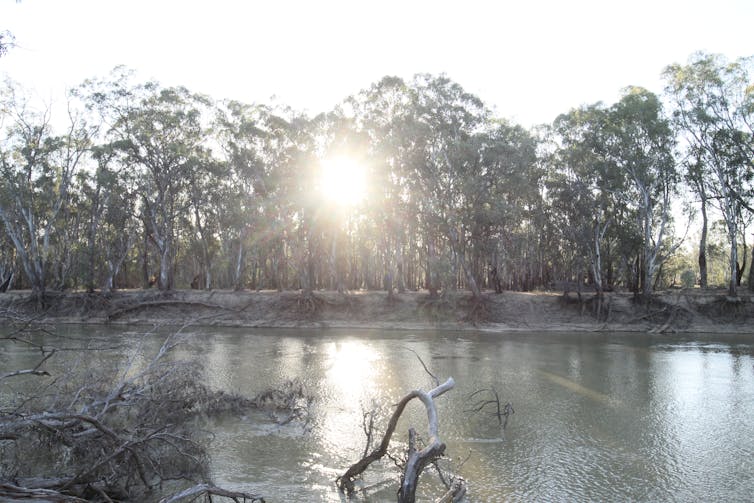 Ring trees were often made from river red gums around the Murray River.
Tim Church/Timmy Church Films.
Ring trees were often made from river red gums around the Murray River.
Tim Church/Timmy Church Films.
Water remains an important story associated with the ring trees, including “cultural flows” - the right to water for cultural purposes. Elder Aunty Marilyne Nicholls has explained that the ring trees all hold stories and have spiritual and cultural significance.
There is one ring tree that is recognised by the broader community and even sign-posted. It is located in the township of Koraleigh on the New South Wales side of the state boundary. Its context has been disrupted by colonisation, cut-off from the broader environmental and cultural landscape, and is flanked by a road and a paddock.
Due to the disruption of its context, this tree has become a single “site”, rather than part of the wider cultural landscape - isolated and dislocated from its complete story. It is now a stranger in an agrarian landscape. The tree is no longer alive, impacted by the drought and lack of access to the river, although its heart-shaped ring remains visible.
Connecting past and present
Many ring trees that can be found in the forests of the Watti Watti landscape have been killed because of the colonial practice of ring barking. Ring barking describes the forestry practice of cutting into a tree’s trunk to kill it and was used for opening the land up for grasses and to source timber for paddle steamers. While we don’t know how long the Ring Tree making practice has been taking place, it is likely that it halted during colonisation, which proved destructive to the continuation of cultural practices.
However, ring trees continue to play an extremely significant role for the Watti Watti community. According to Uncle Doug Nicholls, ring trees form a recognised place where important cultural ceremonies can take place.
Read more: Where art meets industry: protecting the spectacular rock art of the Burrup Peninsula
Building knowledge and understanding in the broader community of these trees is important for their future protection. While formal heritage processes enable one avenue for protecting culturally significant sites, such as listing earth ovens and middens in the forests, Watti Watti Traditional Owners have been working to foster collaborations and space for dialogue about culture.
In the 1990s, the Indigenous Land Corporation, the federal agency which assists with Indigenous land acquisitions, purchased the Tyntyndyer Homestead in Swan Hill which is built on the traditional lands of the Watti Watti. Listed on the Victorian Heritage Register this colonial homestead has two stories to tell – a colonial one and a much older one – the story of the Watti Watti people.
This homestead provides a place for the coming together of Watti Watti Traditional Owners, as well as others in the community who support the goals of preserving the colonial heritage of Tyntyndyer Homestead.
The ring trees exist beyond the curtilage of this property. However the homestead is a focal point to connect with and tell the stories that weave through and across the landscape that is Watti Watti Country, and are manifest in the ring trees.
Authors: Jacqueline Power, Lecturer, University of Tasmania


















