

How Russia’s recognition of breakaway parts of Ukraine breached international law – and set the stage for invasion
- Written by: Rowan Nicholson, Lecturer in Law, Flinders University
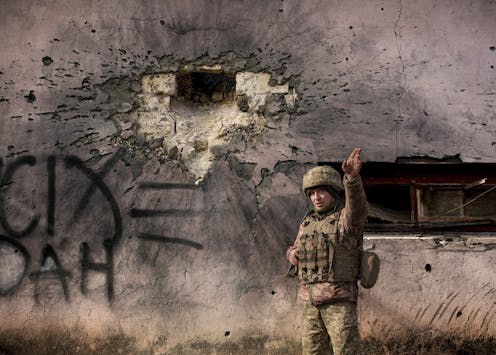
Before Russia began its invasion of Ukraine, it “recognised” two parts of eastern Ukraine as sovereign states: the so-called people’s republics of Donetsk and Luhansk. That recognition is now central to what both Russia and the West are saying about the invasion.
Why does this kind of state recognition matter so much, and how does it challenge international law?
The international law on statehood
International law has rules about what qualifies as a state – and thus what entities get the many rights that follow from statehood. The rules are a compromise between two approaches.
One approach is hard-headed realism. This says we should acknowledge whoever has control on the ground, even if they are lawbreakers or dictators rather than democrats.
The general rule about statehood is that states must meet requirements of effectiveness. The Montevideo Convention of 1933 lists these: population, territory, government and a “capacity to enter into relations with the other states”.
The last requirement can also be described as independence.
The Donetsk and Luhansk republics have probably never had enough independence to qualify as states. For one thing, Ukraine did not give up disputing the territory. For another thing, they have always depended on Russia rather than being truly independent.
Read more: Why Ukrainians are ready to fight for their democracy
But that is not the only problem with them.
The other approach that shapes the law of statehood is the idealism enshrined in the United Nations Charter. One of the rules in the charter, which became binding international law in 1945, is states must not use military force against other states (except defensively or if the UN Security Council authorises it).
This underpins an exception to the general rule. A territory cannot qualify as a state if it was created by illegal military force. And it appears the creation of these two republics in eastern Ukraine in 2014 – and their continued survival – was made possible by illegal Russian military support.
Illegal recognition
Since the Donetsk and Luhansk republics are not states in international law, the territory remains under Ukraine’s sovereignty. By recognising them, Russia denied this sovereignty in a fundamental way. The international lawyer and judge Hersch Lauterpacht called recognition in this situation “an international delinquency”.
In other words, it is illegal. Many states have pointed this out, including the United States and Australia.
This situation used to happen more often. In 1903, the US recognised part of Colombia as the new state of Panama so that Americans could build a canal there. In 1932, Japan recognised part of northeast China as the new state of Manchukuo, which was a Japanese puppet.
What has changed, since 1945, is the rule in the UN Charter against the use of military force by one state against another. That raises the stakes because illegal state recognition can be used to justify an illegal invasion.
The recognition opens up new arguments for Russia
That is exactly what has happened here. As soon as Russia recognised the Donetsk and Luhansk republics, they invited Russian troops onto “their” territory as “peacekeepers”. But it was still Ukraine’s territory, not theirs. And that made the troops invaders, not peacekeepers.
The value of the recognition to Russia is that the invasion looked a little less brazen.
If the two republics genuinely were sovereign states, it would be within their rights to invite the Russian troops, just as other states are free to host US troops. On that premise, Russia can tell its own people and anyone else who will listen that it acted legally.
Some further arguments are now also open to Russia, again based on the incorrect premise that the two republics are states. The Donetsk and Luhansk republics both claim additional Ukrainian territory that they do not control. Russia can now use these claims as a pretext for invading deeper into Ukraine.
Read more: Ukraine: what’s really behind Putin’s deployment of 'peacekeeping' troops? Experts explain
We can get insights into what Russia might do from what it has done in the past.
In 2008, Russia recognised two breakaway parts of Georgia as states – Abkhazia and South Ossetia. It still militarily occupies them.
In 2014, Russia recognised a different part of Ukraine – Crimea – as a new state. In this case, Russia went further than military occupation. The so-called republic of Crimea was uncannily short-lived. Within two days, it held a disputed referendum and signed a “treaty” to become part of Russia.
Russia’s challenge to international law
Russia is not the only state to illegally invade another in recent decades. It is not even the only great power. The US invasion of Iraq in 2003 was widely condemned as illegal, too.
One difference may be that Russia is challenging the law in a more sustained, systematic way that makes democratic states fearful. But it is not quite accurate to say Russia wants to return the world to how it was before 1945. It has not repudiated the UN Charter.
On the contrary, at least for the time being, it is cloaking some of its illegal behaviour in language from international law. That was what recognising the two republics was about.
But it wants a world in which, for Russia, the flimsiest cloak of legal language is enough.
Authors: Rowan Nicholson, Lecturer in Law, Flinders University


















