

How will history – and the law – judge New Zealand’s mothballed MIQ system?
- Written by Dr Jane Norton, Senior Lecturer in Law, University of Auckland
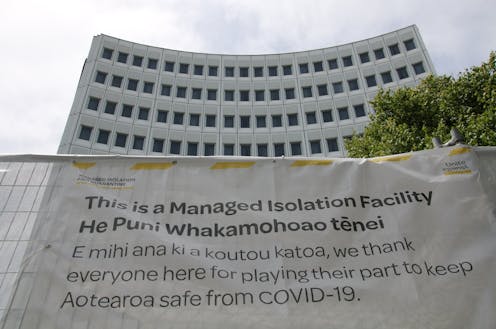
With the effective end of New Zealand’s managed isolation and quarantine (MIQ) system this week, the outcome of the court battle over the government’s border restrictions may have become moot. But the principles at stake are important nonetheless.
Brought by the lobby group Grounded Kiwis, the case was about the legality of the MIQ system, especially its effect on citizens’ right to return home and whether the border controls were justified in the public good.
There’s no doubt the system disrupted the mobility rights of New Zealand’s global diaspora, causing considerable pain and anguish for some. And the case was seen by many as a day of reckoning for MIQ.
In the end, however, the judicial review proceedings ended up with a much narrower focus. Grounded Kiwis effectively only contested the operation of MIQ during the last few months of last year, with their legal complaint largely boiling down to the system having not been appropriately reformed or phased out quickly enough.
Government lawyers responded by setting MIQ in its emergency context and the government’s “stamp it out, keep it out” approach to the pandemic. While changes were made to the MIQ system over its lifetime, reform was necessarily cautious in the light of the level of risk the government and community were prepared to bear.
Legally, the case was focused on a citizen’s right to return in the New Zealand Bill of Rights Act 1990. Limits on that right are only permissible if “reasonable” and “demonstrably justifiable in a free and democratic society”. The courts have developed a special way of assessing this – one that carefully weighs public benefits and private burdens and looks closely at alternative ways to achieve the government’s aim.
MIQ design in the spotlight
So, did MIQ unreasonably and unjustifiably limit the right to return more than was reasonably necessary to achieve the public health goal of significantly reducing the outbreak and spread of COVID-19?
Here the court will have to consider a whole raft of objections to MIQ, such as its very existence, its blanket application to all who wished to enter New Zealand, its restricted capacity and its allocation method.
While individual cases have tended to make headlines, the administration of exceptions was not squarely part of this legal challenge. The focus was on the overall design of the system.
Grounded Kiwis spoke about the right to return as a “foundational right”, from which all other rights flowed. This right should have been afforded greater priority, they said, and New Zealanders should not be denied entry to their country of citizenship – even in a pandemic.
Forcing them to wait for a spot in MIQ breaches this right. They accused the government of being myopically focused on public health.
Public health paramount
But public health was precisely what government lawyers emphasised in court. They pointed to the state’s obligations in domestic and international law to protect all New Zealanders’ rights to life and health, and the importance of minimising the impact on the healthcare system. Caution was needed, especially when vaccinations were still being rolled out.
People’s rights were at the centre of all decision making, government lawyers argued. Ministers did not see mobility rights and public health in competition with each other but hard choices had to be made in the circumstances. People have to be alive and well to enjoy their freedom of movement. Sacrifices were made by all New Zealanders, here or abroad, whether through lockdowns or border restrictions.
Those public health priorities also extended to New Zealand’s diaspora, it was argued, as they enjoy the benefit of a healthy country when they return.
Grounded Kiwis played a delicate game by not explicitly attacking the need for MIQ, but repeatedly arguing there was a tipping point: no one should wait more than three months for entry, regardless of MIQ’s limited capacity or the state of the pandemic.
But there are many within the Grounded Kiwis network who have publicly doubted the wisdom of the government’s elimination strategy. In court, their lawyers spoke of wanting to “put a stake in the ground” so we wouldn’t ever see these border controls again.
In reply, government lawyers stressed the crucial role the elimination strategy played throughout the pandemic and its epidemiological foundation. It’s difficult to see a judge second guessing a public health game plan that has served New Zealand so well.
Was MIQ fit for purpose?
Grounded Kiwis also took issue with the design and operation of the quarantine system, especially the way spots were allocated, initially through a first-in-first-served system and later a virtual “lobby”.
They said alternatives should have been used, including a bespoke risk assessment system for each traveller, more extensive testing and triage, self-isolation and a more sophisticated allocation system. All better, they said, than subjecting returnees to the stress of the random lottery or the earlier free-for-all for open spots.
The government’s lawyers responded by explaining how the systems had evolved over time and why the alternatives Grounded Kiwis wanted either weren’t feasible or generated unacceptable risk in the face of an unpredictable virus.
Self-isolation was ripe for exposure events and would have created its own resourcing challenges, they argued. No alternative priority system, especially one trying to grade every applicant’s reason for travel, would be perfect. A new set of grievances would no doubt emerge.
Importantly, these alternatives didn’t square with the governing risk tolerances and precautionary approach. Director-General of Health Ashley Bloomfield’s evidence recorded that he sought to avoid irreversible decisions with potentially severe negative impacts on health – so much so, he sent out his public advice on key design elements for close peer review.
Ultimately, it’s difficult to know what the judge will make of it all. The philosophical attack on MIQ seems unlikely to succeed. But whether the design of systems allocating spots was sufficiently rigorous may still worry the judge.
Given the re-opening border (at least for vaccinated travellers), the best Grounded Kiwis will be able to achieve is a sense of vindication for past burdens – if the judge finds the design or operation of the system in its final throes imposed unjustified limits on the right of return. A decision on that is still some way off.
Authors: Dr Jane Norton, Senior Lecturer in Law, University of Auckland

















