

How protesters demanding ‘freedom’ from COVID restrictions ignore the way liberty really works
- Written by: Andrew Vonasch, Senior Lecturer in Psychology, University of Canterbury
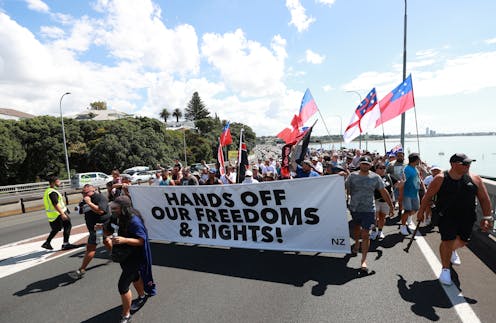
Like the many similar movements against vaccine mandates and other pandemic restrictions around the world, New Zealand’s protests have expressed a unifying concern with personal freedoms.
One of the highest-profile groups at the occupation of parliament grounds in Wellington was “Voices for Freedom”. The occupation itself began with a “freedom convoy”, and many of the signs and placards around the makeshift camp made “freedom” their focus.
And while that particular protest ended in chaos, it seems likely the various movements behind it will continue to make “freedom” their rallying cry.
The extent to which personal freedoms are limited as part of living in a functioning society is ultimately a moral concern about the role of government. But this also requires a clear understanding of the nature of freedom in the first place, and what it means to be a free person in a free society.
At the heart of this lies the distinction between a narrow conception of freedom known as “negative liberty” and the wider concept of “positive liberty”. The former, seemingly preferred by the protesters, implies a freedom from imposed restrictions on people’s behaviour – such as lockdowns and vaccine passes or mandates.
The counter-argument is that reasonable restrictions, if justified to prevent significant harm from COVID-19, actually increase overall freedom. In that sense, the freedom to behave in certain ways becomes a “positive liberty”.
Understanding liberty
Drawing on a long intellectual tradition, the philosopher Isaiah Berlin defined the two forms of liberty in an influential 1958 lecture at Oxford University.
Negative liberty, he said, means the absence of external obstacles or constraints, such as coercive interference by governments.
By contrast, positive liberty means the ability to do the things you want to do. It is associated with self-realisation or self-determination – being in control of one’s own destiny. The protest slogan “my body, my choice”, for instance, is an appeal to individual negative liberty – freedom from mandates and restrictions.
Read more: What are the rights of children at the parliament protest – and who protects them?
But it’s not possible to simultaneously maximise both negative and positive liberty. There are inevitably trade-offs. If the protesters had their way, New Zealanders would have more negative liberty but less positive liberty. Overall, we argue, people would be less free.
Nearly all laws restrict negative liberty, but their effect on positive liberty varies dramatically. For example, laws prohibiting theft restrict negative liberty — they restrict people’s freedom to steal with impunity.
But do such restrictions make you feel un-free? Quite the contrary, laws against theft increase positive liberty. They allow us to feel more secure, and because we don’t have to keep a constant eye on our property, we can do other things.
Justified limits on liberty
Thinking of freedom only through a lens of negative liberty involves a critical problem – it ignores the fact that our actions affect other people: the freedom to drink and drive restricts other people’s ability to use the streets safely; the freedom to smoke in public places exposes others to the potential harms of secondhand fumes.
In general, the choices we make – even concerning our own bodies and what we choose to consume – have moral implications for how and where we can participate in society. Giving people freedom to visit certain places while unvaccinated against COVID-19 restricts other people’s ability to visit those places safely.
Read more: What the 'freedom convoy' reveals about the ties among politics, police and the law
Vaccinated New Zealanders currently enjoy high levels of positive liberty. Life is nearly normal. Crucially, though, this freedom depends on policies designed to reduce the threat of the disease – high rates of vaccination, vaccine certificates and mandates for certain key roles, masks and temporary restrictions on large gatherings to reduce the spread.
Such policies constitute a slight loss of negative liberty. Without these policies, however, positive liberty would be much reduced. New Zealanders could not visit places like gyms, pools, restaurants and shops without fear of catching a potentially deadly disease.
New Zealand has enjoyed more freedom over the past two years than nearly anywhere else, but it has only been possible through restrictions on negative liberty to reduce the risk of COVID-19.
Restriction and risk
Isaiah Berlin was rightly concerned about the potential slippery slope towards totalitarian control inherent in appeals to positive freedom, as witnessed in the USSR where severe restrictions on speech, movement, assembly, literary expression and much else were imposed in the name of “freedom” (namely the freedom to be a good Soviet).
But slippery slopes can be resisted and the risk here seems slight. For COVID policies that restrict negative liberty to enhance overall freedom, they must be necessary to promote positive liberty, responsive to the evidence, and proportional to the threat.
One sign we are not on a slippery slope to totalitarianism: COVID restrictions change with, and are proportional to, the risk. Last year, when New Zealand had zero COVID-19 cases, lockdowns ended and restrictions were few; when the threat increased, restrictions did, proportionally.
Restrictions on negative liberty should be adopted with care and subject to continual review. All citizens, protesters included, are right to value freedom and to be wary of heavy-handed, top-down control.
But that is not the same as calling for an end to COVID-19 rules because such rules limit freedom. A clearer understanding of positive liberty allows us to see that restrictions designed to protect us from COVID-19 actually enhance our overall freedom.
Authors: Andrew Vonasch, Senior Lecturer in Psychology, University of Canterbury


















