Modern Australian
The Times

From field to store to plate, our farmers are increasingly worried about climate change

  • Written by Stephen Bartos, Visiting Fellow, Crawford School of Public Policy, Australian National University
From field to store to plate, our farmers are increasingly worried about climate change

Empty supermarket shelves still shock Australians, who have become accustomed to being able to buy the food they want. But we can expect to see more empty shelves, more often, in coming decades.

Climate change means extreme events such as floods, bushfires and droughts will become more frequent and severe. Those events will disrupt food supply chains, as people along Australia’s sodden east coast have seen again in recent weeks.

Australia certainly isn’t at risk of running out of food. It produces far more food than it consumes, with around 70% of farm production exported.

What is at risk is Australia’s ability to distribute it.

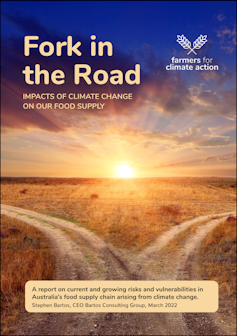
Farmers for Climate Action I was commissioned to prepare a new report on the impact of climate change on food supply, for for Farmers for Climate Action a constituent body of the National Farmers Federation with about 7,000 members. Farmers for Climate Action is not otherwise politically aligned. My methodology included a review of research in this area, interviews with more than a dozen farmers, farmer representative bodies, and other participants in the food supply chain, and a survey of media reporting of recent instances of food shortages. Among the issues identified were the impact of drought, diseases and stress on livestock, the loss of food due to hotter weather, and shorter shelf lives. An unexpected finding was the degree to which everyone involved in the supply chain is affected by uncertainty caused by climate change. It is making future weather highly unpredictable, making planning harder for both farms and in transport networks. Unpredictability makes ensuring supplies hard A further impact is on lending and insurance, where unpredictability means higher costs for financial products – if they can be obtained at all. Some farmers reported that they were unable to insure due to climate risks. All these costs are passed on to consumers in the form of higher food prices. There are also opportunities. Supply chains might become shorter to strengthen resilience and deliver fresher produce to consumers. Farm businesses and food processors are already moving to electrification to manage the risks of relying on fossil fuels and reduce greenhouse gas emissions, saving money in the process. Read more: Relax, Australia does not have (and isn't likely to have) a food shortage For businesses supplying food to export markets, a low-carbon supply chain will be a competitive advantage. In some cases, carbon-friendly production and transport will be a price of entry, without which markets won’t be available at all. The report identifies four responses to climate change: risk management, resilience, adaptation, and mitigation (reducing the impact of climate change). All are needed. Even if Australia meets its Paris targets for climate change, there will be impacts to which the food supply chain will need to adapt. Even good risk management might not be enough Most farmers and businesses in the supply chain are good risk managers. But extreme weather events are increasing the base level of risk they have to deal with. The greater the risk, the more likely it is that risk management plans will be overwhelmed. If climate change continues unabated, this will become a certainty. Governments have a role in strengthening or building alternatives to key supply lines and helping fill gaps in the market where private investment is insufficient due to uncertainty. Governments also have an important risk management role in helping address gaps in data and information on climate impacts, to allow businesses to plan more effectively. Many industry bodies consulted were keen to see more research on the impacts of different projected levels of warming. What farmers want is information and leadership But the bottom line is that if climate change continues, adaptation will not be enough, a point clearly made by the three vice chairs of the Intergovernmental Panel on Climate Change when launching its latest report. The window for taking effective action on climate change is rapidly narrowing. Farmers and processors are taking positive steps for themselves. For example, the Australian red meat industry has a target of becoming carbon neutral by 2030, well ahead of the government’s target of 2050. Read more: Mid-COVID, we find few vulnerabilities in Australia's supply chains Overwhelmingly, the farmers and farmer bodies consulted for the report wanted the Australian government to take the lead, providing clear guidance and direction on urgent climate action. Farmers for Climate Action has responded by calling for deep emissions cuts this decade, to help avoid the worst impacts of climate change. Authors: Stephen Bartos, Visiting Fellow, Crawford School of Public Policy, Australian National University

Read more https://theconversation.com/from-field-to-store-to-plate-our-farmers-are-increasingly-worried-about-climate-change-178885

Celebration of Life vs Traditional Funeral: What's the Difference?

When saying goodbye to someone you love, there is no single way to honour their life. Every family has different traditions, beliefs, and preference...

Building Approval for Roofing Projects: What Homeowners Need to Know

Roofing projects are an important part of maintaining and protecting your home. Whether you're repairing storm damage, replacing an ageing roof, or ...

Chatswood Tutoring And Its Role In Academic Achievement

Academic success often requires more than classroom attendance alone. Students face increasing expectations as they progress through school, particu...

Why Laser Hair Removal Treatments Continue Growing In Popularity

Managing unwanted hair can become time-consuming and frustrating for many people, especially when shaving, waxing, and other temporary methods requi...

Choosing the Right Devices for a Flexible Workplace

For IT leaders managing large fleets, the device layer is where workforce productivity and security policy meet. The shift towards flexible and hybrid...

How Business Advisory Services Help Companies Achieve Sustainable Growth

Every business owner aims to build a profitable and sustainable organisation. While dedication, innovation, and hard work are important, achieving l...

Why Body Contouring Has Become A Popular Cosmetic Treatment

Many people maintain healthy lifestyles through regular exercise and balanced eating habits but still struggle with stubborn areas of fat that are d...

How to Choose the Right POS Hardware for Your Business in Australia

A lot of Australian business owners spend weeks researching POS software but buy hardware almost as an afterthought. That's a mistake. The wrong har...

Why Material Handling Hose Is Critical for Industrial Efficiency

A high-performance material handling hose is an essential component in industries that transport abrasive, dry, or bulk materials on a daily basis...

How to Choose the Right Lawyer in Melbourne for Your Situation

Choosing legal support can feel difficult, especially when the stakes are personal or business-related. The right lawyer in Melbourne should underst...

Hoteliers Look to Clever Value Adds to Increase Revenue

The Australian hospitality industry is still in recovery mode after a notoriously rough patch in recent years. While there has been a post-COVID tra...

Moving to Queensland? Here’s How to Prep Your Car for the Big Move North

There’s no sign of the northern migration slowing down, with thousands of southerners fleeing from chaotic lifestyles and cooler climates for a brig...

Diesel Shortage to Impact Trades and Contractors

Strait of Hormuz blockage affecting all major parts of trades and construction Trades and construction across residential, commercial and industria...

Why Holiday Home Owners Turn to Rental Management Agents

The Allure — and the Reality — of Renting Out Your Property Owning a holiday home is a dream for many Australians. Whether it's a beachside sha...

Why Finding Reliable Doctors In Bundoora Is Important For Long-Term Health

Access to quality healthcare plays an important role in maintaining overall wellbeing and managing health concerns early. Trusted Doctors in Bundoor...

Understanding the Different Types of Car Services: Minor vs Major

When it comes to car maintenance, one of the most important things every vehicle owner should understand is the difference between a minor and a maj...

How Superannuation and TPD Insurance Work Together

Superannuation is an essential part of financial planning in Australia. It is designed to provide individuals with income during retirement, helping...

Tiny Towns funding granted for Mt Hotham and Mt Buller upgrades

Alpine Resorts Victoria (ARV) has welcomed funding support from the Victorian Government’s  Tiny Towns Fund, with both Mt Hotham and Mt Buller se...