

Two years into the pandemic, unequal access to COVID-19 treatments threatens the global recovery
- Written by Deborah Gleeson, Associate Professor in Public Health, La Trobe University
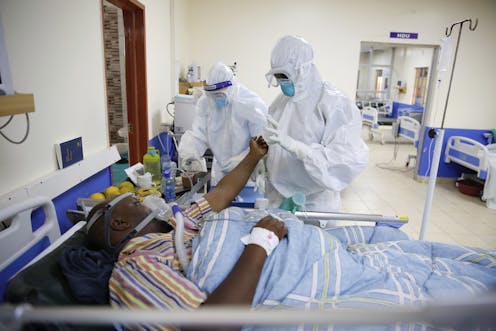
It’s now two years since the World Health Organization began calling the COVID-19 outbreak a pandemic.
Two years ago, it was unclear whether it would even be possible to develop an effective vaccine or treatment for the novel coronavirus. In the interim, we’ve seen enormous scientific advances made in record time, bringing not one but several vaccines, and a range of treatments, to the market.
But access to vaccines is still extremely uneven across the world. And now similar problems are emerging with inequitable access to COVID-19 treatments.
Meanwhile, negotiations at the World Trade Organization (WTO) for a waiver of intellectual property rights for COVID-19 health products and technologies, underway for almost 18 months, are still in a state of paralysis. And there is a risk that any agreement reached at the WTO might only apply to vaccines, leaving treatments unavailable or unaffordable for around half the global population.
Access to vaccines is still vastly unequal
Almost 11 billion COVID-19 vaccine doses have been administered worldwide, but more than a third of the world’s population remains unvaccinated and only 13.7% of people in low-income countries have yet received one or more doses.
By the end of 2021, more boosters had been administered in high-income countries than the total doses given in low-income countries.
While the supply flowing through COVAX has been increasing over the last few months, there is still a long way to go to reach the WHO target to vaccinate 70% of the population of every country by the end of June 2022.
And with effective treatments now entering the market, we are likely to see similar patterns of inequity unless we address the dynamics that prevent equitable access.
Antiviral treatments have become increasingly important
Treatments such as the oral antivirals Paxlovid, made by Pfizer, and Lagevrio, made by Merck Sharpe & Dohme with Ridgeback Biotherapeutics, are an increasingly important part of the toolkit for fighting the pandemic.
Pfizer’s Paxlovid is a combination of a new chemical entity called nirmatrelvir, and ritonavir, an older drug used to treat HIV. Paxlovid works by binding to an enzyme that is needed for viral replication. Pfizer reported that clinical trial participants who received the drug within three days of symptom onset had an 89% lower risk of hospital admission or death.
Read more: Merck v Pfizer: here's how the two new COVID antiviral drugs work and will be used
Merck’s molnupiravir (brand name Lagevrio) also prevents viral replication, but in this case by incorporating itself into the viral RNA, disabling its ability to reproduce. Molnupiravir reduces the risk of hospitalisation by around 30%.
While both drugs have limitations, they have been shown to reduce the risk of severe illness among adults who are at higher risk, and have the advantage over other types of treatment in that they can be taken at home. This is particularly important for countries without strong health systems, and where vaccination coverage is less than ideal.
Patents on treatments enable high prices and profits
Pfizer has signalled it has filed, or intends to file, patent applications covering Paxlovid in at least 61 countries as well as a number of regional patent offices.
Multiple patent applications have also been filed for molnupiravir in many high income countries and some middle income countries such as India and Brazil.
It may take years for some of these patent applications to be either rejected or granted, but the uncertainty makes it difficult for generic companies to enter the market.
Merck is selling a course of molunpiriavir to high income countries such as the United States for US$712 (A$970), around 40 times the cost of production. Pfizer is charging US$530 ($A722) for a course of Paxlovid.
While both Pfizer and Merck have offered tiered pricing based on a country’s income level, it remains unclear what prices will be set and whether they will be affordable. Tiered pricing has been criticised for failing to lower prices sufficiently for middle-income countries in the past.
Paxlovid is another huge money-spinner for Pfizer, which expects to generate US$22 billion (A$30 billion) in revenue from sales of the drug in 2022. And Merck’s 2022 revenue forecast for Lagevrio is $5-6 billion (A$6-8 billion).
Generic antivirals for low-income countries, but middle-income countries miss out
Both Pfizer and Merck have entered into voluntary licensing agreements with the Medicine Patents Pool which will enable generic companies anywhere in the world to make cheaper copies of the drugs for certain low-income countries.
But these license agreements are tightly restricted. Merk’s agreement with the Medicines Patent Pool permits supply of the generic copies to only 105 countries. Pfizer’s license agreement for Paxlovid restricts its supply even more tightly, to 95 low and middle-income countries covering only 53% of the global population.
These licensing agreements both exclude middle-income countries such as Thailand, China, and Mexico – countries where the prices for the patented products risks putting them out of reach.
High income countries have pre-purchased large quantities
Making the situation even worse, rich countries are buying up the limited supplies of the patented products, as they did for vaccines.
Pfizer expects to manufacture 120 million courses of Paxlovid this year. At least 30 million of the treatment courses have already been pre-purchased by rich countries, including 20 million contracted to the United States. In contrast, Pfizer has promised to provide only 10 million doses for low-income countries, a very inadequate amount in comparison with the burden of disease.
Merck plans to make 20 million courses of Lagevrio in 2022, 3.1 million of which have been promised to the US government, and Merck has also entered into deals with “over 30 markets globally including Canada, Korea, Australia, Japan, Thailand and Ukraine”.
Australia’s Health Minister announced advance purchase agreements for 500,00 doses of Paxlovid and 300,000 courses of molnupiravir in October 2021.
Stalemate at the WTO
Unfortunately, the effort invested in creating new products has not been matched by efforts to share them equitably.
A proposal to waive WTO rules that require countries to provide patents and other intellectual property rights for COVID-19 health products and technologies, first made by India and South Africa in October 2020, is now co-sponsored by 63 of the WTO’s 164 countries and supported by more than 100.
Adoption of this proposal, known as the TRIPS waiver, would enable manufacturers to enter the market without fear of litigation over infringing intellectual property rights. It would clear the way for far more widespread production of COVID-19 vaccines, treatments, diagnostic tests and other technologies to fight the pandemic.
But the TRIPS waiver proposal is still languishing due to opposition by the EU, UK and Switzerland - headquarters to powerful pharmaceutical corporations - and the pharmaceutical industry has been lobbying against it.
The EU is pushing a separate proposal, which relies on existing WTO rules that allow for compulsory licensing. However, this is an onerous and protracted process that is unworkable for providing speedy access on a global scale.
And the US is only supporting a waiver for vaccines. This is a limited approach that would leave many middle-income countries unable to either afford patented drugs or to buy the generic versions.
Two years into the pandemic, it’s well past time for a global solution that provides access to all the products and technologies the world needs to manage COVID-19.
Read more: How the intellectual property monopoly has impeded an effective response to Covid-19
Authors: Deborah Gleeson, Associate Professor in Public Health, La Trobe University

















