

It's time Australia dumped its bureaucratic list-based approach to temporary work visas
- Written by Will Mackey, Senior Associate, Grattan Institute

Australia’s temporary skilled migration program is hard for businesses to use while still not protecting migrants from exploitation.
There is a better way, concludes a new report from the Grattan Institute on fixing temporary skilled migration.
The long-standing practice of restricting temporary sponsorship to occupations classified as “in shortage” should be abandoned. Instead, temporary sponsorship should be reserved for higher-wage jobs in any occupation.
Occupation classifications are inflexible
There are more than 1,000 occupations in the Australian and New Zealand Standard Classification of Occupations (ANZSCO).
The government use these classifications of Australia’s 13 million jobs for a range of purposes.
The National Skills Commission (which advises the federal government on workforce skills needed) and the Department of Home Affairs (which oversees visa programs) use them to compile three lists of skills wanted by Australia’s skilled migration schemes. One list is focused on short-term needs, another on longer-term needs and the third on skills needed in regional areas.
Defining needed skills by occupation, however, is an inflexible way to meet shortages in a rapidly changing labour market – and flexibility is the very thing temporary skilled migration programs are meant to provide.
This rigidity is becoming ever more of a problem as more highly skilled service industries develop. New tasks and roles take time to be classified as official occupations. For example, ANZSCO didn’t recognise the developing and in-demand profession of “data scientist” as an occupation until September 2019.
An occupation ‘shortage’ is hard to measure
For occupations that do exist, deciding which are “in shortage” isn’t clear-cut.
For example, the National Skills Commission’s 2021 Skills Priority List defines a “shortage” as:
when employers are unable to fill or have considerable difficulty filling vacancies for an occupation, or significant specialised skill needs within that occupation, at current levels of remuneration and conditions of employment, and in reasonably accessible locations.
This is unsound. Wages change over time. Wages for a job where demand is greater than supply will probably increase relative to other jobs. Pegging the definition to “current levels of renumeration” will overstate the roles in which there is a genuine shortage.
But even with a better definition, Australian policy makers would still lack the data – such as timely vacancy and wage data for each of the 1,000 occupations – to identify skills shortages in real time.
Without this information it is difficult to see what, beyond input from industry lobby groups, determines which occupations become eligible for temporary sponsorship.
Read more: Australia is creating an underclass of exploited farm workers, unable to speak up
Not all jobs within an occupation are equal
A system that looks at occupations rather than jobs also misses crucial parts of the story.
A senior accountant working for a multinational corporation in a capital city and a graduate accountant working for a local business in a country town have the same occupation. But the level of education and experience, responsibilities and remuneration offered for each job will vary dramatically.

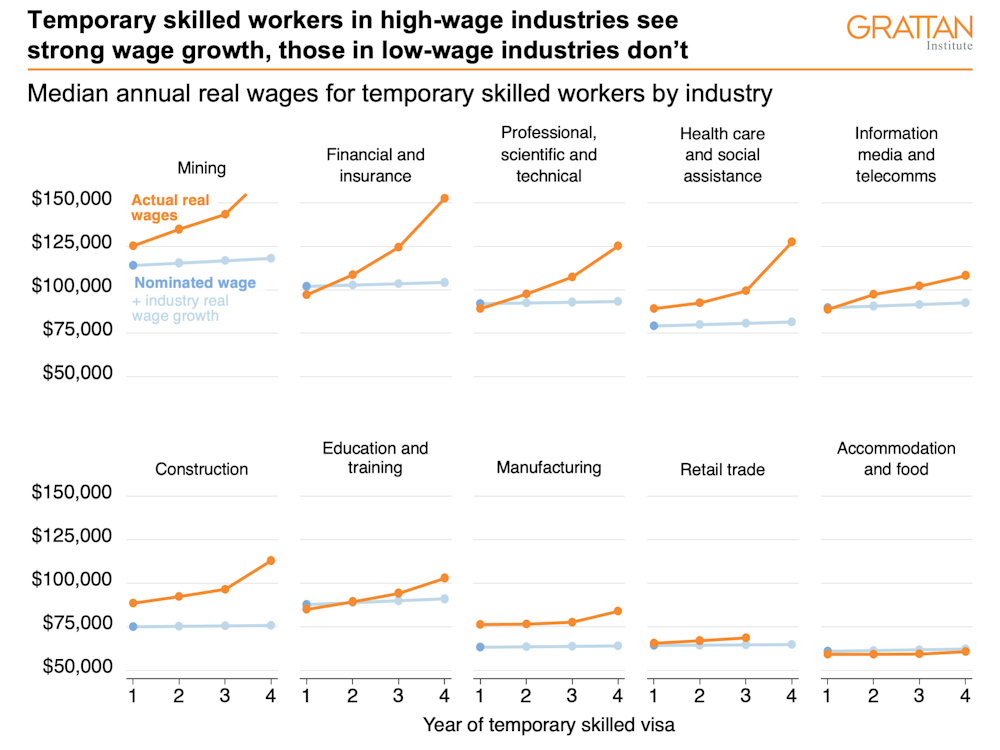 Grattan Institute
By removing occupation lists, the proportion of full-time jobs open to temporary skilled migrants would rise from 44% to 66%.
Conversely, the number of jobs that employers would no longer be able sponsor a temporary migrant to fill – those now on the list paying below $70,000) is tiny. In accommodation and food services, the sector that uses temporary skilled visas the most, these jobs make up just 1.5% of the labour force; in other sectors it’s less than 0.5%
Grattan Institute
By removing occupation lists, the proportion of full-time jobs open to temporary skilled migrants would rise from 44% to 66%.
Conversely, the number of jobs that employers would no longer be able sponsor a temporary migrant to fill – those now on the list paying below $70,000) is tiny. In accommodation and food services, the sector that uses temporary skilled visas the most, these jobs make up just 1.5% of the labour force; in other sectors it’s less than 0.5%
 Grattan Institute
Given migrant workers in lower-paid jobs are most likely to be exploited, this reform should reduce employer abuses and increase public confidence in the temporary skilled program.
Targeting higher-wage migrants will better address most genuine skills shortages that emerge. Removing cumbersome and uncertain occupation lists will give businesses greater certainty and a simpler application process to access the skills needed in emerging industries.
Read more:
We've let wage exploitation become the default experience of migrant workers
High-skilled migrants pay more in taxes than they receive in public services and benefits. Targeting temporary migrants with higher skills will also increase the pool of high-quality candidates for Australia’s permanent skilled migrant intake.
Australia can get the best of both worlds from its temporary skilled migration program by making it simpler for everyone. It will to deliver more for Australian businesses, workers and the economy.
Authors: Will Mackey, Senior Associate, Grattan Institute
Grattan Institute
Given migrant workers in lower-paid jobs are most likely to be exploited, this reform should reduce employer abuses and increase public confidence in the temporary skilled program.
Targeting higher-wage migrants will better address most genuine skills shortages that emerge. Removing cumbersome and uncertain occupation lists will give businesses greater certainty and a simpler application process to access the skills needed in emerging industries.
Read more:
We've let wage exploitation become the default experience of migrant workers
High-skilled migrants pay more in taxes than they receive in public services and benefits. Targeting temporary migrants with higher skills will also increase the pool of high-quality candidates for Australia’s permanent skilled migrant intake.
Australia can get the best of both worlds from its temporary skilled migration program by making it simpler for everyone. It will to deliver more for Australian businesses, workers and the economy.
Authors: Will Mackey, Senior Associate, Grattan Institute 
















