

the hidden history of women in Australian airforce bands
- Written by Anthea Skinner, Postdoctoral research associate, The University of Melbourne
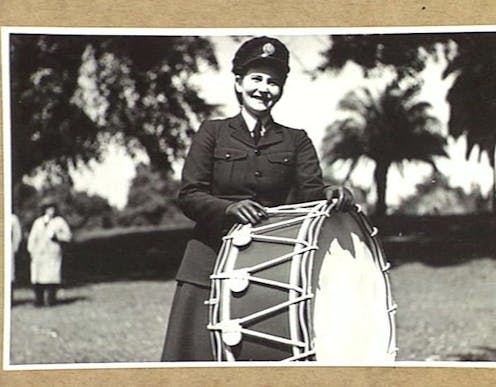
Military bands, with their shiny instruments, formal uniforms and precision marching are one of the most instantly recognisable symbols of a nation’s defence forces. As such, throughout much of history, their membership as been limited to men: Australian defence force bands only formally welcomed women into their ranks after the introduction of the Sex Discrimination act in 1984.
Despite this, during World War II, a groundbreaking group of women serving in the Women’s Auxiliary Australian Air Force (WAAAF) performed alongside their male Royal Australian Air Force (RAAF) counterparts to form some of the earliest documented mixed-gender defence force bands in the world.
At the beginning of World War II women were only allowed to serve in the defence force as nurses. As the war progressed, women’s auxiliary services were formed by the army, navy and air force to fill non-combat positions left vacant by men serving overseas.
I first became aware of the existence of WAAAF performers in supposedly all-male RAAF bands while I was conducting research on the history of Australia’s defence force bands. I was contacted by Olive Jardine (née McNeil), who had joined the WAAAF during World War II and who had played with her local RAAF band during that time.
I was so sure that these bandsmen had, indeed, all been bandsmen that I almost dismissed her, politely informing Olive the parameters of my study meant I couldn’t include women’s auxiliary bands.
But Olive was resolute.
She assured me that although she had served with the WAAAF, she had been invited to join her base’s RAAF band due to a shortage of male musicians during the war.
I was soon to discover she was just one of many such women: up to a quarter of RAAF bands had at least one female member during World War II.
Read more: Women in Australia's military: On the frontline of the gender war
Volunteer-led bands
World War II saw a rapid increase in the number of all-female bands and orchestras, and in Australia the army, navy and air force all formed women-only auxiliary bands. While women-only bands were becoming a more familiar sight, mixed-gender military bands were much rarer.
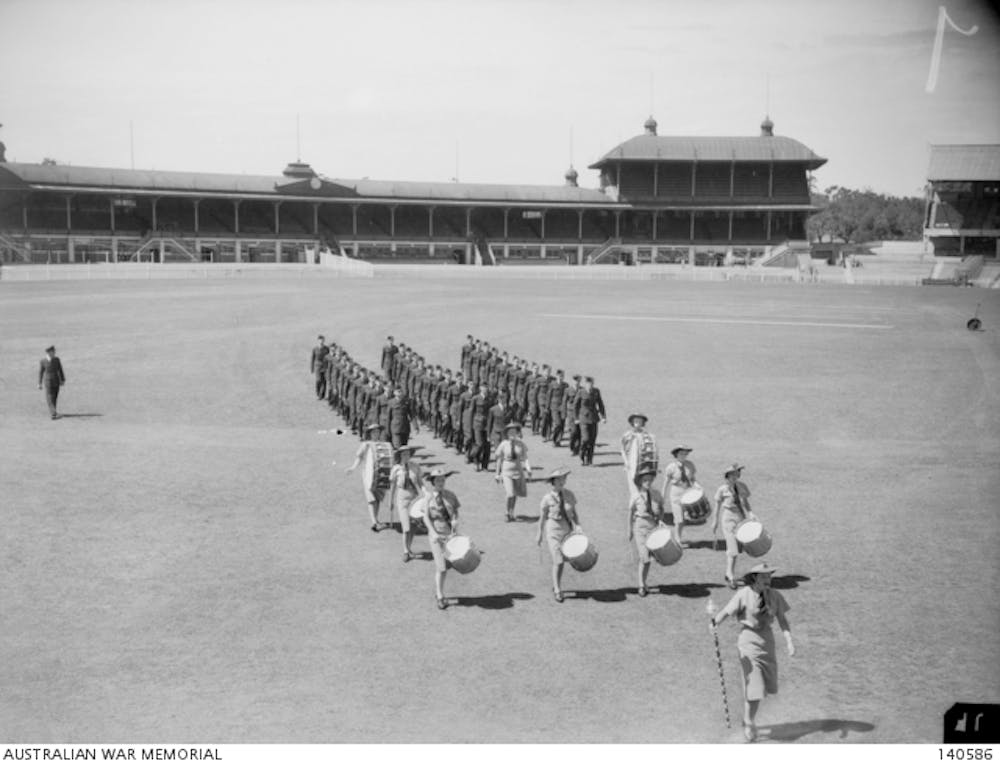
In the USA, a couple of bands featured visiting women – but RAAF bands are the only defence force bands known to regularly feature men and women playing together at this time.
Australia’s army and navy were well established by World War II, and so had more ingrained traditions, including professional bands. But as a newer division of the defence force, only formed in 1921, RAAF bands were still volunteer bands made up of any interested members serving on base.
In the army and navy, musicians served together as a unit and the different regulations for members of women’s auxiliary forces made it impossible for them to join these bands.
However RAAF bands worked more like the many volunteer sports clubs on bases, with little (if any) oversight from air force hierarchy, opening the door for members of the WAAAF to join.
Ladies to the front
Olive’s story is typical of the young women joining these bands.
Keen to help with the war effort, she signed up to the WAAAF as an accounts clerk and was stationed at Uranquinty in New South Wales. An experienced piano teacher, she volunteered to play organ at church services where she was approached by members of the base band who were looking for new musicians. They offered to teach her to play tenor horn, and she became the band’s only female member.
It wasn’t always a case of the odd-woman out. The Mallala band in South Australia had as many as six female members at any one time.
 A combined RAAF and WAAAF Band marching in 1944.
Australian War Memorial
A combined RAAF and WAAAF Band marching in 1944.
Australian War Memorial
Other women even held leadership positions in their bands. In Perth, Hannah Colley, whose father was a bandsmen in World War I, was given the prestigious role of playing the bugle calls at Perth’s 1944 Armistice Day ceremony, a role usually given to the most skilled bugler in the band.
She would go on to post-war career playing in concert parties as a musician in the Army’s Entertainment Unit.
Meanwhile, Mary Palmer stood in as acting Drum Major in her band in Ascot Vale, Victoria, after learning to swing a mace by practising with a broom.
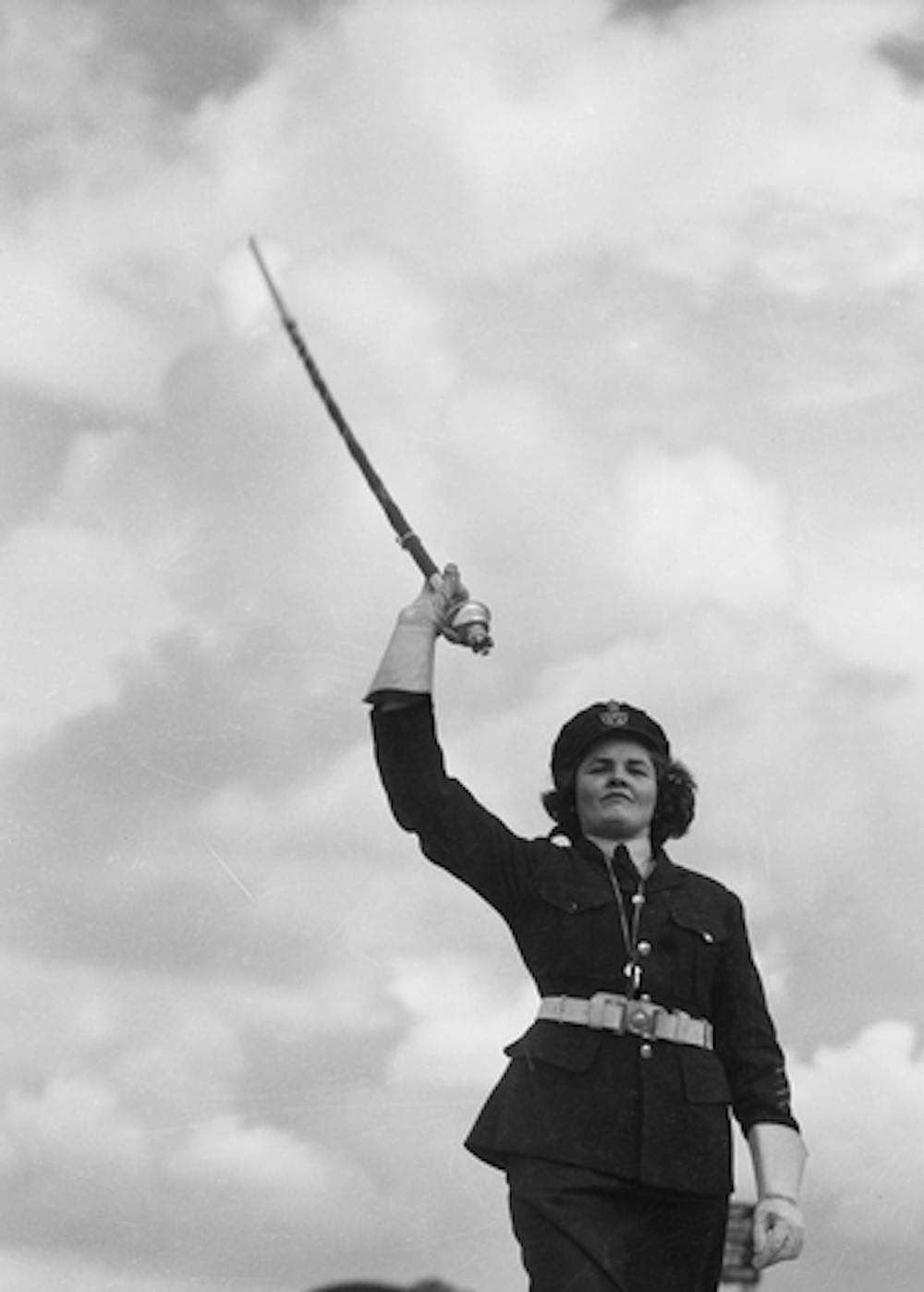 Drum Major Mary Parker, photographed in Melbourne in 1943.
Australian War Memorial
Drum Major Mary Parker, photographed in Melbourne in 1943.
Australian War Memorial
The loss – and return – of women
The pioneering women serving in RAAF bands during World War II performed proudly, and even held leadership positions alongside men.
After the war, the RAAF introduced its first professional band service. Entry was now restricted to men who had auditioned and who were employed by the air force solely for their musical skills. The WAAAF was discontinued in 1947 and reformed as the Womens Royal Australian Air Force (WRAAF) in 1950, however, women were not eligible to join the band corps until the introduction of the Sex Discrimination Act some 40 years later.
Perhaps one of the most refreshing aspects of these stories is the way these ground-breaking women were supported by their communities. Olive’s male bandmates taught her to play tenor horn, local newspapers proudly reported on the performances of their local WAAAF members and Hannah chose to follow in her father’s footsteps to become a defence force musician.
The musicians of the WAAAF proved to the Australian public that women could work as equals alongside men, both on the parade ground and on stage, paving the way for the generations who came after them.
Authors: Anthea Skinner, Postdoctoral research associate, The University of Melbourne

















