

how Russia's war on Ukraine has rattled the nuclear world order
- Written by: John Quiggin, Professor, School of Economics, The University of Queensland
Vladimir Putin’s invasion of Ukraine has upended all kinds of certainties, created new possibilities and closed off old ones. This is certainly true for the world’s use of nuclear power.
Late last month, Russia seized the defunct Chernobyl nuclear plant in northern Ukraine. The move rekindled fears about nuclear safety, decades after the plant’s catastrophic meltdown in in 1986.
And the war has prompted a scramble for new energy supplies in Europe – including potentially extending the life of existing nuclear plants.
All this points to the folly of nations exiting nuclear power while continuing to use coal, gas and oil – fuels that are more polluting, more expensive and often sourced from brutal dictatorships.
Danger at Chernobyl
The Chernobyl nuclear plant no longer produces nuclear power. But Russian-Ukraine combat damaged a high-voltage power line to the plant, temporarily cutting off electricity needed to cool spent nuclear fuel and run other safety systems.
Radiation around the plant spiked after the occupation – probably due to dust disturbed by Russian tanks.
This week, radiation monitoring systems in the Chernobyl exclusion zone were not working and yesterday, forest fires broke out around the plant.
And Chernobyl staff were reportedly close to collapse recently after working for weeks at Russian gunpoint.
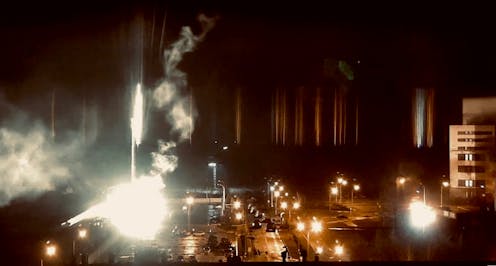
Elsewhere, Russian forces this month seized Ukraine’s large Zaporizhzhia nuclear plant, in an attack which started a dangerous fire near one of its reactors. This underscores the risk to Ukraine’s four operating nuclear power plants and their 15 reactors.
Global shockwaves
These events will raise concerns about nuclear plants operating anywhere in potential conflict zones. They are also likely to trigger more stringent safety requirements at plants, further increasing the cost of nuclear power.
What’s more, Russia – and its state-owned company Rosatom – will no longer be a welcome partner anywhere in the democratic world.
Within weeks of Russia’s invasion, the Finnish government announced it would not grant a permit to a long-planned power station in that country. The project included a Russian owner and Russian nuclear reactor, and Rosatom’s design.
The break with Russia is also likely to make governments even more skittish about dealing with unpredictable regimes.
As tensions worsen between the West and both China and Russia, nations will want to avoid risky deals which may see them lose control of crucial infrastructure.
Read more: Russia's energy clout doesn't just come from oil and gas – it's also a key nuclear supplier
For example, the UK government is reportedly seeking to remove China’s state-owned nuclear energy company from all future power projects in that country. But it’s struggling to attract other private investors.
With China and Russia out of the picture, the design options for new nuclear plants will shrink drastically.
Contenders from the West have run into financial problems in recent years, and a Korean design has had no international orders for over a decade.
The great remaining hope for new construction of nuclear plant design rests on “small modular reactors”. The most advanced proposal, put forward by United States-based company Nuscale, involves modules produced in factories then shipped to sites to be installed as needed.
This technology has been hyped for many years, but has not progressed past the prototype stage. Its arrival is likely still years away, if it ever happens.
Postponing nuclear retirement
By contrast, there is good news for the world’s existing nuclear reactors.
The European Union relies heavily on Russian fossil fuels, but the threat posed by Moscow means it must wean itself off this source.
Every other energy source must be considered. It’s too late to start building new nuclear plants, but the life of existing plants could be extended.
Belgium has already deferred its planned closure of a nuclear plant, possibly until 2035.
Germany shut down half its nuclear plants in January, as part of a plan to phase out atomic power. This misguided decision was taken even as Putin’s armies were massing on the Ukrainian border, and before Germany had eliminated its reliance on gas and coal.
Germany’s remaining nuclear plants are due to close at the end of the year. The country is now under pressure to revisit this plan – but that will not be easy.
Germany has long been working towards the nuclear exit, including ending orders for new fuel. Reversing the process now would require special legislation and urgent intervention to secure new fuel supplies.
For the moment, the German government rejects both an extension of nuclear power and an embargo on Russian gas. But the second position may prove untenable.
The US has banned imports of Russian coal and gas, and Europe will come under growing international pressure to follow. Alternatively, Russia could make good on its threat to cut off gas supplies to Europe.
In that case, Germany is likely to find ways to overcome the legal and technical obstacles to extending nuclear power.
Looking ahead
Russia’s war on Ukraine won’t produce the resurgence in new nuclear plants predicted 20 years ago.
But it accentuates the urgent need for nations to free themselves from dependence on coal, oil and gas. Until then, our best option is to keep nuclear plants running as long as possible.
Authors: John Quiggin, Professor, School of Economics, The University of Queensland


















