

No, sunscreen chemicals are not bleaching the Great Barrier Reef
- Written by: Nial Wheate, Associate Professor of the Sydney Pharmacy School, University of Sydney
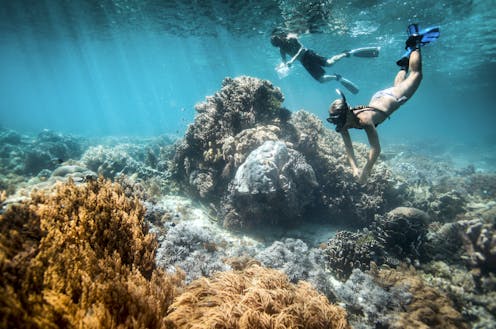
For the sixth time in the last 25 years, the Great Barrier Reef is bleaching. During bleaching events, people are quick to point the finger at different causes, including sunscreen.
Why sunscreen? Some active ingredients can wash off snorkelers and into the reef, contaminating the area. So could this be the cause of the Barrier Reef’s bleaching?
In a word, no. I reviewed the evidence for sunscreen as a risk to coral in my new research, and found that while chemicals in sunscreen pose a risk to corals under laboratory conditions, they are only found at very low levels in real world environments.
That means when coral bleaching does occur, it is more likely to be due to the marine heatwaves and increased water temperatures that have come with climate change, as well as land-based run-off.
Why have we been concerned over the environmental impact of sunscreens?
After we apply sunscreen, the active ingredients can leach from our skin into the water. When we shower after swimming, soaps and detergents can further strip the these sunscreen chemicals off and send them into our waste water systems. They pass through treatment facilities, which cannot effectively remove them, and end up in rivers and oceans.

It’s no surprise, then, that sunscreen contamination has been detected in freshwater and seas across the globe, from Switzerland to Brazil and Hong Kong. Contamination is highest in the summer months, consistent with when people are more likely to go swimming, and peaks in the hours after people have finished swimming.
Four years ago, the Pacific island nation of Palau made world headlines by announcing plans to ban all sunscreens that contain specific synthetic active ingredients due to concern over the risk they posed to corals. Similar bans have been announced by Hawaii, as well a number of other popular tourist areas in the Americas and Caribbean.
These bans are based on independent scientific studies and commissioned reports which have found contamination from specific active ingredients in sunscreen in the water at beaches, rivers and lakes.
Read more: There's insufficient evidence your sunscreen harms coral reefs
Notably, the nations and regions which have banned these active ingredients, like Bonaire and Mexico, have local economies heavily reliant on summer tourism. For these areas, coral bleaching is not only an environmental catastrophe but an economic loss as well, if tourists choose to go elsewhere.
How do we know sunscreen isn’t the issue?
So if contamination concerns over these active ingredients are warranted, how can we be sure they’re not the cause of the bleaching in the Great Barrier Reef?
Put simply, the concentrations of the chemicals are too low to cause the bleaching.
The synthetic ingredients used in most products are highly hydrophobic and lipophilic. That means they shun water and love fats, making them hard to dissolve in water. They’d much prefer to stay in the skin until they break down.
Read more: Research Check: should we be worried that the chemicals from sunscreen can get into our blood?
Because of this, the levels found in the environment are very low. How low? Think nanograms per litre (a nanogram is 0.000000001 grams) or micrograms per litre (a microgram is 0.00001 grams). Significantly higher levels are found only in waste water treatment sludge and some sediments, not in the water itself.
So how do we reconcile this with studies showing sunscreen can damage corals? Under laboratory conditions, many active ingredients in sunscreen have been found to damage corals as well as mussels, fish, small crustaceans, and plant-like organisms such as algae and phytoplankton.
The key phrase above is “under laboratory conditions”. While these studies would suggest sunscreens are a real threat to reefs, it’s important to know the context.
Studies like these are usually conducted under artificial conditions which can’t account for natural processes. They usually don’t account for the breakdown of the chemicals by sunlight or dilution through water flow and tides. These tests also use sunscreen concentrations up to thousands of times higher – milligrams per litre – compared to real world contamination levels found in collected samples.
In short, laboratory-only studies are not giving us a reliable indication of what happens to these chemicals in real world conditions.
 Laboratory studies don’t tend to account for dilution in seas or rivers.
Shutterstock
Laboratory studies don’t tend to account for dilution in seas or rivers.
Shutterstock
If it’s not sunscreen, what is it?
The greatest threats to the reef are climate change, coastal development, land-based run-off like pesticides, herbicides, and other pollutants, and direct human use like illegal fishing, according to a 2019 outlook report issued by the reef’s managing body.
Reefs get their striking colours from single-celled organisms called zooxanthellae which grow and live inside corals. Importantly, these organisms only grow under very specific conditions, including narrow bands of temperature and light levels. When conditions go outside the zooxanthellaes’ preferred zone, they die and the coral turns white.
As a result, the likeliest cause of this bleaching is climate change, which has increased ocean temperatures and acidity and resulted in more flooding, storms, and cyclones which block light and stir up the ocean floor.
So do you need to worry about the impact of your sunscreen on the environment? No. Sunscreen should remain a key part of our sun protection strategy, as a way to protect skin from UV damage, prevention skin cancers, and slow the visible signs of ageing. Our coral reefs face much bigger issues than sunscreen.
Authors: Nial Wheate, Associate Professor of the Sydney Pharmacy School, University of Sydney
Read more https://theconversation.com/no-sunscreen-chemicals-are-not-bleaching-the-great-barrier-reef-179938


















