

preparing for more climate disasters means taking more personal responsibility for risk
- Written by: Celeste Young, Collaborative Research Fellow, Sustainable Industries and Liveable Cities (ISILC), Victoria University
Sydney is bracing for flash floods and landslides as the city yet again endures a disastrous downpour, with a month’s worth of rain falling in just 24 hours and evacuation orders issued. The rain is forecast to continue all week.
Communities in New South Wales have endured one disaster after another. As exhausted residents in Lismore began cleaning up from the record-breaking flood in late February, a second flood inundated the city. Indeed, some flood-damaged towns this year were previously in the path of the Black Summer bushfires.
Climate change is making disasters more frequent and severe, so how should we be preparing for these inevitable events?
As our latest research shows, a key aspect of pre-disaster preparation is that people accept and understand what risks they face and how they’ll be impacted. Stocking up on toilet paper in preparation for COVID lockdowns is an example of what happens when they don’t.
Meeting new challenges
One of the lasting mantras in disaster risk management is “hope for the best, anticipate the worst”. But what happens when the worst-case scenario is realised – or even exceeded?
During the Black Summer bushfires in 2019, Rural Fire Service Commissioner Shane Fitzsimmons said:
We cannot guarantee a fire truck at every home. We cannot guarantee an aircraft will be overhead every time a fire is impacting on your property. We cannot guarantee that someone will knock on the door and give you a warning that there’s fires nearby.
What’s more, the recent NSW floods saw local communities instigate their own rescue operations, with boat or a jet ski owners pulling stranded survivors from inundated homes.
Being prepared at the individual, household and local community level is essential. Emergency management and support agencies such as hospitals are becoming overwhelmed by the unprecedented scales of recent disasters.
First, this is because many emergency workers who respond to earthquakes, cyclones, floods, fires, and storms are volunteers. Second, some events such as the pandemic are unbudgeted and exceptional, so agencies need additional resources.
Third, a disaster is, by definition, an event that exceeds the capacity to respond, making “disaster response” a paradox.
It is unreasonable to expect people to cope with all disasters – but it is reasonable to expect people to manage a certain level of risk. So how much responsibility should fall on the individual, and how much needs to be shared across governments, industry, agencies, and throughout the community?
72 hours are crucial
For those directly affected, the 72 hours surrounding the event can be the most important. This spans the time between early warning, onset, and the immediate responses that may involve defence, evacuation or rescue.
In the United States, you’re encouraged to be prepared to cope for 72 hours in a disaster. We are beginning to see this encouraged in Australia along with greater acknowledgement of personal responsibility for risk.
Local disaster agencies in Australia are promoting lists of essentials to keep on hand, including first-aid kits, medications, and enough food and water for three days.
People are also encouraged to prepare psychologically, and rehearsing survival plans has been found to be especially useful with children. And emergency management agencies and community groups provide guidance for those with a disability, non-English speakers, and people with pets and other domestic animals.
Read more: Floods leave a legacy of mental health problems — and disadvantaged people are often hardest hit
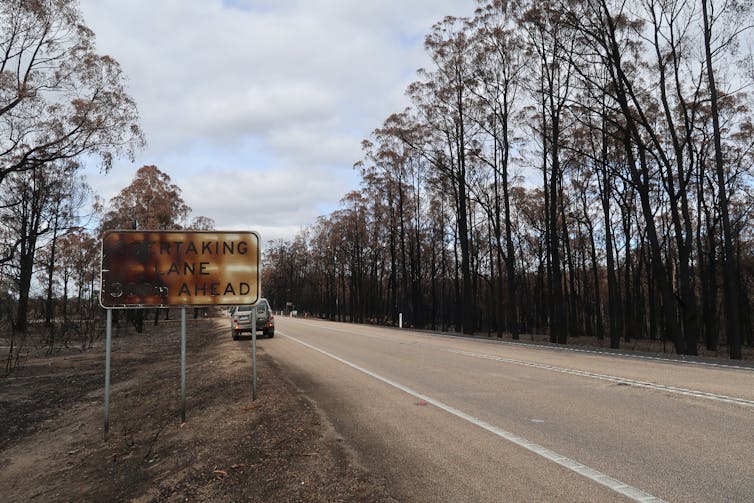
Still, information does not always guarantee preparation. Our research surveyed bushfire-hit residents in East Gippsland following the Black Summer fires. We found people new to an area were less likely to be prepared or understand how to respond to risks.
They were also more likely to have unrealistic expectations about how long and demanding the recovery process was. Some people from non-English speaking backgrounds were isolated within their communities and did not know where to access information.
Owning your risk
Our Risk Ownership Framework allows communities and the public and private sector to unpack the complex connections of shared risk ownership. We explore the questions “who owns a risk?” and “how do they own it?”
We learned that if one area is unable to manage their risk, then it can increase or transfer to another person or entity.
For example, a homeowner may be responsible for home and contents insurance, while a community is responsible for maintaining social connectivity. Likewise, local government may own and maintain flood levees, while state government regulates the planning for them.
Read more: Homeless and looking for help – why people with disability and their carers fare worse after floods
We also explored the concept of “unowned” risks – where roles and responsibilities in disasters are unallocated or unfulfilled. These can impact important community values such as liveability, local businesses (such as tourism) and natural resources.
Unowned risks raises difficult questions such as:
will the forests and wildlife recover and if so, how long will this take?
will displaced residents return to their communities, or will housing availability and affordability force them out?
will communities, such as Lismore, remain viable in the face of future disasters under climate change?
These questions often get passed over in favour of more immediate needs.
The escalation and breadth of disasters these last two years has left communities with barely enough time to recover before the next one arrives. We need to start negotiating how to prepare for the unexpected and what follows.
The mantra of community resilience and empowerment is now a central narrative, but recent events show there’s a pivotal role for government that cannot be neglected if we’re to survive future disasters.
We need a national conversation on what risk ownership for disaster means – personally and politically.
Read more: First come floods, then domestic violence. We need to prepare for the next inevitable crisis
Authors: Celeste Young, Collaborative Research Fellow, Sustainable Industries and Liveable Cities (ISILC), Victoria University


















