

Amid COVID and heated debate about China, how will multicultural Australia vote in 2022?
- Written by: Andrew Jakubowicz, Emeritus Professor of Sociology, University of Technology Sydney
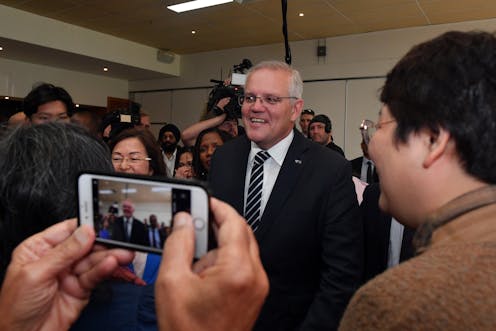
The debate over whether an “ethnic vote” phenomenon exists in Australia re-emerges at each federal election.
Some argue people from ethnic communities can be influenced by issues which are cultural or which relate to their countries of origin rather than to their duties as Australia citizens.
We know from previous elections that sections of multicultural Australia can play a critical role in the election outcome. But obviously different communities have different concerns and this can play out unevenly.
What might this mean in 2022?
What has happened before?
Ahead of the 2016 federal election I suggested issues associated with ethnicity would play a critical role in the deciding votes in marginals with significant multicultural populations. As it turned out they did – delivering at least two seats in NSW and one in Victoria to the Coalition and in turn, government.
In 2019 I suggested ethnic voters might well save Morrison’s government, again mainly among disappointed opponents of the 2017 same-sex marriage legislation. While Queensland proved more important in the large, but Chisholm and Reid gave Morrison the tiny buffer he needed to win.
But there was no uniform “ethnic vote”. In some Labor electorates in 2019, the “ethnic vote” was a socially conservative one – with voters swinging away from the ALP, due to its commitment to same-sex marriage and the Liberal’s promise of a religious discrimination act.
My colleague Christina Ho and I drilled down into the 2019 results for the marginal Liberal seat of Banks in Sydney, concluding that the large local population of Chinese Australian voters tended to be slightly more pro-Labor than the average voter, but followed the broader swing towards the Liberals.
What is different in 2022?
Both Liberal and Labor-held seats will be important in 2022. Some critical electorates with significant ethnic populations include Parramatta, Reid, Banks, Fowler, Greenway and Lindsay in NSW, and Chisholm, Bruce, and Wills in Victoria.
Goldstein and Kooyong in Melbourne and Wentworth in Sydney also have significant Jewish populations. Nearby North Sydney also has a high number of overseas-born voters. All four of these seats are being challenged by “teal” independents.
Ethnicity may also present itself in some significant new ways this time.
The international world is more present in this election than it usually is, with Russia’s invasion of Ukraine, and ongoing tensions with China front of mind and the news agenda. There has also been a significant increase in new citizens. Over 2020-21 this included about 24,000 Indians, 9,000 Filipinos, and 7,000 Chinese.
The government’s pandemic responses has also greatly challenged the “most successful multicultural society in the world” slogan. Not only have Australians with overseas connections been cut off from the rest of the world (or been locked out of the country) but we have seen high death rates among ethnic communities, the undermining of their well-being through lockdowns (which affected industries employing high proportions of ethnic workers), and reinvigorated racism.
Ahead of the 2022 vote, the ALP’s decision to install candidates in Fowler and Parramatta who are not from diverse cultural backgrounds nor from the local area might be thought of as patronising and ultimately, not a vote winner. Well-known Vietnamese Australian local councillor Dai Le is standing as an independent in Fowler, which could hurt parachute candidate, Kristina Keneally.
Where the parties stand
The Federation of Ethnic Communities of Australia has a comprehensive election wish-list. This includes an Office for Multicultural Australia and a new, well-resourced anti-racism strategy.
So far, we have little detail on the major parties’ election policies on multiculturalism and for ethnic Australians.
Last year, Immigration Minister Alex Hawke promised a multicultural cohesion statement but this has not yet eventuated. The recent federal budget also cut expenditure for multicultural programs, and reduced support to the Australian Human Rights Commission, which does important anti-racism work.
The ALP has not yet released its main policy goals, though a 2021 report on multicultural engagement was very limited in its goals and did not include earlier commitments to expand the government’s multicultural policy capacity.
The Greens proposal for a federal multicultural commission sits undebated before the Senate, though the party has a specific set of anti-racism policies for the 2022 campaign.
On the ground
A focus on two electorates - one in Victoria and the other in NSW - shows us what impact an “ethnic bloc” might have.
The first is the ultra-marginal seat of Chisholm, currently held by Liberal MP Gladys Liu on a margin of just 0.5% and contested by Labor candidate Carina Garland.
According to the (latest available) 2016 Census data, half the population of Chisholm reported speaking a language other than English at home. The electorate had a China-born population of 14%, with 17% having both parents born in China. About 20% spoke a Chinese language at home. The next major community language was Greek.
Reflecting the high proportion of the China-born population, 36% of the population reported “no religion”, while 6% identified as Buddhist. In 2019 the Greens vote of 12% and the ALP of 34% were not enough to halt the Liberal win, with a primary vote of 43%. The informal vote was 4.5%.
Key issues this time include the rising racism experienced by Chinese Australians during the pandemic, the antipathy to China voiced by the government, and the perception of economic threats associated with the major parties.
The Parramatta campaign
The second seat is Parramatta, which the Labor Party currently hold on 3.5%. Here outgoing Labor MP Julie Owens will be replaced by candidate Andrew Charlton. He is challenged by Liberal candidate Maria Kovacic.
According to the 2016 Census, more than 60% of the Parramatta population speak a language other than English at home, with Arabic and Mandarin equal on 8%, Cantonese and Hindi about equal on 5% and Tamil on 3%. About 15% were born in India, with another 8% in China.
The electorate has a large number of Catholics, Hindus and Muslims. Since 2019 the sub-continent population has risen, with many more becoming citizens. In 2019, even though the ALP won the seat, the first preference swing to the Liberals was 7%, with an informal vote of 8%.
Parramatta will be affected by the strong campaign by Christian groups to focus attention on the need for a Morrison-government type religious discrimination act, which may also find some support among Muslim communities.
Critically, the ALP candidate is a non-local white man, parachuted into an electorate which was badly impacted by COVID lockdowns. The Coalition’s candidate has strong links to local eastern European communities, Christian churches and business and voluntary organisations, including networks of business women in western Sydney.
Ultimately in heavily “ethnic” electorates we will see ethno-cultural values tested against socio-economic interests. Diaspora voters will decide whether these interests reinforce or counteract each other and then how that propels their vote.
Authors: Andrew Jakubowicz, Emeritus Professor of Sociology, University of Technology Sydney

















