

how new technology is revealing the secrets of an under-researched undersea world
- Written by: James Bell, Professor of Marine Biology, Te Herenga Waka — Victoria University of Wellington
Despite New Zealanders’ close connection with the oceans, very few will have heard of “temperate mesophotic ecosystems” (TMEs). Even fewer will appreciate their importance for coastal fisheries, and possibly climate change mitigation.
TMEs typically occur at depths of between 30 and 150 metres – the twilight zone of our oceans, where little sunlight remains. But science is beginning to shed light on these remarkable ecosystems, and the need to protect them.
While there has been plenty of research on the deep oceans (greater than 200m) and the shallow seas (less than 30m), TMEs have received surprisingly little attention. They have only been recognised as distinct ecosystems in the past 15 years.
TMEs are beyond the reach of most scientific divers, but the recent development of relatively small and cheap remotely operated vehicles (ROVs) now allows greater access to these extraordinary undersea regions.
ROVs, such as the New Zealand-made Boxfish, can be deployed from small boats and are equipped with high-resolution cameras and robotic arms to identify organisms and collect specimens. We’re now able to regularly observe TMEs and our understanding of them is growing rapidly.
What do rocky TMEs look like?
Unlike the shallow seas, which are generally dominated by habitat-forming fleshy seaweeds, TMEs are dominated by animals.
At their shallowest, they support a mixture of seaweeds and animals, but as you descend deeper into low light conditions, encrusting algae and unique animal species begin to dominate.
Animals adapted to low light conditions include sponges, sea fans and sea squirts. Indeed, recent research from New Zealand found sponges can occupy more than 70% of the available space on rocky TMEs.
Given these ecosystems are likely to be widespread throughout temperate seas, it’s feasible that sponges might be even more abundant than algae in coastal ocean regions.

Ecological and economic importance
While we still know little about the ecology of TMEs, they’re important in several ways for wider coastal ecosystems.
The three-dimensional nature of the sponges and other animals that dominate TME habitats creates structural complexity on the sea floor. This provides a home to a range of organisms, from small and juvenile fish to crabs, that are likely to use this habitat to evade predators.
Also, many fish species migrate between shallow water and these deeper twilight ecosystems, likely looking for food and shelter.
The sponges that dominate TMEs filter large volumes of water and are able to capture dissolved carbon and transform it into detritus. Scavengers such as small crustaceans and worms can eat sponge detritus. Subsequently, these little creatures are eaten by larger organisms (like fish) higher up the food chain.
TMEs are therefore likely to be extremely important to coastal fisheries.
Our evaluation of depth-related changes in temperature suggests TMEs could also be important in the mitigation of climate change impacts, particularly marine heat waves that drive extremes in sea water temperature.
We’ve found water temperature in the depths where TMEs occur is usually several degrees lower than at the surface, which may provide a refuge for mobile fish species from shallow waters.
Furthermore, if shallower populations are damaged by human activity, then deeper water TME populations may be able to replenish them by providing larvae.
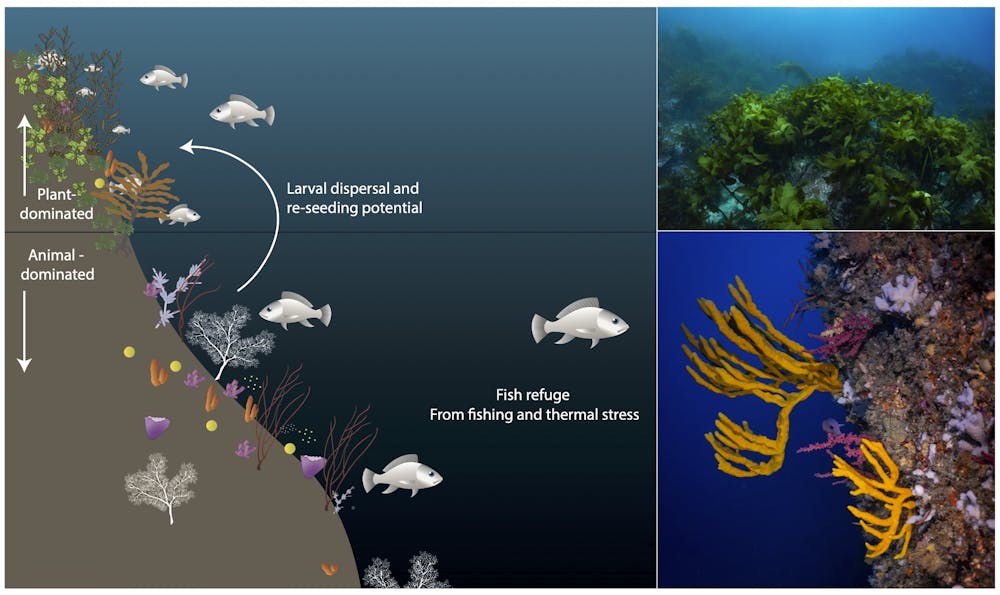 Fish can migrate between shallower seaweed-dominated systems and deeper animal-dominated mesophotic ecosystems.
Author provided (no reuse)
Fish can migrate between shallower seaweed-dominated systems and deeper animal-dominated mesophotic ecosystems.
Author provided (no reuse)
Human impacts on TMEs
While TMEs are likely to be affected by the same anthropogenic factors as surface waters, some specific stressors may have a greater impact.
The domination of TMEs by many upright (often slow-growing) tree-like forms, including sponges and sea fans, makes these ecosystems particularly vulnerable to physical disturbance.
Rocky TMEs often overlap with fisheries that use pots and traps, such as for lobsters and crabs. These fishing activities can smash and damage sponges and sea fans, which may take many years to recover.
The domination of rocky TMEs by filter-feeding organisms, and their proximity to the surface, makes them susceptible to the impacts of increased sediment in the water column, which increases turbidity and the amount of sediment settling on organisms.
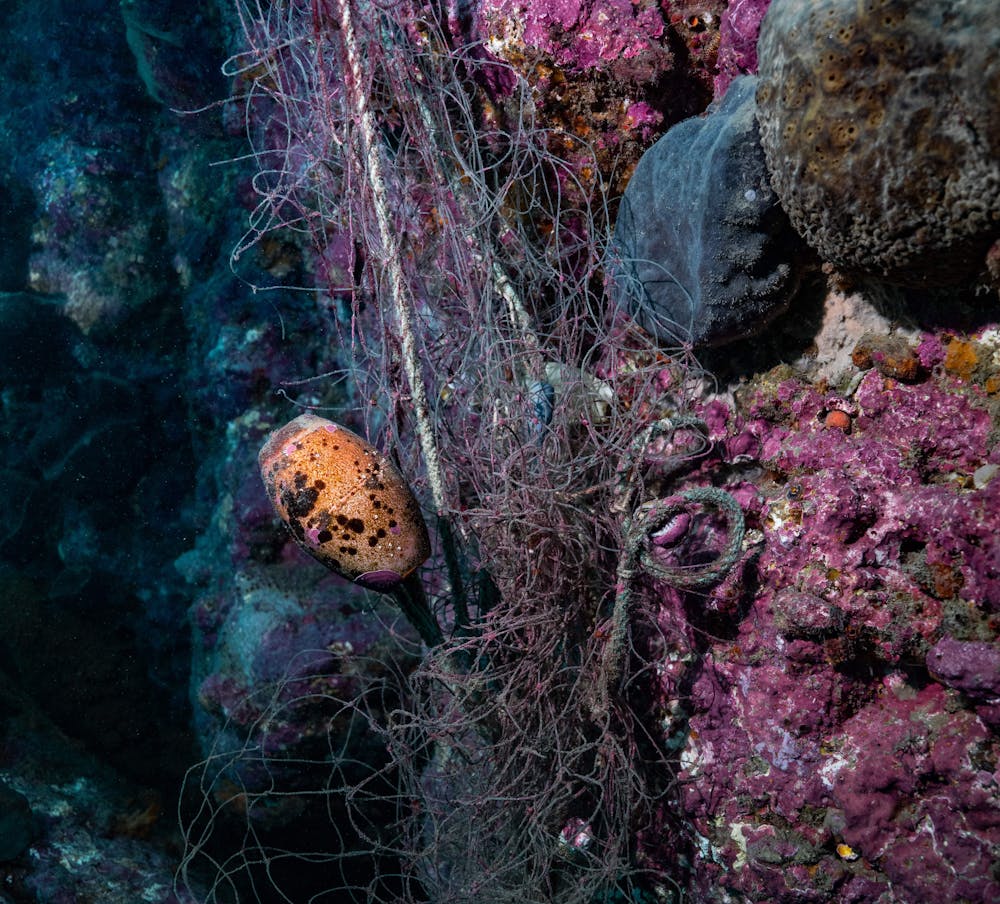 Discarded fishing nets and lines have major impacts on temperate mesophotic ecosystems.
Valerio Micaroni, Author provided (no reuse)
Discarded fishing nets and lines have major impacts on temperate mesophotic ecosystems.
Valerio Micaroni, Author provided (no reuse)
Increased sediment might result from changes in land use in coastal areas, for example from construction or farm conversions, or from trawling, dredging or sea-floor mining.
Our recent analysis has shown very few of the rocky TMEs across the world’s oceans have been explored and characterised. Even fewer are protected as part of existing management and conservation frameworks.
In most places where they are protected, it’s usually a side effect of protecting shallow-water ecosystems that border TMEs.
The diverse and ecologically important communities found in TMEs need greater recognition and protection of a unique biodiversity we’re only now coming to properly understand.
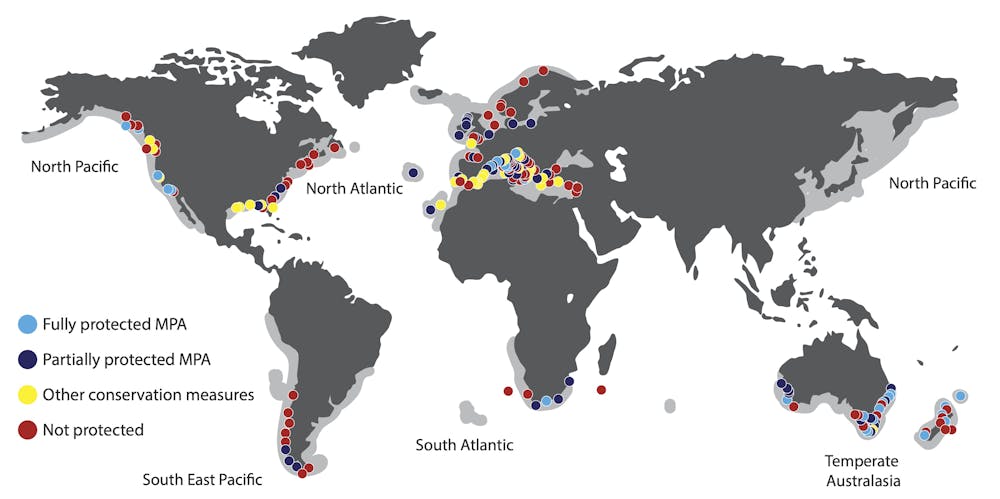 Global distribution of reported temperate mesophotic ecosystems and the level of protection they are afforded.
Author provided (no reuse)
Global distribution of reported temperate mesophotic ecosystems and the level of protection they are afforded.
Author provided (no reuse)
Authors: James Bell, Professor of Marine Biology, Te Herenga Waka — Victoria University of Wellington

















