

Australia's social housing system is critically stressed. Many eligible applicants simply give up
- Written by: Hal Pawson, Professor of Housing Research and Policy, and Associate Director, City Futures Research Centre, UNSW Sydney

Plenty was said in the election campaign about the very real challenges faced by first home buyers and by homeowners already mortgaged to the hilt. But little comment focused on the cost-of-living predicament faced by low income renters.
Our new report, released today, reveals a social housing system critically stressed, with demand rapidly outpacing supply.
Many eligible applicants in need simply give up on ever being allocated a spot. Probably far more, knowing their faint hope of a tenancy offer, never even apply.
Social housing system capacity cut by more than half
Rental stress is where a tenant’s housing costs leave not enough remaining income to cover basic household essentials.
This is estimated to affect two thirds of the low-income private tenant population – around a million households.
And across Australia, but especially in the regions, the past two years have seen rents rising at rates unseen in more than a decade.
However, this only compounds the much more longstanding trend of growing demand pressure at the lower end of the private rental market.
In part, this reflects a quarter-century of near-stagnation in social housing stock in Australia.
While the national population is now 41% higher than in 1996, social housing has expanded by just 3% over that period.
Effectively, social housing system capacity has been cut by more than half since the 1990s.
Just under 30,000 new applicants were granted a social housing tenancy, Australia-wide, in 2020-21.
As the most meaningful indicator of supply, that compares with 52,000 lettings in 1991 – a 42% reduction. But proportionate to national population, the latest figure is 61% down.
Indeed, the three years to 2021 saw overall social housing waiting list numbers rising by 16%, Australia-wide, to 164,000 households.
Nationally, the annual number of “new greatest need applications” (mainly people experiencing or at risk of homelessness) grew by 48% over this period, suggesting soaring demand.
As our research reveals, stress on the New South Wales social housing system is clearly intensifying. The proportion of total lettings to highest priority applicants increased from 41% to 60% in the six years to 2020-21.
This means longer wait times for income-eligible but non-priority social housing applicants.
In Queensland, meanwhile, waiting list numbers grew by 78% in the four years to June 2021 (to some 28,000 households). Average waiting times for registered applicants also increased by 83%.

High rates of ‘churn’
But despite recent increases, the longer-term trend of social housing waiting list numbers has remained largely flat. 2021 point-in-time registrations barely exceeded the number for 2006.
This is despite substantially increased housing need over this period as evidenced by trends in homelessness, rental stress and other indicators.
Our research reveals some likely explanations for this paradox.
Most importantly, social housing waiting lists now see high rates of “churn” – where many applicants register each year but many others exit lists without gaining a social housing tenancy.
Quantifying these processes, we draw on unpublished government statistics for New South Wales, where June 30 2021 waiting list applications totalled nearly 50,000.
Our evidence suggests that during 2020-21, over 6,000 registrations were cancelled or withdrawn. That’s in addition to the 12,000 registrations ending thanks to a social housing tenancy allocation.
In part, this pattern likely reflects the realisation by many non-priority applicants that the prospect of a tenancy offer is remote.
After all, for those needing a three bedroom property, the NSW government projects typical waiting times of more than a decade in most of its 25 Sydney letting areas.
Rigorous waiting list management is also implicated, with registrations deleted when an applicant (intentionally or otherwise) fails to reconfirm eligibility and interest.
Limiting social housing eligibility
Restricting eligibility to register for social housing is central to rationing; in particular, through income limits.
As highlighted in our report, there is great variation across the country in the maximum income allowed before you’re no longer eligible.
In most jurisdictions, the 2021 income limit for a single person was below the current minimum wage (assuming full-time employment).
Weekly income limits defined by the Queensland and West Australian governments (A$609 and $450 for single adults in 2021, respectively) have remained static or almost unchanged for more than a decade.
This has managed demand by effectively tightening applicant eligibility over time.
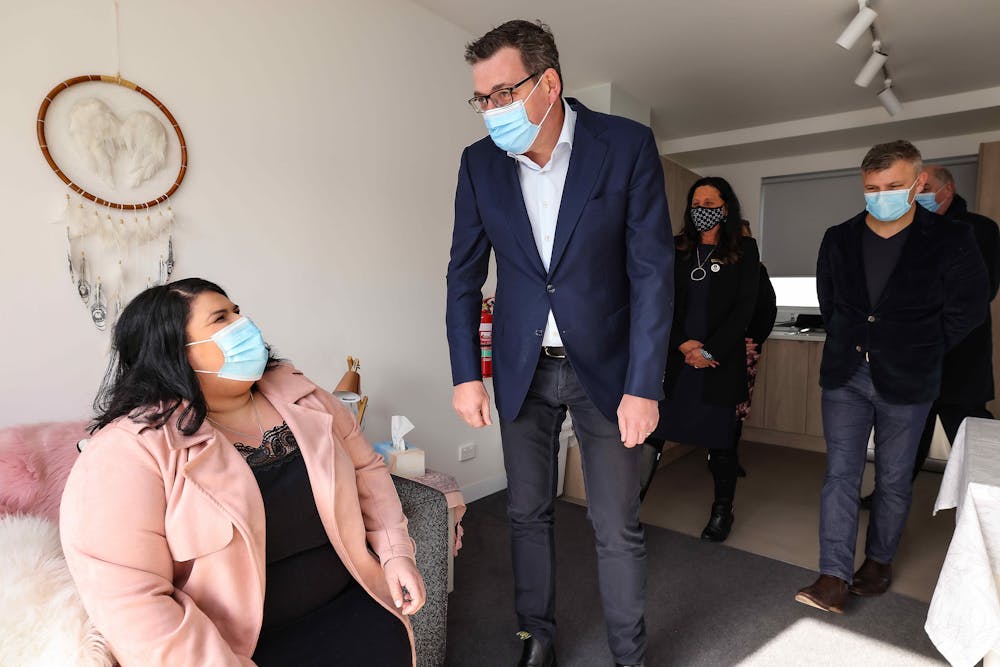 In Queensland and Victoria, post-COVID economic recovery pledges have included significant new social housing construction.
AAP Image/Pool, Ian Currie
In Queensland and Victoria, post-COVID economic recovery pledges have included significant new social housing construction.
AAP Image/Pool, Ian Currie
The rationing challenge
State and territory government staff face unenviable challenges in rationing a static or shrinking resource at a time of growing need.
The roots of this scenario can be traced back to the end of Australia’s routine national public housing construction program, which ran for 50 years until 1996, until its effective termination under the Howard government.
In certain states (notably Queensland and Victoria), recent post-COVID economic recovery pledges include significant new social housing construction investment funded by states themselves.
The incoming federal Labor government has also pledged a six year scheme to construct 30,000 new social and affordable rental homes.
Advocates will welcome these commitments. But to truly relieve low income housing stress, the national program needs to be expanded in scale and maintained long term.
Otherwise, the challenge faced by state and territory governments in rationing scarce social housing will become tougher still.
Read more: The many faces of social housing – home to 1 in 10 Australians
Authors: Hal Pawson, Professor of Housing Research and Policy, and Associate Director, City Futures Research Centre, UNSW Sydney

















